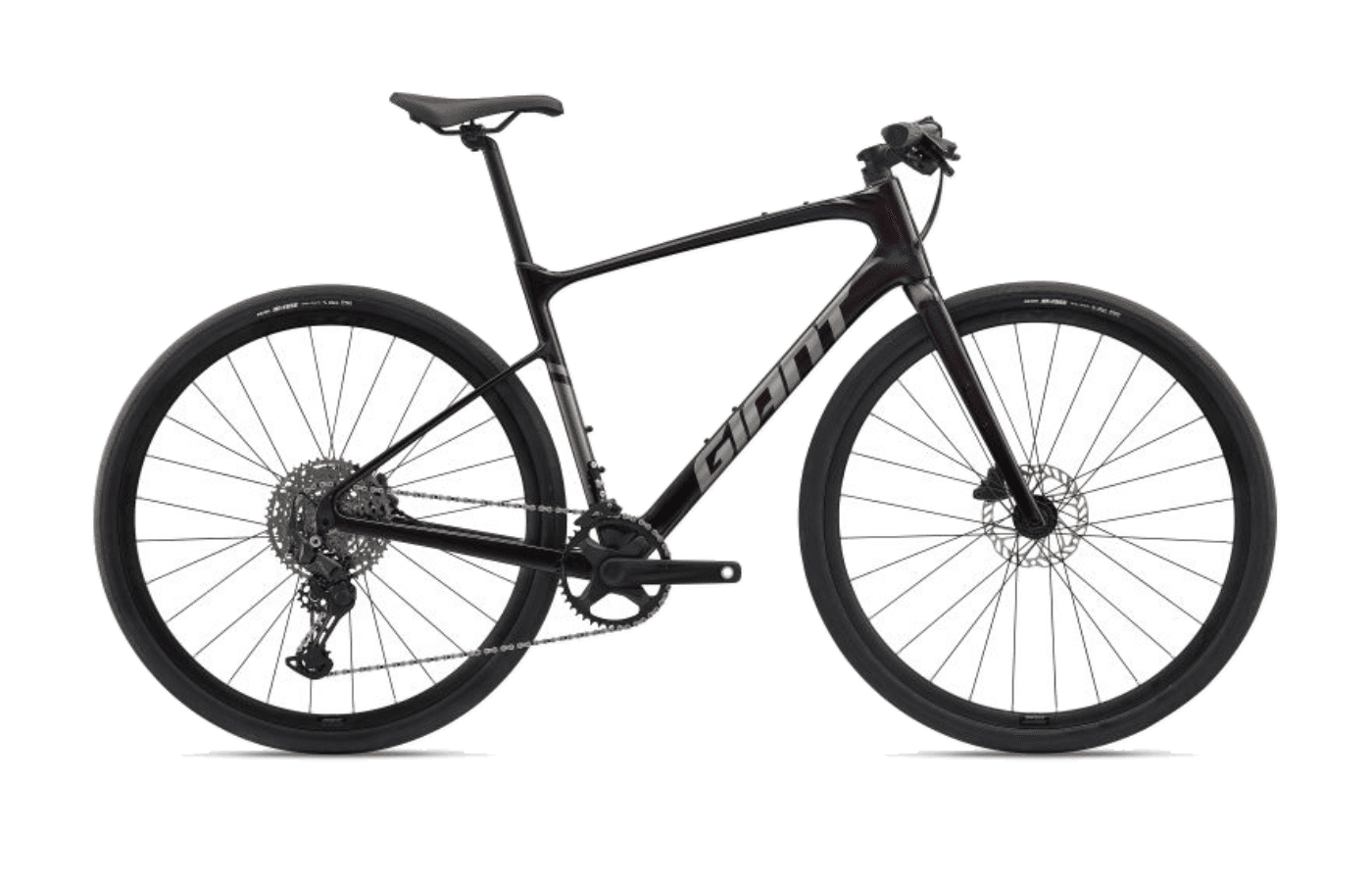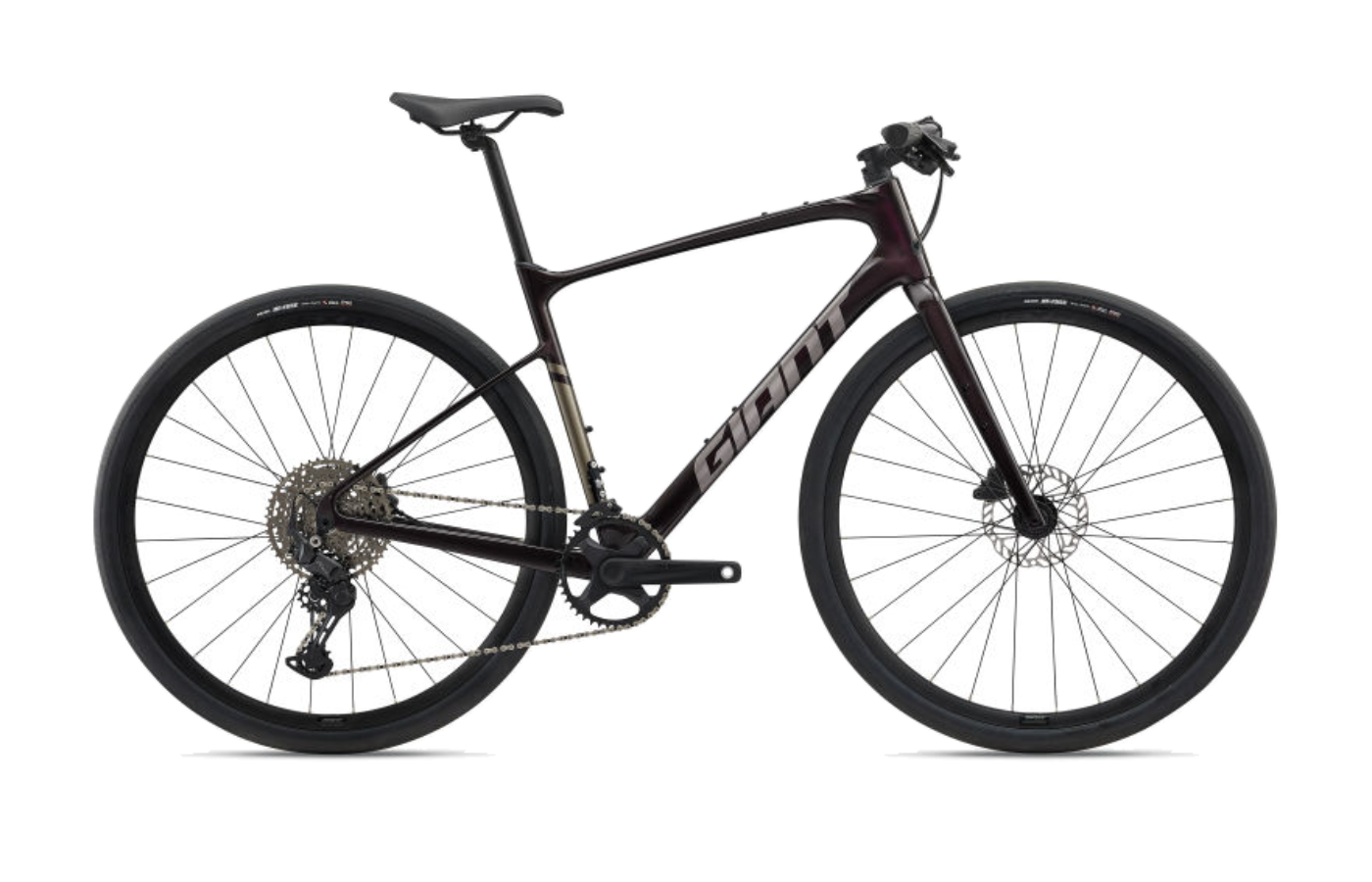
The current Giant FastRoad AR Advanced takes the flat-bar fitness-bike format and shifts it decisively toward all-road use. Rather than chasing pure on-road quickness, this generation is built around a carbon frame and fork, hydraulic disc brakes, and tire clearance up to 42 mm, making it better suited to broken pavement, rough bike paths, and light gravel than a traditional fast commuter or road-biased hybrid. It sits in the market as a higher-end fitness bike for riders who want flat-bar control and everyday practicality without giving up the lighter weight and sharper response of a carbon chassis.
What distinguishes the AR Advanced platform is how deliberately Giant has balanced comfort, stability, and stiffness. The frame uses a dropped seatstay layout and a D-Fuse seatpost to add compliance, while geometry changes from the earlier FastRoad concept—a slacker front end, longer wheelbase, and lower bottom bracket—push handling toward stability on uneven surfaces. At the same time, Giant retains a performance angle through its oversized PowerCore bottom-bracket area and asymmetric chainstay design, intended to preserve pedaling stiffness. Rack and fender mounts further broaden the bike's role, making it a credible option for fitness riding, commuting, and mixed-surface utility rather than a narrowly focused urban speed bike.
Where to get it.
No retailers stocking size S.
No retailers carrying size S right now.
Spec sheet.
Every component shipped with this build.
Geometry & fit.
7 sizes published.
The FastRoad AR Advanced's geometry is clearly tuned for stability and a more upright, confidence-oriented fit than a typical flat-bar road bike. Across the size range, head tube angles run from 70.5 degrees in S to 71.5 degrees in L/XL, paired with relatively long 435 mm chainstays and wheelbases from 1047 mm to 1105 mm. Those numbers point to calmer steering and better composure on rough surfaces, especially when combined with the fairly high trail figures in the smaller sizes—73.7 mm in S and 70.4 mm in M/ML. A 75 mm bottom-bracket drop across all sizes lowers the rider's center of gravity, which should help the bike feel planted rather than twitchy.
Fit is also biased toward comfort and control. Stack figures are fairly generous, from 552 mm in S to 646 mm in XL, while reach stays moderate at 396-432 mm, suggesting a less stretched position than many drop-bar all-road bikes and a natural posture for fitness riding or commuting. Effective top tube lengths of 560 mm to 630 mm scale conventionally through the range, and the seat tube angle varies between 73 and 73.5 degrees, keeping rider position neutral rather than aggressively forward. Overall, the geometry supports the bike's intended role: efficient enough for fast pavement riding, but notably more stable and forgiving when surfaces deteriorate.
Where the handlebar sits relative to the bottom bracket — the single most important fit pair.
01Fit geometry6 values
02Component geometry3 values
03Handling geometry7 values
Which size should I buy?
Slide your height to see the recommended size. GearWise's fit algorithm works from the published stack, reach, and ETT — the brand's own recommendation may differ.
→Calculated from GearWise's own stack / reach / ETT algorithm — the brand's size chart may recommend a different size, and a proper bike fit beats any calculator.
The lineup.
1 build, ranging $2,000.