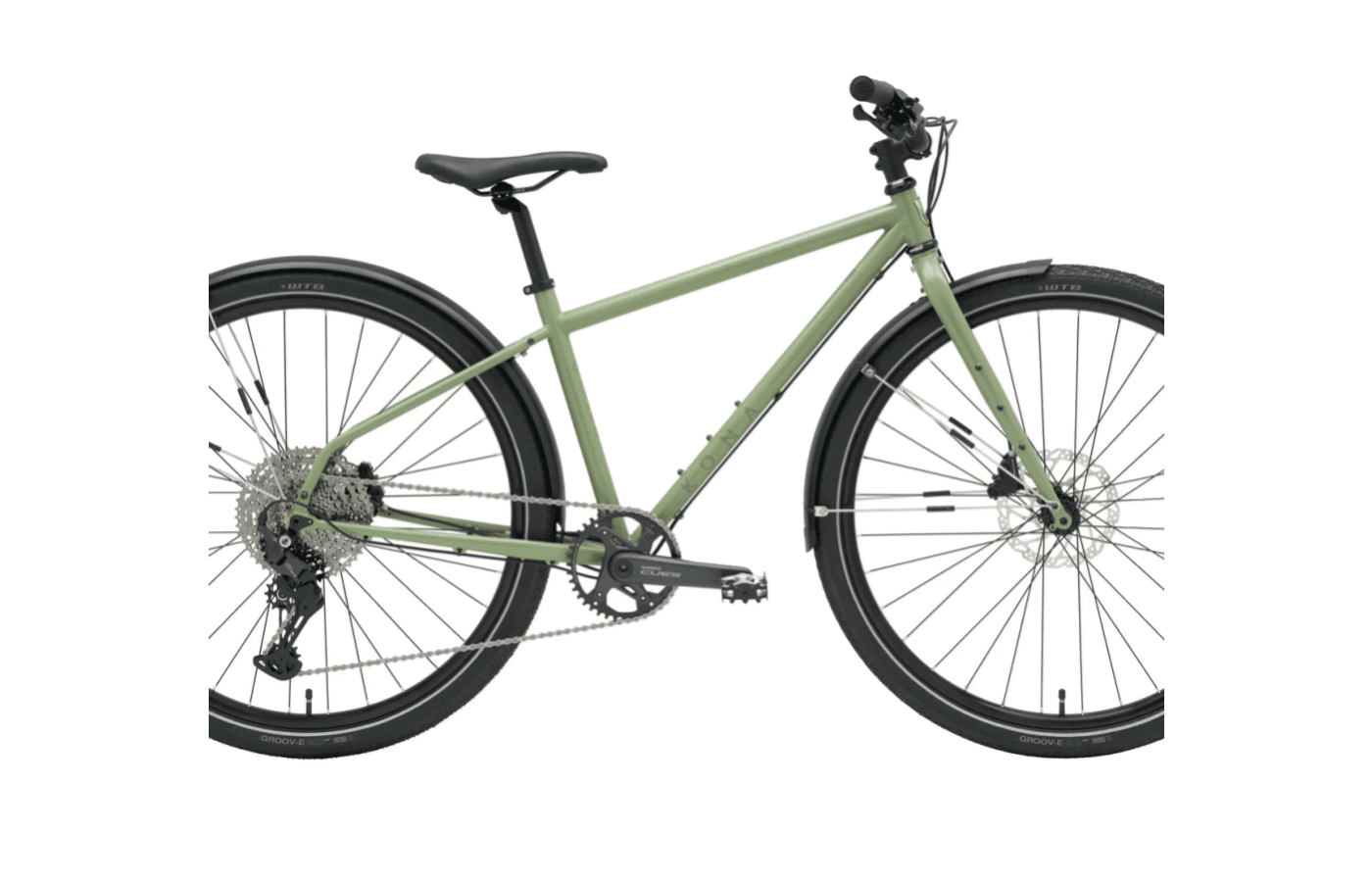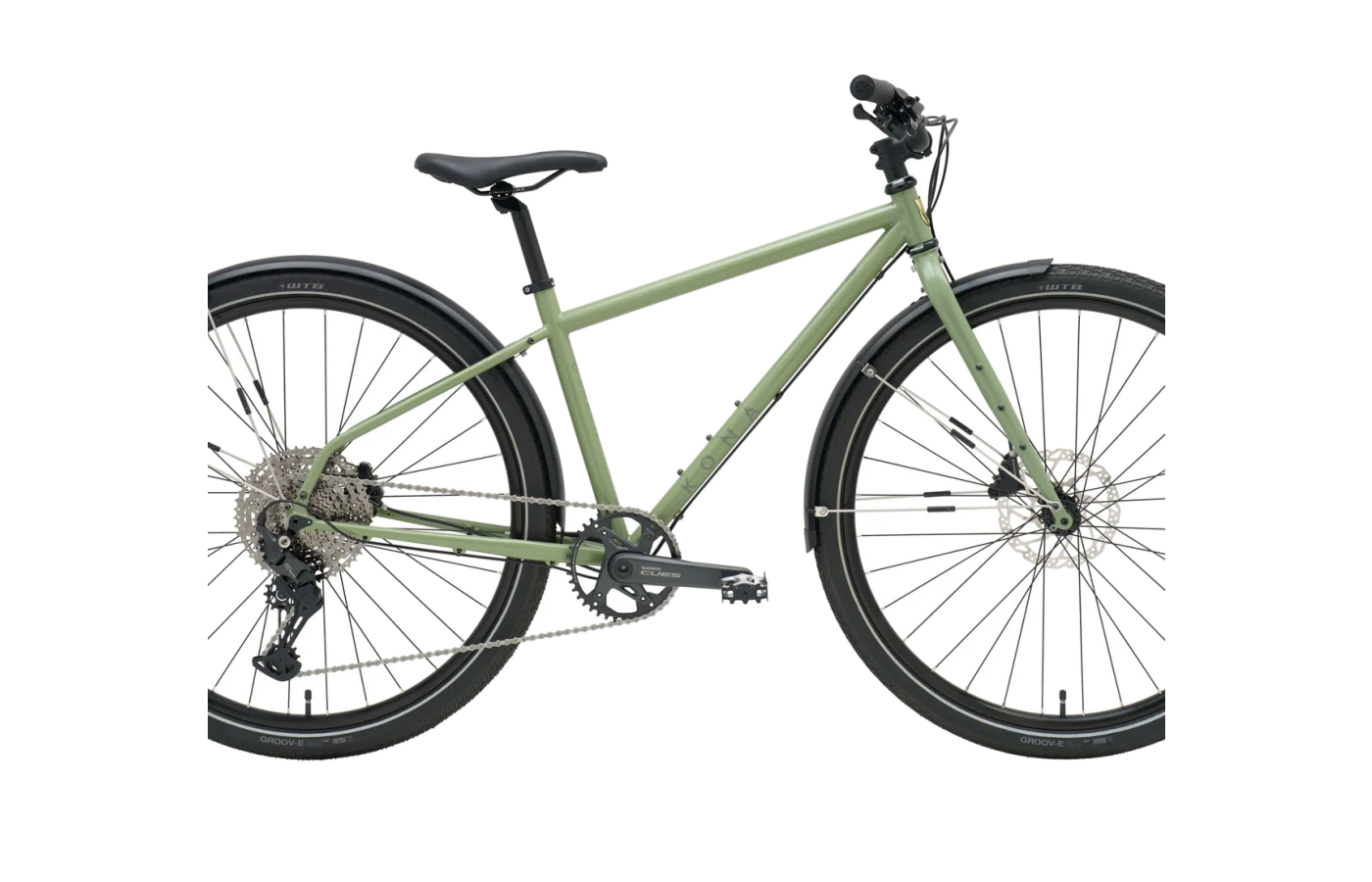
The 2026-present Kona Dr Dew is a substantial redesign rather than a routine update. It remains a steel, rigid-fork commuter built from full cromoly, but the underlying concept has shifted toward a more stable, higher-volume urban and light all-road platform. Kona moved the bike to 29x2.0 tires and paired that with notably revised commuter geometry: a 69° head angle, 470 mm chainstays across all sizes, a taller bottom bracket position, shorter head tubes, and longer wheelbases than the previous frame. The result is a bike that clearly prioritizes straight-line composure, load-friendly manners, and rough-surface capability over quick, twitchy city-bike handling.
The hardware choices reinforce that practical, durability-first brief. The new frame uses external EC34 headset cups, a threaded 73 mm BSA bottom bracket, and 12x100 / 12x142 thru-axles with 180 mm centerlock rotors, all of which point to easier serviceability and more current wheel and brake standards than many traditional flat-bar commuters. In the market, the Dr Dew sits as a steel urban bike for riders who want commuter utility but also value the ride quality, tire volume, and stability of a rigid all-road machine. It stands apart from lighter, racier city bikes by leaning into robustness and control.
Where to get it.
No retailers stocking size S.
No retailers carrying size S right now.
Spec sheet.
Every component shipped with this build.
Geometry & fit.
4 sizes published.
The Dr Dew's geometry is unusually long and stable for an urban/commuter bike. Across the size range, the head tube angle is a slack 69°, chainstays are a lengthy 470 mm, and wheelbase stretches from 1098 mm in S to 1231 mm in XL. Reach figures are also fairly generous for the category at 400 mm to 490 mm, while stack runs from 539 mm to 651 mm. Together, those numbers suggest a bike with calm steering, strong front-wheel composure, and predictable tracking, especially when carrying cargo or riding on broken pavement and gravel paths.
The 70 mm BB drop is paired with Kona's stated taller bottom bracket relative to the prior frame, reflecting the move to larger 29x2.0 tires rather than an especially low-slung commuter stance. Effective top tube lengths from 565 mm to 689 mm and the relatively short head tubes indicate a fit that can be set up efficiently without making the bike feel cramped, but the overall layout still favors stability over agility. Riders should expect secure, planted handling and ample room, with less of the quick low-speed steering response associated with shorter-wheelbase city bikes.
Where the handlebar sits relative to the bottom bracket — the single most important fit pair.
01Fit geometry6 values
02Component geometry3 values
03Handling geometry8 values
Which size should I buy?
Slide your height to see the recommended size. GearWise's fit algorithm works from the published stack, reach, and ETT — the brand's own recommendation may differ.
→Calculated from GearWise's own stack / reach / ETT algorithm — the brand's size chart may recommend a different size, and a proper bike fit beats any calculator.
The lineup.
1 build, ranging $1,099.
The provided data lists a single available build, the Dr Dew (37), but does not include pricing or a detailed component specification. As a result, there is not enough information to compare build tiers or assess relative value within the range.
What is clear from the model information is that the platform itself brings several notable spec-level features: a full cromoly frame and rigid fork, clearance for 29x2.0 tires, external EC34 headset cups, a threaded 73 mm BSA bottom bracket, and Shimano 12x100 / 12x142 thru-axle hubs with 180 mm centerlock rotors. Those choices emphasize durability, modern wheel security, and easier long-term maintenance.