FX
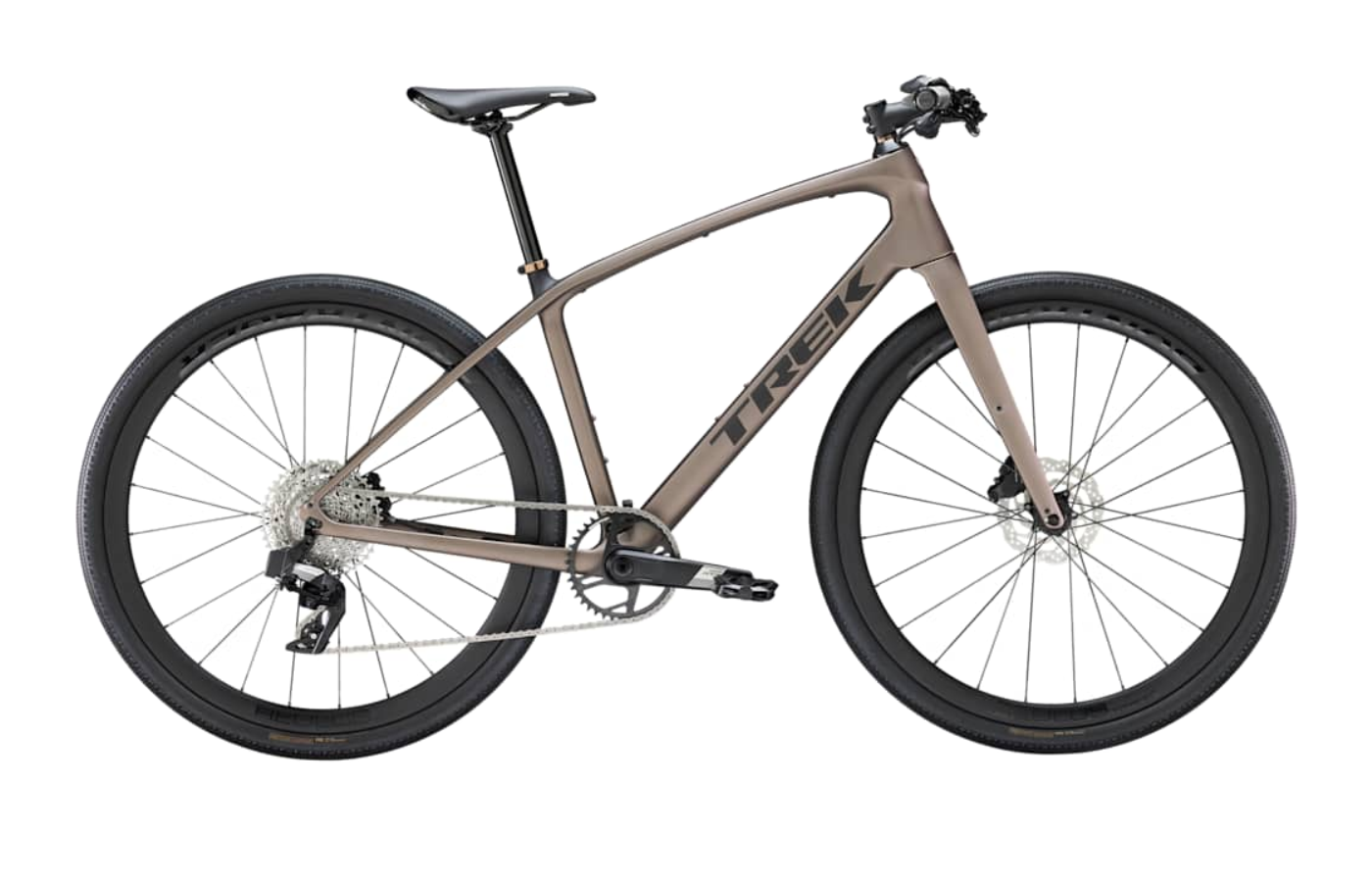
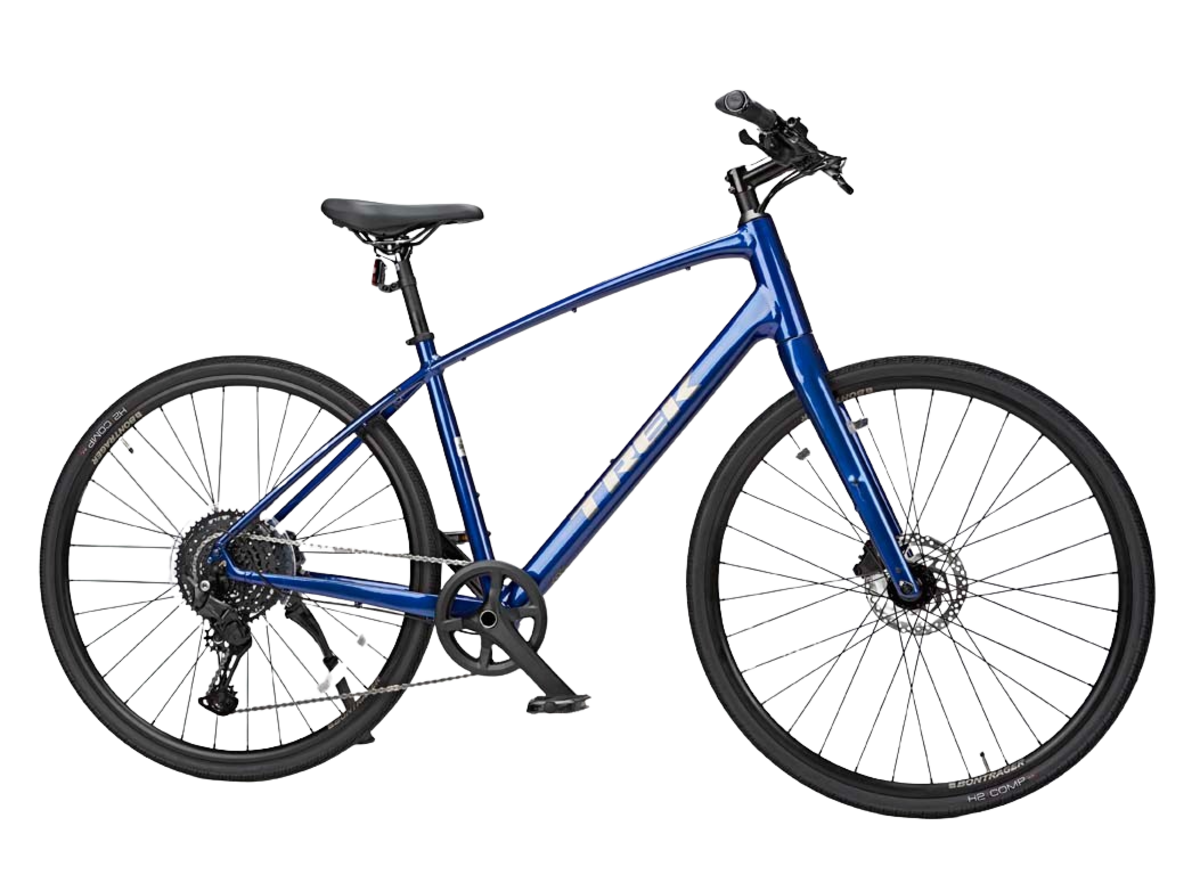
Trek’s Gen 4 FX updates the brand’s core fitness-hybrid platform with a more utility-ready frame while keeping the bike’s basic identity intact: rigid, flat-bar, fast on pavement, and practical for daily transportation. The new chassis adds a broader set of mounts for racks, fenders, bags, a low-rider front rack, and Trek’s Adventure Boss frame bag, which makes this generation notably more adaptable than the previous FX. It also moves to post-mount disc tabs on the frame and is commonly paired with Shimano’s newer CUES/LinkGlide drivetrains on current FX 2 and FX 3 builds, reinforcing its shift toward durability and everyday usability rather than pure fitness-bike minimalism.
In use, the Gen 4 FX sits squarely between a road-adjacent flat-bar fitness bike and a true commuter hybrid. Stock 700x35 mm tires and roughly 40 mm tire clearance give it enough volume for rough pavement and light gravel paths, while the rigid frame and fork keep pedaling direct and efficient. Geometry changes such as a bottom bracket height around 285 mm and chainstays around 447 mm on common published charts point to a stable, planted character rather than an ultra-quick, nervous feel. In the market, it remains one of the more complete mainstream options for riders who want one bike for commuting, fitness riding, and general urban use without stepping into drop-bar road or gravel territory.
Geometry & fit.
5 sizes published.
The Gen 4 FX uses numbers that point to a stable, upright fitness-bike fit rather than a stretched, aggressive road position. In size M, the bike has a 594 mm stack and 393 mm reach, paired with a 71-degree head tube angle, 74-degree seat tube angle, 442 mm chainstays, and a 1065 mm wheelbase. That combination puts the rider fairly upright for visibility and comfort, while the moderately steep seat angle keeps pedaling position efficient enough for fitness riding. Across the size range, stack rises from 543 mm in XS to 648 mm in XL, while reach stays relatively moderate at 383-410 mm, so the fit prioritizes accessibility over a long, low cockpit.
Handling is tuned conservatively for urban use. The 442 mm chainstays are long for a fitness hybrid, and with wheelbases from 1047 mm to 1082 mm, the bike should feel planted and predictable rather than especially sharp. Head angles steepen from 70 degrees in XS to 72.5 degrees in XL, while trail drops from 74 mm to 58 mm, a common size-specific adjustment that helps smaller bikes stay calm and larger bikes avoid sluggish steering. The fixed 65 mm BB drop also keeps the center of gravity reasonably low. Overall, the geometry suggests easy low-speed control, steady straight-line behavior, and enough responsiveness for city riding, but not the quick, twitchy feel of a more aggressive flat-bar road bike.
Where the handlebar sits relative to the bottom bracket — the single most important fit pair.
01Fit geometry6 values
03Handling geometry8 values
Which size should I buy?
Slide your height to see the recommended size. GearWise's fit algorithm works from the published stack, reach, and ETT — the brand's own recommendation may differ.
→Calculated from GearWise's own stack / reach / ETT algorithm — the brand's size chart may recommend a different size, and a proper bike fit beats any calculator.
The lineup.
7 builds, ranging $700 – $3,500.
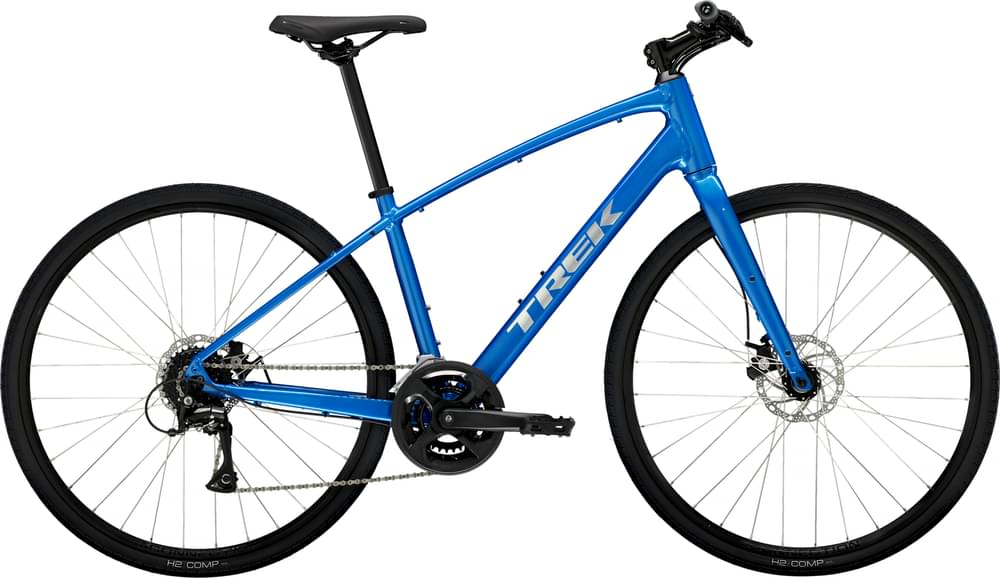
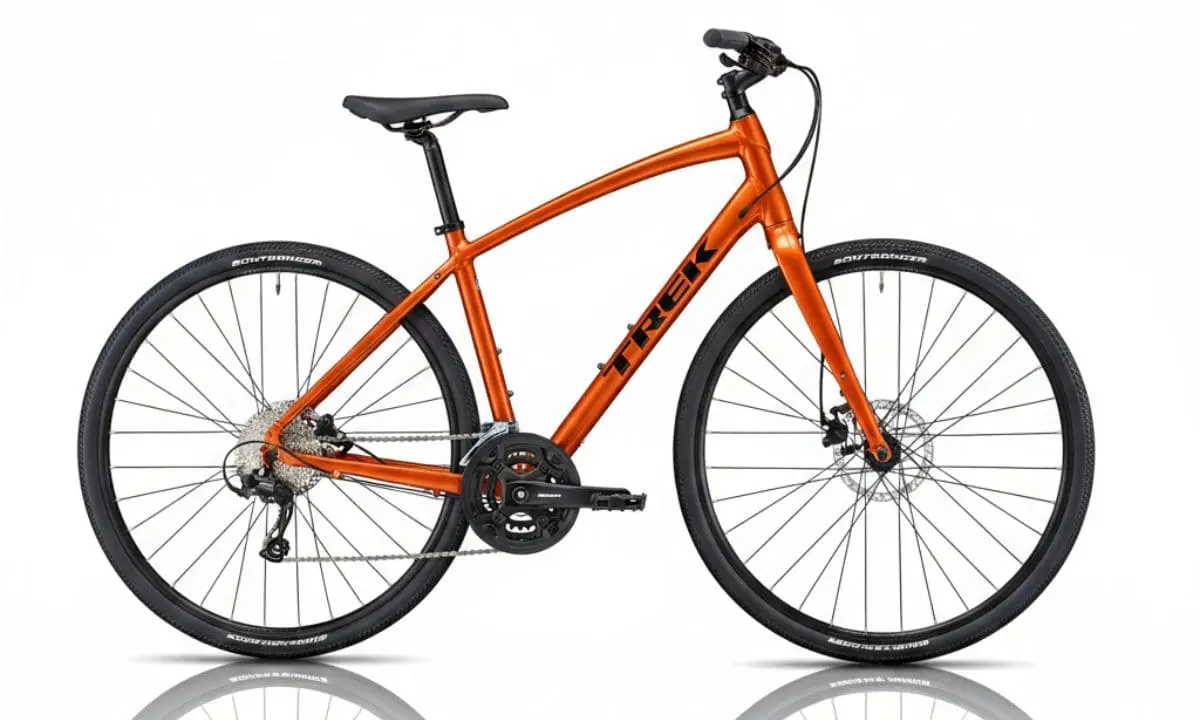
The published Gen 4 range spans from entry-level utility builds to much more premium fitness-oriented models. At the lower end, the FX 1 Stepover Gen 4 is listed at $699.99, followed by the FX 2 Midstep and FX 2 Stepover at $899.99. Reviews and spec references position these bikes as practical everyday options, with the FX 1 using a 2x8 Shimano Tourney/Acera drivetrain, mechanical disc brakes, and a weight around 13 kg, while the FX 2 steps up to hydraulic brakes and a more capable mid-range parts mix. These are the value-focused choices for commuting and general riding, with the FX 2 especially standing out as the affordable hydraulic-brake option.
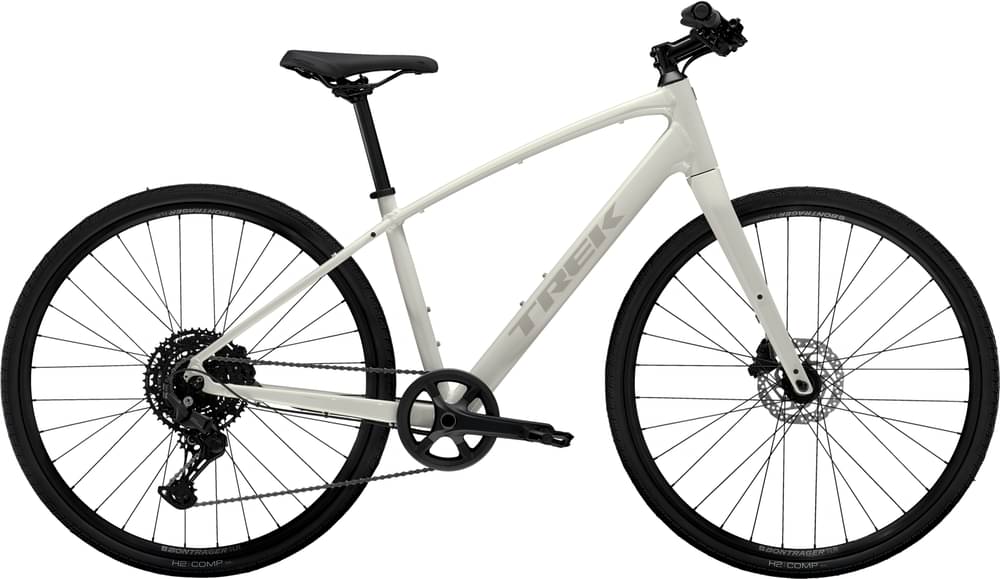
Above that, the lineup broadens into FX Sport territory: Sport AL 3 at $1,199.99, Sport SL 4 at $1,999.99, Sport SL 5 at $2,299.99, and Sport SL 6 at $3,499.99. Within the standard FX family, the FX 3 is the key step-up build, commonly cited around $1,050/£1,000, with a carbon fork, Shimano CUES 1x10 drivetrain, hydraulic discs, and an 11.5 kg claimed weight. Reviewers repeatedly singled it out as the sweet spot because it delivers the biggest jump in ride quality and refinement over the entry models without moving into the far more expensive Sport SL pricing. In broad terms, the lower models emphasize durability and simplicity, while the FX 3 and above shift toward lighter weight, better damping, and stronger fitness-bike performance.


From the press.
5 reviews from the cycling press.
Reviewers consistently describe the Gen 4 FX as a well-judged pavement and city bike with a sporty edge. Opticycles called the FX 3 a strong "commuter-sprinter" and said Trek got the all-round balance right, while Consumer Reports highlighted the FX 3’s ability to carry speed on the flats, handle most urban climbs easily, and deliver nimble handling with reasonable comfort. Across reviews, the bike’s Alpha Gold aluminum frame, upright-but-forward riding position, and 35 mm tires were recurring positives, giving it a road-like feel without the harsher posture of a drop-bar bike.
The biggest praise is reserved for the higher-spec models, especially the FX 3. Reviewers repeatedly noted that the carbon fork improves vibration damping and makes the bike feel lighter and more refined than the lower trims, and the hydraulic brakes on FX 2 and FX 3 were preferred over the FX 1’s mechanical discs for modulation and wet-weather confidence. At the same time, several weaknesses came up consistently: lower-tier models feel heavier and less snappy, the upright flat-bar position creates more wind resistance at speed than a road bike, and the stock saddle is often cited as a comfort weak point on longer rides. There is also broad agreement that while the FX handles light gravel and park paths well enough, its rigid setup and geometry make it a poor choice for rough trails or technical off-road riding.
TREK FX 3 GEN 4 2025 - Review, Specs & Price
TREK FX 1 GEN 4 2025 - Review, Test & Price
Trek FX 2 Gen 4 Hybrid Bike Review: The Perfect Fitness Bike for Everyday Rides?
Trek FX 3 Gen 4 Bike Review - Consumer Reports