RaceMax
vsGrail
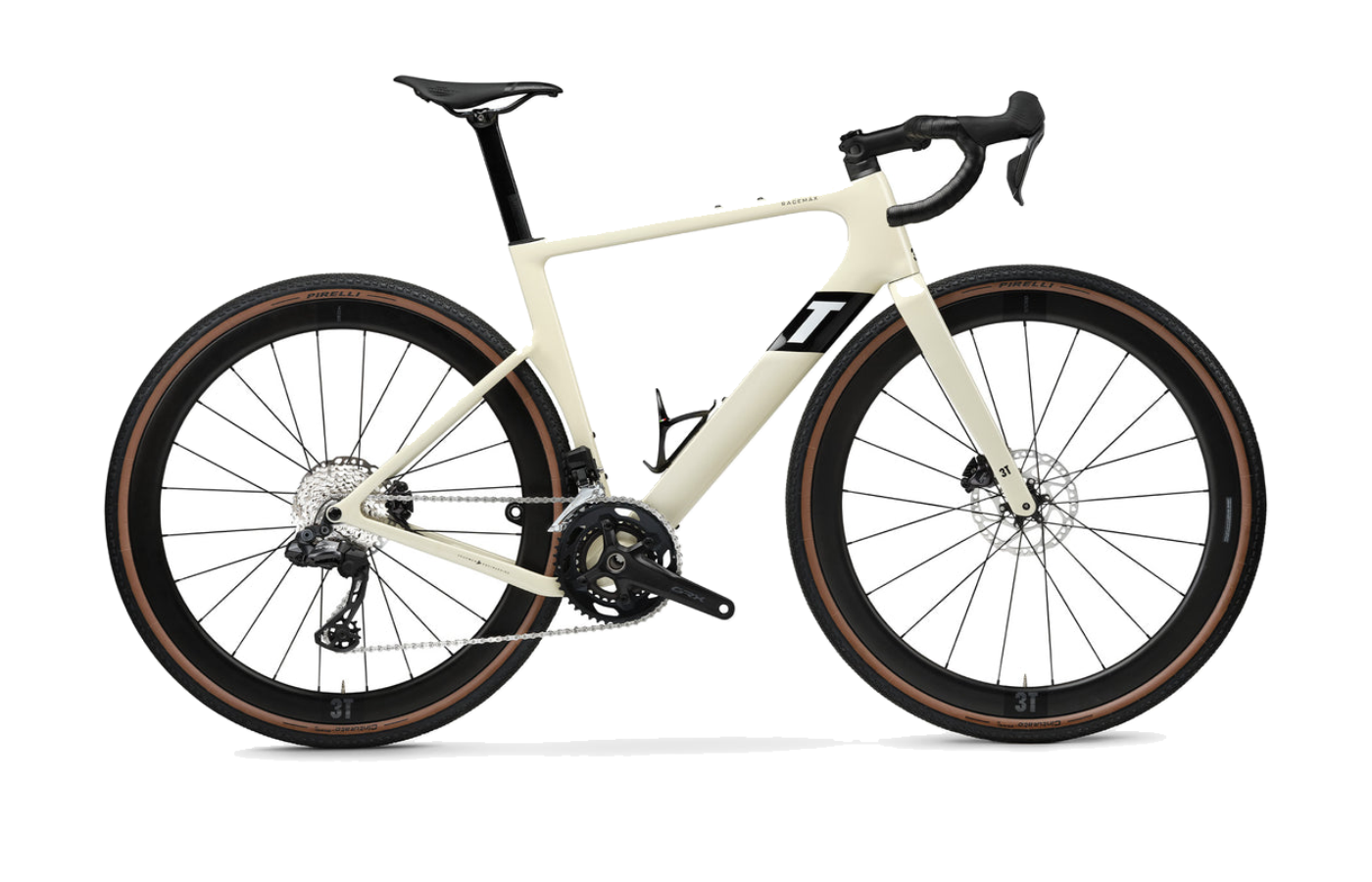
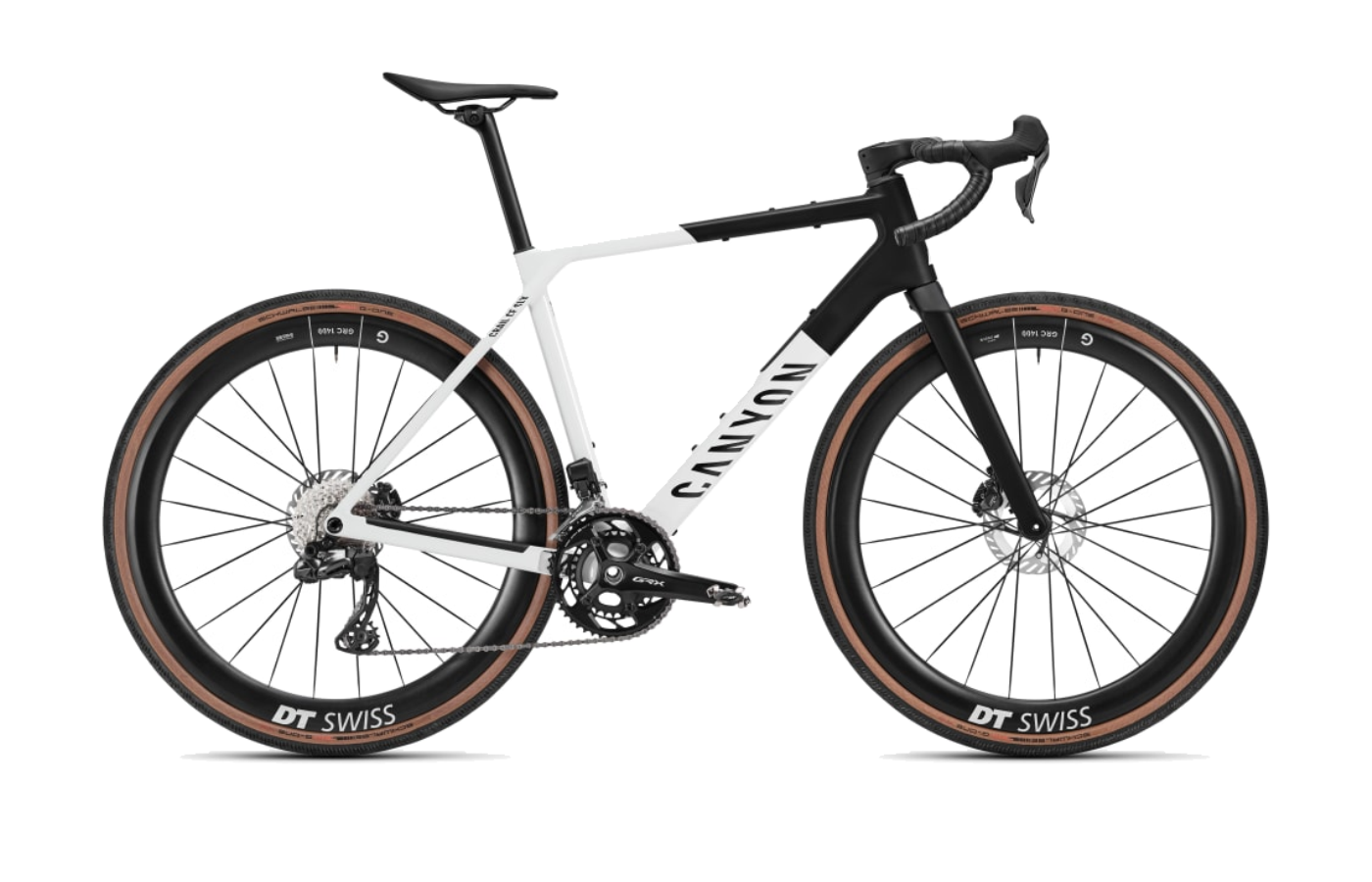
Two aero gravel racers, two pricing planets.
The 3T RaceMax is the boutique quiver-killer with two-wheelset ambitions. The Canyon Grail Gen 2 is the consumer-direct race weapon that undercuts everything in its class.
RaceMax
- True quiver-killer — a wheelset swap morphs it from fast road bike to 650b x 2.1" trail machine.
- Three bottle mounts plus bento-box mount — built for genuinely long days when you need to carry your own water.
- Distinctive Vroomen design language — the WAM/RAM system and shielded downtube give it real engineering character.
- Platform starts at $6,799 — no entry-level Rival or 105 build exists.
- Stiff frame plus aero seatpost transmits a lot of feedback; comfort lives in the tire.
Grail
- Class-leading value — full GRX Di2 with DT Swiss carbon wheels at $5,599, undercutting everything in the segment.
- Calm, planted handling — the 27 mm-longer wheelbase and 71.5° head angle plough through chunky gravel.
- Genuinely useful integration — downtube storage, magnetic Fidlock frame bag, and a Gear Groove cockpit interface.
- Fixed integrated cockpit — fit adjustments mean buying an aftermarket bar-stem.
- Direct-to-consumer model: no demos, and Escape Collective reported visible QC issues out of the box.
Editor’s analysis
Both are aero gravel bikes built to go slow, faster. One asks you to pay for Vroomen's design philosophy; the other asks how it's possible to charge so little for a Force AXS race rig.
On paper, the 3T RaceMax and Canyon Grail are surprisingly close. Both clear 42 mm tires, both run aero-shaped carbon frames with one-piece integrated cockpits, both target the same gravel-race rider hunting Strava segments and Unbound starts. But spend any time inside the spec sheets and the divergence is dramatic — the Grail's full GRX Di2 build with DT Swiss carbon wheels lands $1,500 below 3T's GRX Di2 build with similar carbon hoops.
The 3T RaceMax is the older, more boutique animal. Gerard Vroomen — of Cervélo fame — designed it around the WAM/RAM tire-measurement system, a third bottle mount under the downtube, and a 75 mm-wide truncated-airfoil downtube that shields water bottles from the wind. Reviewers across Velo, Bicycling, and BikeRadar landed on the same verdict: it's a quiver-killer that genuinely earns the title with a 700c wheelset for road and a 650b knobby setup for chunky trails. The catch is that the platform doesn't start until $6,799, and unlocking its full character realistically means a second wheelset.
The Canyon Grail Gen 2 is the newer, sharper-pointed tool. The 2024 redesign slackened the head angle by a degree, stretched the wheelbase 27 mm, and ditched the divisive double-decker Hoverbar for a one-piece Double Drop cockpit with downtube storage and a Fidlock frame bag that Canyon claims is 1.3–1.5 watts faster than running naked. Reviewers from Bike Perfect, Granfondo, and Cycling News converge on the same call: it's one of the best-handling pure race bikes in the segment, and at $5,599 for a full GRX Di2 carbon build it sets a value benchmark the boutique brands can't touch.
Put another way: the 3T RaceMax is what you buy when you want one bike that does road and gravel and you can stomach a $7k entry. The Canyon Grail is what you buy when you've already accepted the consumer-direct tradeoffs (no demos, fit must match the integrated cockpit) and want the most race bike per dollar in the category.
Where the builds differ.
Comparing our editor's-pick builds side-by-side. Winners highlighted row-by-row — lower price and weight, and the better-spec component, each mark a point.
Build variants & pricing
Both platforms top out around $6–9k, but the floor differs sharply: the Grail starts at $2,899 in alloy-wheel GRX trim; the RaceMax doesn't start under $6,799.
Prices are current US MSRP. The Canyon Grail's downtube storage and Gear Groove cockpit interface are reserved for the CF SLX and CFR frames — the entry-level CF SL builds skip both.
How they fit, how they steer.
Sizes picked by fit for a 5'8" rider on each bike — note the convention gap (3T runs numeric, Canyon runs T-shirt). The Grail XS sits 30 mm lower in stack with virtually identical reach, runs 7 mm longer chainstays (425 vs 418), and slackens the head angle to 71° — composed where the 3T is sharper.
Which size should I buy?
Both ranges overlap in the middle, but the Canyon's T-shirt sizing tends to run small — riders who normally take a 54 may end up on an S.
→These are starting points. Flexibility, riding style, and preferred position all shift the answer — if you’re between sizes, a professional fit beats a chart.
What the magazines said.
Published reviews from trusted cycling outlets. Click through for the full write-up.
Which one should you buy?
If you want one bike for road and gravel and have the budget to fund two wheelsets, get the 3T RaceMax. If you want the most race bike per dollar, get the Canyon Grail.
RaceMax
If you can only justify one drop-bar bike and want it to do everything from Tuesday-night road rides to weekend bikepacking on knobby 650b tires, the RaceMax is genuinely versatile in a way most gravel race bikes aren't. The price is the price, but you're paying for engineering and longevity, not marketing.
Grail
If you're lining up for Unbound, BWR, or any long-format gravel race and want stable, predictable handling at speed, the Grail is the sharper tool. The integrated storage means you carry tools and snacks without strap-on bags, and the price leaves room for a power meter, race wheels, and entry fees.
Questions buyers actually ask.
Short answers to the things we get emailed about most often.
01Which is faster on smooth gravel?
Roughly a wash, with the edge to the Canyon Grail. Both bikes run aero-shaped tubes and integrated cockpits; both reviewers describe as fast on flats and rolling terrain. The Grail Gen 2 has a published 9.1-watt aero gain over the previous Grail at 45 km/h, and the integrated Fidlock frame bag is claimed to add another 1.3–1.5 watts when fitted.
The 3T RaceMax counters with its 75 mm-wide truncated-airfoil downtube and aero seatpost, but doesn't publish comparable wind-tunnel numbers. Reviewers consistently called both "blisteringly quick" on hardpack — if you're choosing on flat-gravel speed alone, you're splitting hairs.
02What's the maximum tire clearance on each?
3T RaceMax: 42 mm officially on 700c, but real-world clearance is tight — Velo flagged "oddly limiting tire clearance" on 700c, especially in mud. The bike's hidden party trick is 650b compatibility, which opens it up to 2.1–2.25" knobby tires for genuine off-road work.
Canyon Grail: 42 mm officially, 700c only. Some reviewers report the frame can fit 45 mm unofficially, but Canyon doesn't endorse it. If 42 mm isn't enough, Canyon points you to the Grizl instead.
03Which has the better integrated cockpit?
The Canyon's CP0039 is more refined; the 3T's setup is more flexible. Canyon's one-piece carbon Double Drop bar replaces the polarising double-decker Hoverbar from the original Grail — it's got 16° of flare in the drops, 5° of backsweep on the tops, and a Gear Groove interface for accessories. Reviewers praise the ergonomics but consistently flag the wide stock widths (420 mm on XS/S frames) and the fact that fit changes mean buying an aftermarket replacement.
The 3T uses a separate stem (3T More) and bar (3T Superergo Integrale LTD or Aeroghiaia), which means standard stem-length swaps are possible without replacing the entire cockpit. The flip side: 3T's internal cable routing was called "fiddly" by Boundlessmag and was linked to laboured shifting on at least one mechanical Ekar build.
04Why is the 3T so much more expensive than the Canyon?
Two reasons: distribution model and platform positioning. Canyon sells direct-to-consumer in most of its markets, so it skips the dealer margin most boutique brands pay — BikeRadar called the Grail's mid-tier CF SLX 8 Di2 build "class-leading value for money" against $8k+ rivals from BMC and Factor.
3T is a small Italian brand selling mostly through dealers, and the RaceMax platform doesn't have an entry-level alloy-wheel option — every build is carbon-wheel-ready and at least Shimano GRX Di2 or SRAM Rival XPLR AXS. You're paying for a more boutique product made in smaller volumes.
05Can either fit a 1x setup with a wide-range cassette?
Yes, both. The 3T RaceMax offers a SRAM Rival XPLR AXS 1x13 build at $8,999 with a 10–46T cassette; reviewers in the past have also confirmed Campagnolo Ekar 1x13 and SRAM Eagle AXS "mullet" 1x12 setups bolt onto the same frame, opening up a 10–50T range for steep gravel climbing.
The Canyon Grail offers SRAM Force XPLR AXS 1x13 (top trim, $6,099) and SRAM Rival XPLR AXS 1x12/13 on lower trims. Canyon's frame officially supports single chainrings up to 50T.
06How does service and warranty compare?
The 3T RaceMax is dealer-supported in most markets, so adjustments, warranty claims, and crash-replacement work go through your local 3T dealer. The Canyon Grail is direct-to-consumer; warranty runs through Canyon's regional service centres, and adjustments mean either DIY or paying an independent shop. Escape Collective's reviewer received a Grail with a misadjusted front derailleur, misaligned brake caliper, and warped rear rotor out of the box — a reminder that the consumer-direct model puts more burden on the buyer for setup.
07Which is better for bikepacking?
The 3T RaceMax, slightly. Both bikes have hidden fender mounts and accommodate frame bags, but the RaceMax adds a third bottle mount under the downtube and a bento-box mount on the top tube, plus the option to run wider 650b tires for rougher routes. The Canyon's downtube storage compartment (CF SLX and CFR only) is convenient for tools but doesn't replace the cargo capacity of a proper frame-bag setup. Neither is a Cutthroat — both are race bikes first.
08What about the integrated frame storage on the Canyon?
The CF SLX and CFR Grail frames include a downtube LOAD storage compartment with internal clips for a multi-tool and mini-pump, plus an optional Fidlock-magnetic Aero Load frame bag that Canyon claims is 1.3–1.5 watts faster than running without it. The catch: most accessories (computer mount, frame bag, fork sleeves) are sold separately and use Canyon-specific fittings, so the true bike-out-the-door cost runs higher than the sticker. The cheaper CF SL frames skip the storage compartment and the Gear Groove cockpit interface entirely.
Similar bikes
If your priorities don’t map cleanly onto either of these, one of these adjacent bikes probably fits better.
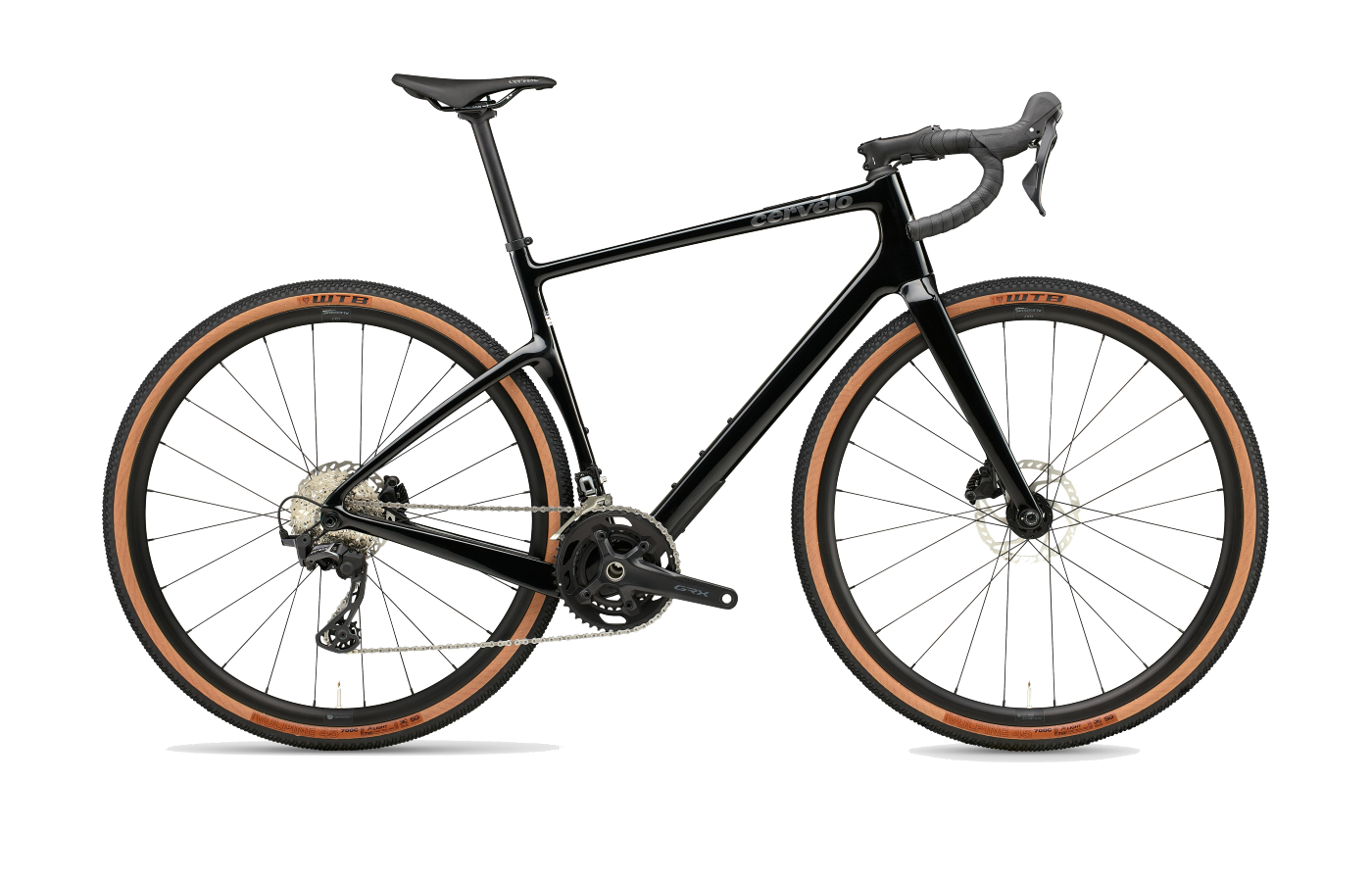
Aspero
The most direct rival to the 3T — also a Vroomen-designed aero gravel racer with road-like handling, but typically less expensive and with more conventional cockpit ergonomics. The middle ground between the 3T's boutique premium and the Canyon's value play.
Compare →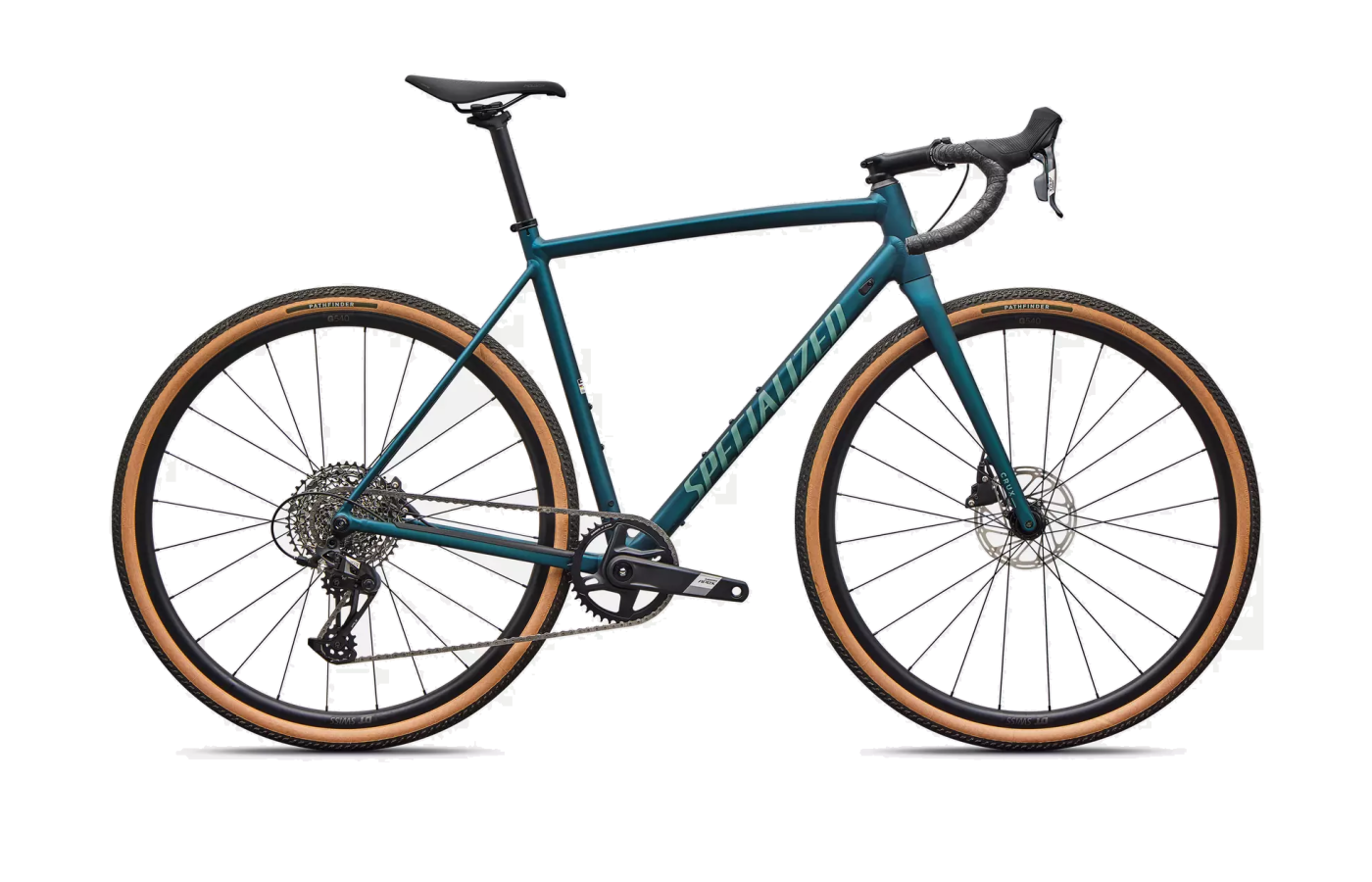
Crux
For the rider who finds both bikes too stiff. The Crux is significantly lighter and more compliant, with a more relaxed ride character — it trades aero shaping for plush comfort and a frame that climbs better than either bike here.
Compare →Grizl
Canyon's adventure-leaning sibling to the Grail. More tire clearance, more relaxed geometry, and no proprietary integrated cockpit — the better pick if 42 mm doesn't cover your local trails or if Grail's fit constraints scare you off.
Compare →