Oltre
vsSprint
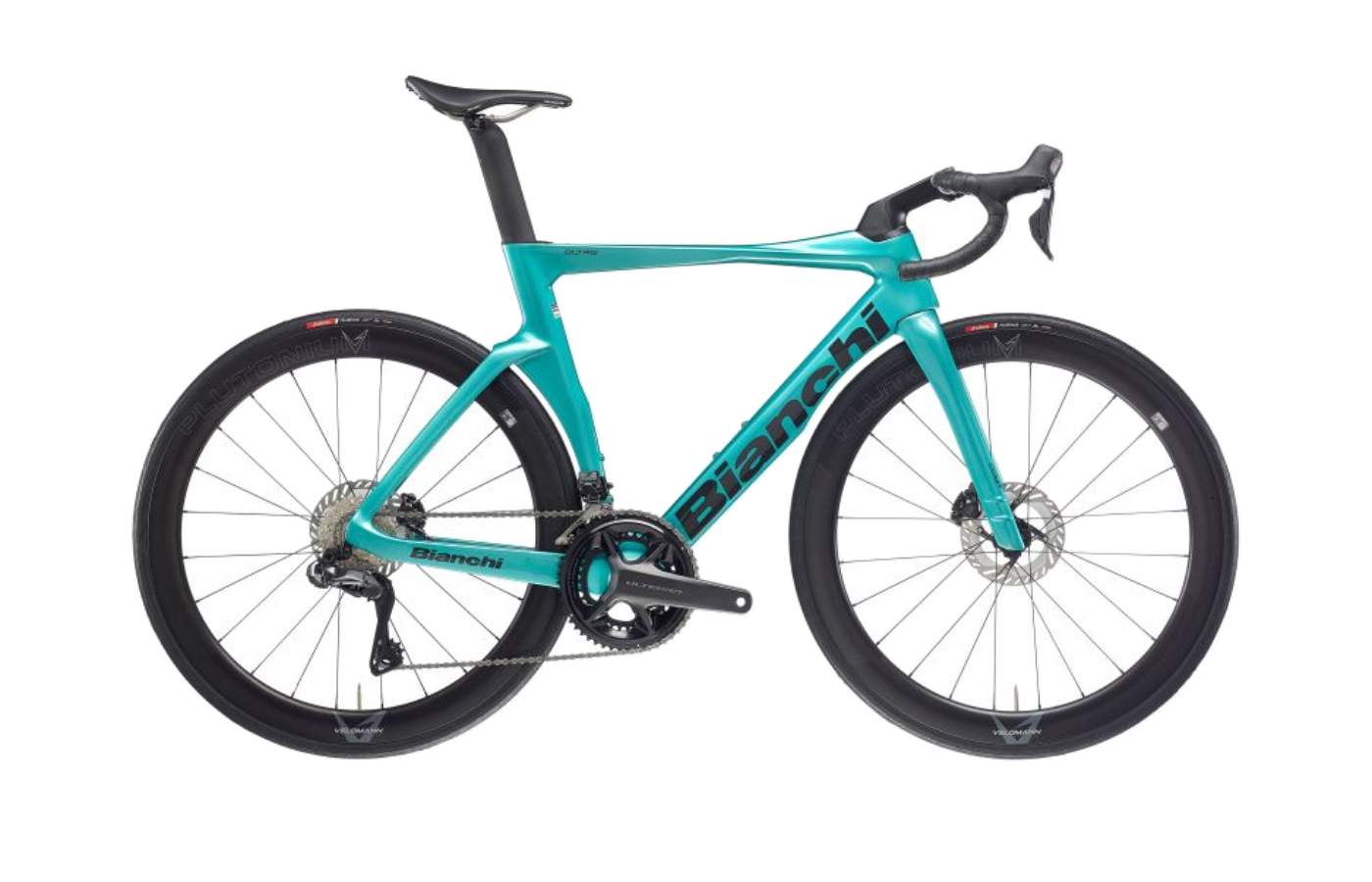
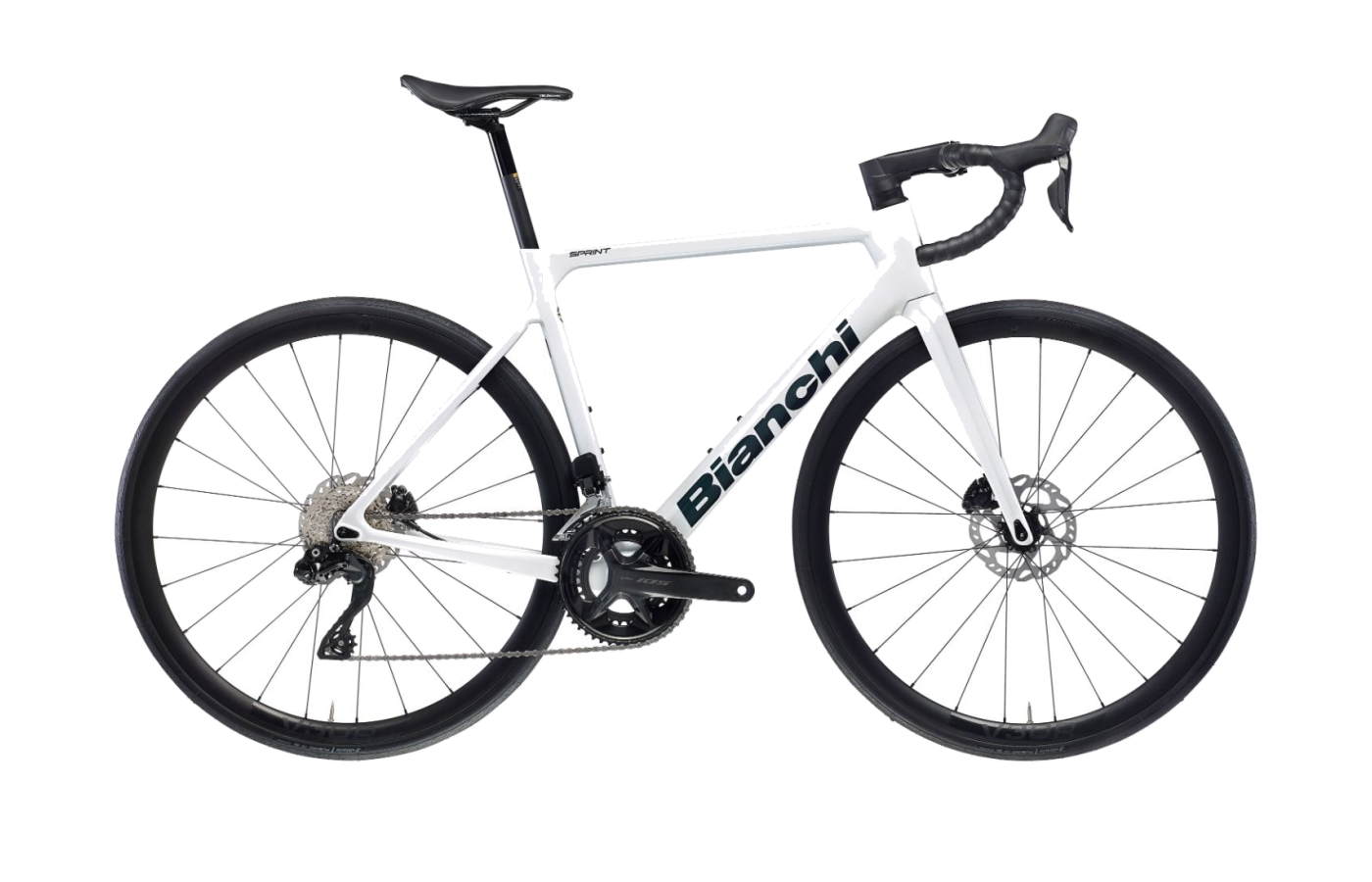
Two Celeste race bikes from very different worlds.
The Oltre is Bianchi's no-compromise hyperbike. The Sprint is the same brand's pragmatic carbon all-rounder at a fraction of the price.
Oltre
- True hyperbike aero — Bianchi claims a 17 W saving at 50 km/h over the previous Oltre XR4, with integrated cockpit and tube shapes built around a wind tunnel.
- Countervail damping on the Pro and Comp frames takes the edge off road buzz without softening the race geometry.
- Race-grade rear-end stiffness — reviewers describe 'no flex at all' and 'top-shelf' power transfer out of the saddle.
- Aggressive low front end (118 mm head tube on size 55) demands flexibility and a professional fit.
- Heavier than its claimed weight — reviewers measured ~8.0–8.3 kg actual versus Bianchi's 7.3 kg claim.
Sprint
- Complete Shimano 105 groupset on every build — no shortcuts on chainset or brakes, which is rare at this price.
- Comfortable race geometry — a 545 mm stack at size 55 lets you ride a sportive without being folded in half.
- Legitimate upgrade platform — reviewers say the chassis is 'fast to get up to speed' and only really opens up with a wheel swap, so the frame buys patience.
- Stock Velomann 30 mm alloy wheels are heavy (~2 kg per pair); they're the obvious first upgrade.
- No carbon-tier or electronic-Ultegra option in the lineup — if you want SRAM Force or Ultegra Di2, you're shopping the Oltre.
Editor’s analysis
This isn't a head-to-head. It's a question of how much bike you actually need — the WorldTour weapon, or the every-Sunday club racer that happens to wear the same paint.
On paper, both share the Celeste badge and Bianchi's race DNA, but the Oltre and Sprint are aimed at completely different riders. The Oltre is the brand's flagship aero platform — the same frame Team Arkea-B&B Hotels races on the WorldTour, complete with Formula One-inspired air deflectors on the head tube and an extremely low front end. The Sprint is the carbon entry point: same race heritage, none of the radical aero packaging, and a price tag that lets you buy a power meter and still come out under the cost of the cheapest Oltre.
The Bianchi Oltre exists to win flat and rolling races. Reviewers describe it as a bike that 'begs to be ridden hard and fast,' with a 'seriously hefty bottom bracket' and a stiff rear end that delivers what Bicycling Australia called 'top-shelf' power transfer. The Pro and Comp models add Countervail — Bianchi's vibration-cancelling carbon layup — which softens road buzz without softening the geometry. It's still a low, aggressive, demanding bike. Reviewers consistently warn that it 'rewards effort and punishes laziness' and strongly recommend a professional fit.
The Bianchi Sprint takes that race heritage and makes it livable. The frame keeps a 'power box' front end with no detectable flex, but the geometry is conservative — a 545 mm stack at size 55 versus the Oltre's 520 mm — and the 2024 ICR update routes cables internally without the integrated cockpit complexity. Reviewers call out that it 'doesn't get thrown off course' on rough roads and works equally well for spirited club rides, sportives, and entry-level racing. It's the bike for the rider who wants Italian race pedigree without a five-figure invoice or a yoga certification.
Put another way: the Bianchi Oltre is what you buy when you race seriously, train with power, and have a coach. The Bianchi Sprint is what you buy when you ride hard, want a beautiful bike, and would rather spend the difference on wheels, kit, and a trip to the Dolomites.
Where the builds differ.
Comparing our editor's-pick builds side-by-side. Winners highlighted row-by-row — lower price and weight, and the better-spec component, each mark a point.
Build variants & pricing
The Oltre runs from $6,100 (Comp Ultegra Di2) to $25,647 (RC Founder Edition). The Sprint tops out at $3,650 — every Oltre is more expensive than every Sprint.
The Oltre is electronic-only across all builds and starts at the Ultegra Di2 tier; the Sprint maxes out at 105 Di2. We've matched the closest electronic tiers on each side, but a true apples-to-apples drivetrain comparison isn't possible — the platforms simply don't overlap. Prices are current US MSRP.
How they fit, how they steer.
Sized for a 5'8" rider on each bike — the Oltre fits up at a 570, the Sprint at a 550. Even at the smaller frame, the Sprint sits 9 mm taller in stack and 14 mm shorter in reach than the Oltre — a far more relaxed cockpit. Head tube angles match at 73 degrees; the Sprint's chainstays are 1 mm longer, splitting the difference on stability.
Which size should I buy?
Size recommendations based on stack, reach, and effective top tube. Both ranges run from 470 to 590; the Sprint adds a 610 at the top end.
→These are starting points. Flexibility, riding style, and preferred position all shift the answer — if you’re between sizes, a professional fit beats a chart.
What the magazines said.
Published reviews from trusted cycling outlets. Click through for the full write-up.
Which one should you buy?
If you race, train with power, and want WorldTour aero, get the Oltre. If you want Italian race pedigree on a real-world budget, get the Sprint.
Oltre
If your weekly ride is a 35+ km/h hammerfest on flat and rolling roads, you race or chase Strava segments seriously, and you have the flexibility for a low front end — this is one of the most distinctive hyperbikes in the segment. The Countervail-equipped Pro and Comp frames make long efforts surprisingly tolerable for a bike this aggressive.
Sprint
If you want a fast, race-influenced carbon bike for club rides, sportives, and the occasional crit — and you'd rather invest the savings in wheels and a coach — the Sprint is the smart buy. Reviewers call it 'the ultimate all-round bike for your next long-distance sportive, weekly club ride, or race.'
Questions buyers actually ask.
Short answers to the things we get emailed about most often.
01How much faster is the Oltre than the Sprint on flat roads?
Bianchi's published numbers claim the Oltre saves 17 watts at 50 km/h versus its predecessor (the XR4), with a 30% aero advantage in variable winds. There's no head-to-head Oltre-vs-Sprint wind tunnel data, but the Sprint uses traditional round-ish tube shapes and a non-integrated cockpit, so the gap is meaningful at racing speeds.
At social-ride paces below 30 km/h, the difference is small enough that frame, fit, and rider position matter more than the aero numbers.
02Which climbs better?
Honestly, neither is a climber's bike. The Oltre is built for flats and rolling terrain — Bicycling Australia called it 'uncomfortable and sluggish at times' on long, steep gradients, and noted the actual measured weight (~8.2 kg in size 55) is well above the claimed 7.3 kg. Other reviewers were kinder, saying the stiff rear end 'helps a lot on climbs.'
The Sprint's stock 105 setup with a 50/34 chainset and 11-34 cassette gives it more climbing range out of the box, and reviewers say it has 'enough to climb Hardknott or Wrynose.' Neither will beat a Specialissima or Aethos uphill — that's not their job.
03What's the maximum tire clearance?
Both frames are officially rated to 32 mm. Most riders fit a true 28–30 mm comfortably; reviewers note a 34 mm tire might be tight, especially around the front derailleur on the Oltre.
Neither is a gravel bike. For chip-seal and patchy tarmac they're fine — for anything rougher, look at Bianchi's Impulso or a dedicated all-road frame.
04Why is the Oltre so much more expensive?
Three reasons. First, frame technology: the Oltre uses Bianchi's high-modulus aero carbon with the proprietary Countervail vibration-damping layup on the Pro and Comp models, plus extreme tube shaping that's expensive to mold. Second, build kit: every Oltre ships electronic — Ultegra Di2 minimum, Dura-Ace Di2 or Force AXS on the higher tiers — with carbon wheels and an integrated carbon cockpit. Third, brand positioning: the Oltre is a WorldTour 'hyperbike,' priced like one.
The Sprint hits a different price target by using a more conventional carbon layup, alloy wheels, and an alloy cockpit, and by topping out at 105 Di2.
05Do I need a professional bike fit for these?
For the Oltre, yes — every reviewer says so. The 520 mm stack and 118 mm head tube on a size 55 are 'extremely low,' and the integrated carbon cockpit has limited adjustability after purchase. Get the fit right before you buy, or budget for a new bar/stem unit (~$400+) if you need to change it.
For the Sprint, a fit is recommended but less critical. The geometry is more conservative (a size 55 Sprint sits 25 mm taller in stack than a same-size Oltre), and the conventional Velomann stem and bar are easy and cheap to swap if you need a different length.
06What's the difference between the Oltre RC, Pro, and Comp?
RC is the flagship — the lightest carbon layup, no Countervail, what the WorldTour pros race. Frame shape and geometry are identical across all three.
Pro uses the same shape but adds Bianchi's Countervail vibration damping in the layup, at a small weight cost (~50 g) and a meaningful drop in price.
Comp is the entry-tier Oltre — different carbon grade, slightly heavier, but the same aggressive geometry and aero shape. It's the one we picked for the spec comparison here because it's the closest in price and component tier to the Sprint.
07Is the Sprint upgradable, or should I just buy more bike?
It's genuinely upgradable, and reviewers are emphatic about it. One Sprint review from Robjchesters explicitly says: 'unless you have crit racing aspirations I would personally pick the former [Sprint] and save up for a wheel upgrade to truly unleash the potential this chassis has to offer.' The frame stiffness is reportedly there — the stock 30 mm alloy wheels at ~2 kg per pair are the bottleneck.
A $1,000–$1,500 carbon wheelset transforms the bike. Even with that upgrade, total spend stays well below the cheapest Oltre.
08Are both compatible with mechanical shifting?
Oltre: no. Every Oltre frame (RC, Pro, Comp) is electronic-only — internal routing assumes Di2 or AXS wires, not mechanical cables.
Sprint: yes. The Sprint frame is mechanical and electronic compatible, and Bianchi sells both a 105 mechanical build (~$3,000) and a 105 Di2 build ($3,650). If you want mechanical shifting in this comparison, the Sprint is the only option.
Similar bikes
If your priorities don’t map cleanly onto either of these, one of these adjacent bikes probably fits better.
Specialissima
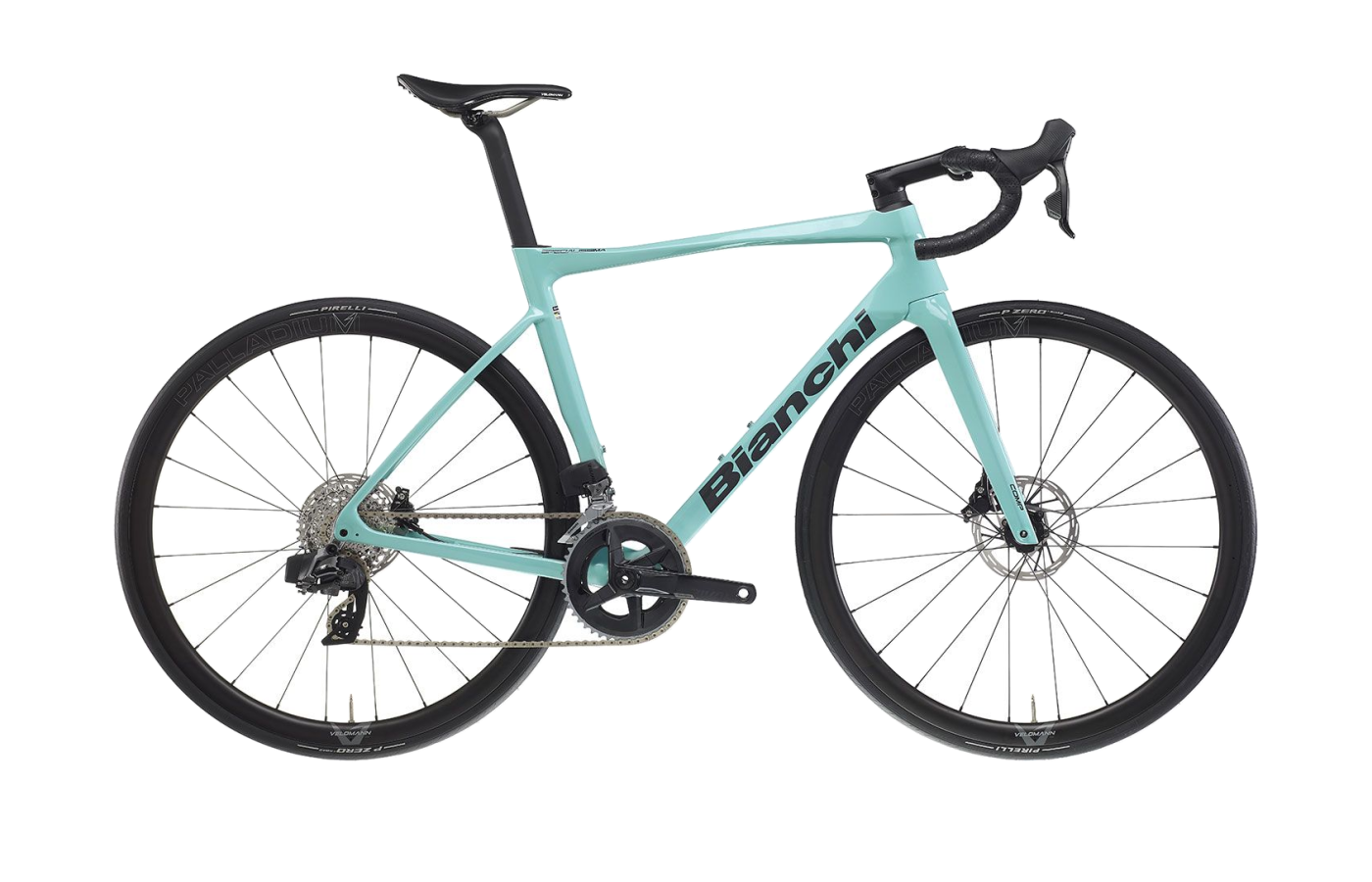
Bianchi's pure climber — same Italian race heritage as the Oltre, but optimized for steep gradients instead of wind-tunnel watts. The bike to buy if your weekend means mountains, not crit corners.
Compare →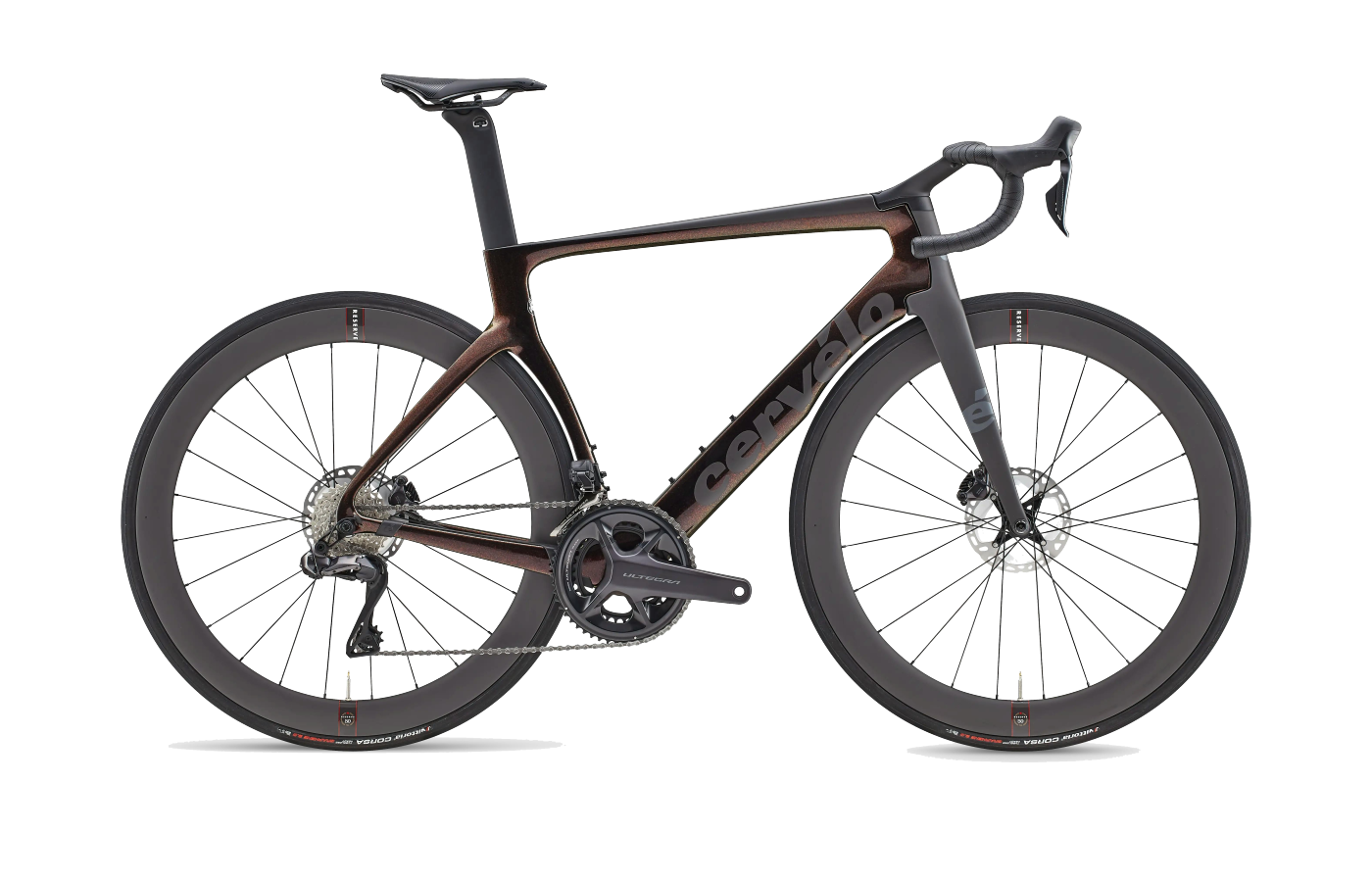
S5
The Oltre's most direct aero rival — same V-stem philosophy, more proven WorldTour wins, and a better-executed integrated cockpit if you value serviceability.
Compare →
Garda
Another Italian all-rounder that splits the difference between aero touches and endurance compliance — the closer cross-shop to the Sprint than to the Oltre.
Compare →