Canyon SendervsTrek Session
Does the pursuit of the fastest lap time require a stiff carbon scalpel or a compliant aluminum sledgehammer? The Canyon Sender and Trek Session both recently committed to high-pivot suspension layouts, but they offer fundamentally different answers to that question. One relies on carbon precision and aggressive kinematics, while the other bets on the "calm" ride feel of metal and extreme geometry adjustability.

Overview
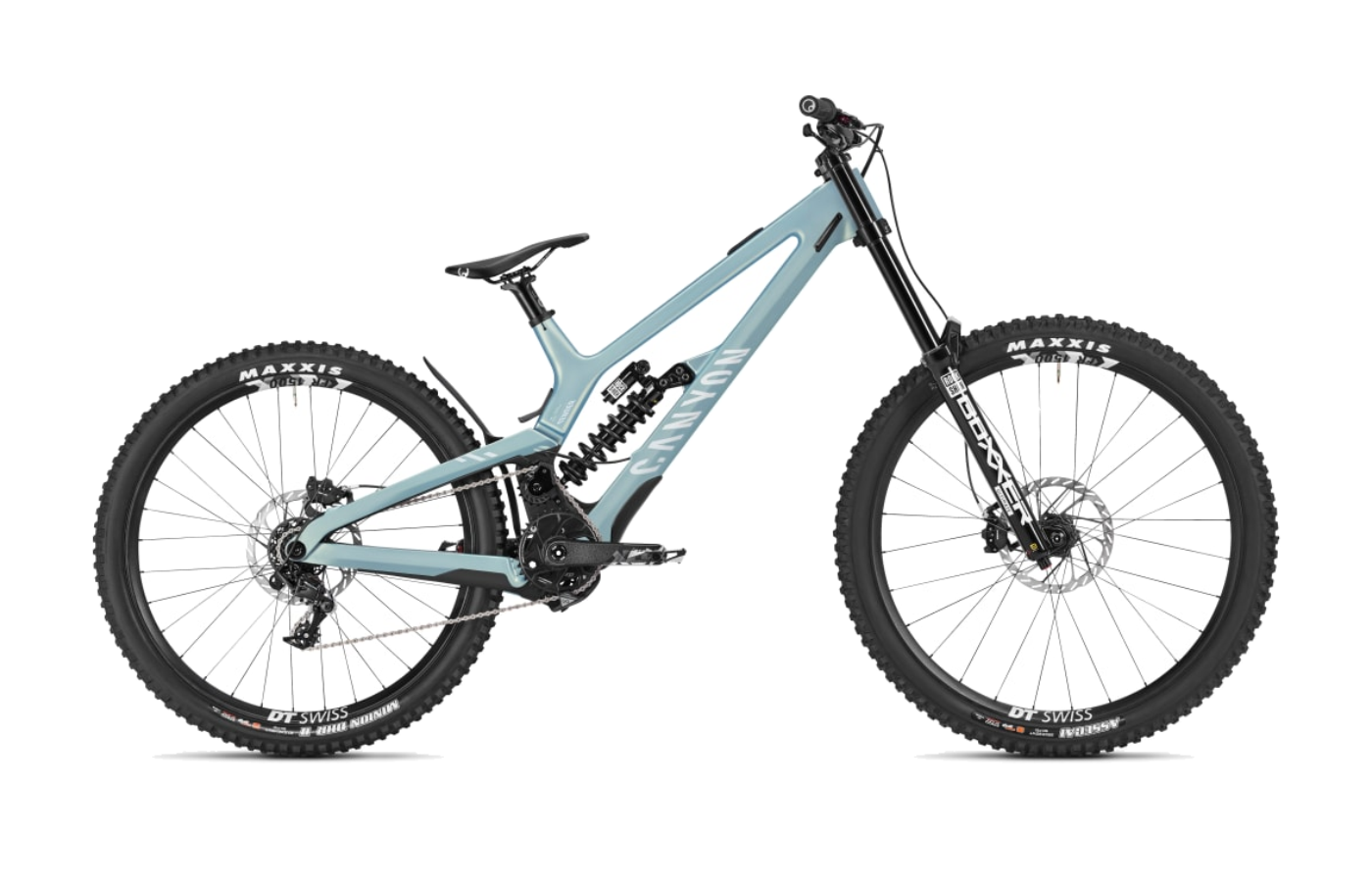
These two bikes are high-pivot downhill machines with a single purpose: devouring rough terrain at World Cup speeds. However, their design philosophies are diametrically opposed. Canyon engineered the Sender Gen 3 as an uncompromising carbon race tool, focusing on a massive 17.5mm rearward axle path to maintain forward momentum through square-edged hits. Trek took a sharp turn with the latest Session, ditching carbon for an Alpha Platinum Aluminum frame because their factory racers found the metal prototype "calmer" and more predictable when loading into corners. While the Canyon is a dedicated mullet (29-inch front, 27.5-inch rear) built for agility and speed, the Trek Session is a chameleon. It ships as a full 29er but features enough flip-chips and headset adjustments to run as a mullet or even a full 27.5-inch setup. Canyon utilizes its direct-to-consumer model to offer a higher parts-per-dollar ratio, often providing full carbon frames and top-tier suspension for thousands less than the retail-distributed Trek. The Session counters with a massive dealer network and a "bomb-proof" reputation that prioritizes surviving a season of bike park abuse over shaving every possible gram.
Ride and handling
The Session is famously muted. Reviews describe it as a "cheat code" that makes violent chunder feel strangely stable, allowing the rider to stay centered through repetitive chop that would buck a pilot on a more traditional four-bar bike. Its high-pivot axle path moves the wheel 12–25mm rearward, meaning the bike effectively "speeds up" through square-edged obstacles. However, this stability comes at a cost in tight sections. As the wheelbase grows under compression, the 452mm chainstays (on the R3 size) can feel ponderous, making it an awkward effort to snap the rear end through slow-speed switchbacks. In contrast, the Canyon Sender is a "freight train" that demands an active riding style. It doesn't just mute the trail; it requires the rider to stay "on" and provide direction. The Sender's 438mm chainstays are the shortest in its class, which, combined with the smaller 27.5-inch rear wheel, gives it an agility that the Trek lacks in tight turns. But try to cruise passively and the Canyon will punish you; it is a precision tool that only comes alive when you push it to the limit. The suspension offers solid mid-stroke support that prevents the bike from wallowing, making it easier to pump for speed than the more isolated Trek. Braking performance also differentiates the two. The Sender uses a high anti-rise setup (124–130% at sag) that keeps the chassis level and active under heavy braking, allowing racers to wait until the very last second to shut down speed. The Trek's ABP (Active Braking Pivot) similarly keeps the suspension moving while you're on the binders, but reviewers noted a "skidding across the top" sensation with the stock G5 tires. If you want a bike that isolates you from the violence of the trail to save energy, the Trek is the winner. If you want a bike that translates rider input into instant, aggressive forward drive, the Canyon is the superior ally.
Specifications
The most consequential spec difference is at the rear brake. Trek inexplicably specs the Session with a 180mm rear rotor, a choice that reviewers found inadequate for a 37-pound bike designed for high-speed descents. It manages heat poorly, leading to inconsistent lever throw and faster pad wear. Canyon equips the CFR Team with powerful SRAM Maven Silver brakes and 200mm rotors at both ends, providing the stopping power a World Cup-level sled requires. Suspension packages also favor the Canyon at similar price points. The Sender CFR Team packs a full RockShox Ultimate suite, including the BoXXer Ultimate and the Vivid Coil DH, which offers a consistent, linear feel and excellent hydraulic bottom-out resistance. The Session 9 features a similar RockShox Ultimate package but moves to an air-sprung Super Deluxe Ultimate DH. While the air shock is easier to tune for different rider weights, several testers preferred the coil-like sensitivity of the Sender's high-pivot link. Drivetrains across both lines rely on SRAM's specialized 7-speed DH groups, though the Trek Session 8 uses the entry-level GX DH to hit a lower price floor. Trek’s in-house Bontrager Line DH 30 wheels receive high marks for their 108-point Rapid Drive hubs and impressive durability, but the Bontrager G5 tires are often criticized for their unpredictable transition to side knobs. The Sender's Maxxis Assegai/Minion DHR II combo is the gold standard for downhill traction and is ready to race out of the box without a tire swap.
| Sender | Session | |
|---|---|---|
| FRAMESET | ||
| Frame | Canyon Sender CFR (CFR carbon) | — |
| Fork | RockShox BoXXer Ultimate, 200mm travel, 20x110mm, 52mm offset, 1 1/8" steerer | — |
| Rear shock | RockShox Vivid COIL DH | — |
| GROUPSET | ||
| Shift levers | SRAM X01 DH | — |
| Front derailleur | — | — |
| Rear derailleur | SRAM X01 DH (medium cage) | — |
| Cassette | SRAM PG720, 7-speed, 11-25T | — |
| Chain | SRAM PC 1110 (listed as 11s) | — |
| Crankset | SRAM X01 DH, 1x | — |
| Bottom bracket | SRAM DUB BSA (BSA 83) | — |
| Front brake | SRAM Maven Silver Stealth, 4-piston hydraulic disc | — |
| Rear brake | SRAM Maven Silver Stealth, 4-piston hydraulic disc | — |
| WHEELSET | ||
| Front wheel | DT Swiss FR1500, 20x110mm, 6-bolt, 30mm internal, aluminium rim | — |
| Rear wheel | DT Swiss FR1500, 12x148mm, 6-bolt, 30mm internal, aluminium rim | — |
| Front tire | Maxxis Assegai MaxxGrip DH, 2.5" | — |
| Rear tire | Maxxis Minion DHR II, 2.4" | — |
| COCKPIT | ||
| Stem | Canyon G5, 45mm, 31.8mm clamp | — |
| Handlebars | Canyon G5 aluminium, 30mm rise | — |
| Saddle | Ergon SMD20 | — |
| Seatpost | Canyon G5 aluminium seatpost, 34.9mm | — |
| Grips/Tape | Ergon GDH Team | — |
Geometry and fit comparison
Canyon sizing is aggressive and runs long. A size Large Sender features a 495mm reach, but the headset cups allow for +/- 8mm of adjustment, meaning you can stretch it to a massive 503mm or pull it back to 487mm. This level of reach-tuning is a professional-grade feature the Trek doesn't match. Trek utilizes "reach-based sizing" (R1, R2, R3), where the R2 sits at 465mm and the R3 at 493mm. A rider who feels cramped on an R2 but stretched on an R3 has no middle ground, whereas the Canyon owner can dial in the perfect front-center. Handling numbers tell the story of two different stability goals. The Trek R3 in the low setting has a gargantuan 1,312mm wheelbase. Combined with a 63-degree head tube angle, this makes the Session one of the most stable platforms on the market for wide-open, high-speed tracks. The Canyon Large is slightly tighter at 1,303mm, primarily due to those short 438mm chainstays. This shorter rear end is why the Sender feels more "flickable" and responsive in the air and through berms. The Trek's Mino Link offers a high setting that raises the bottom bracket by 9mm and steepens the head angle to 63.6 degrees. This is essential for riders who want to run a mullet wheel setup on the Session without dragging their pedals through the rocks. Canyon lacks a geometry flip-chip for the head angle but provides a 5mm bottom bracket adjustment. The Canyon is more specialized; the Trek is more adaptable to different body types and wheel preferences.
| FIT GEO | Sender | Session | |
|---|---|---|---|
| Stack | 635 | — | — |
| Reach | 495 | — | — |
| Top tube | 630 | — | — |
| Headtube length | 110 | — | — |
| Standover height | 754 | — | — |
| Seat tube length | 420 | — | — |
| HANDLING | Sender | Session | |
|---|---|---|---|
| Headtube angle | 63 | — | — |
| Seat tube angle | 78 | — | — |
| BB height | — | — | — |
| BB drop | — | — | — |
| Trail | — | — | — |
| Offset | — | — | — |
| Front center | — | — | — |
| Wheelbase | 1303 | — | — |
| Chainstay length | 438 | — | — |
Who each one is for
Canyon Sender
The Sender is for the privateer racer who spends their weekends staring at a GoPro trying to find two-tenths of a second. It is a stiff, demanding machine that rewards strength and high-speed commitment. If your local tracks are filled with momentum-killing holes and technical roots where a rearward axle path can literally pull you forward, the Canyon is your best tool for the podium.
Trek Session
The Session is for the rider who values a "quiet" ride and wants to minimize fatigue during a long day of lift-serviced laps. If you find carbon frames too harsh or chatter-heavy, the aluminum Session offers a compliant, planted alternative. It is also the ideal choice for the tinkerer who wants one frame that can transition from a full 29er race bike to a mullet-wheeled park bike with a few simple chip flips.