Kona Big HonzovsHonzo
Looking for a hardcore hardtail that won't break the bank? Kona's Honzo and Big Honzo lines have long been stalwarts in this category, but these two models cater to distinct preferences. One leans into the plush, grippy world of plus-size tires, offering surprising compliance. The other is a sharper, more aggressive 29er, ready to push the limits of what a hardtail can do, often at the expense of comfort.

Overview
The Kona Big Honzo, established in its 2019 iteration, carved out a niche as a versatile aggressive hardtail, largely defined by its 27.5 x 2.8-inch plus-size tires. This setup aimed to bridge the gap between hardtail simplicity and full-suspension comfort, making it a compelling choice for riders seeking enhanced traction and damping without the complexity of a rear shock. Reviewers often lauded its ability to feel like a much bigger travel bike, delivering a ride that was both fun and stable across varied terrain. In contrast, the Kona Honzo line, particularly the 2021 generation and its aggressive ESD build, doubles down on performance with 29-inch wheels and more progressive geometry. While the base Honzo models offer a capable aluminum platform, the ESD pushes into truly aggressive territory with a chromoly steel frame, longer travel forks, and burly components. This bike is less about plushness and more about precise handling and stability when things get rowdy, demanding an assertive riding style. Where the Big Honzo softened the blows with high-volume rubber, the Honzo often transmits more trail feedback, especially in its aluminum variants. The core distinction between these two models comes down to their wheel and tire philosophy and the resulting ride feel. The Big Honzo is the forgiving, traction-rich option that smooths out the trail, making it approachable for a wider range of riders or those transitioning from full suspension. The Honzo, particularly the ESD, is a sharper instrument, designed for riders who embrace the directness of a hardtail and want to exploit its agility and stability on challenging descents and technical singletrack. It's a bike that rewards skill and physical input, a veritable dirt jumper in a trail package, while the Big Honzo offers a more cushioned, confidence-inspiring experience.
Ride and handling
The ride quality dramatically separates these two hardtails. The Big Honzo, with its 27.5 x 2.8-inch plus-size tires, truly delivers a 'bigger travel bike' feel, according to reviewers. This high-volume rubber absorbs a lot of trail chatter, giving it 'traction for days' and an 'extra suspension damping' effect that significantly boosts comfort and confidence. It feels 'fun and lively, yet stable and confident in any situation,' making it a surprisingly forgiving hardtail that can even make some riders question the need for full suspension. Conversely, the aluminum Kona Honzo models, while undeniably 'playful, lively, and snappy,' are also 'notably stiff,' resulting in a ride that can be 'harsh' and 'bouncy' on rough terrain. Reviewers didn't mince words, calling it 'way stiffer than a Chameleon' and comparing its compliance to 'the Carbon Chameleon in a bad way.' This rigid rear end means riders, especially those under 180 lbs, will feel 'a lot of vibrations to my hands, ankles, hips, and knees,' leading to fatigue on long, chunky rides. The steel Honzo ESD, however, offers a more 'compliant and supple' ride than its aluminum siblings, mitigating some of this harshness. Handling characteristics also diverge based on their core geometries and wheel sizes. The Big Honzo, with its 67.5-degree head tube angle and 430mm chainstays, provides a balanced feel, offering 'quick direction changes' and an 'engaging feel through turns.' The plus tires enhance grip in corners, adding to its stable disposition. The Honzo ESD, by comparison, features a slacker 66.5-degree head tube angle and shorter 425mm chainstays (on a size L), creating a much more aggressive descending posture. It's a 'speed demon on tight and twisty singletrack,' zipping around corners with ease and feeling 'stable at higher speeds.' While the Big Honzo excels as a versatile all-rounder, the Honzo ESD rewards an assertive, active riding style, coming alive when pumped and pushed, though it can feel 'lazy and unresponsive' if ridden passively. Its shorter chainstays make manuals and bunny hops easier, cementing its playful, dirt-jump-ready character.
Specifications
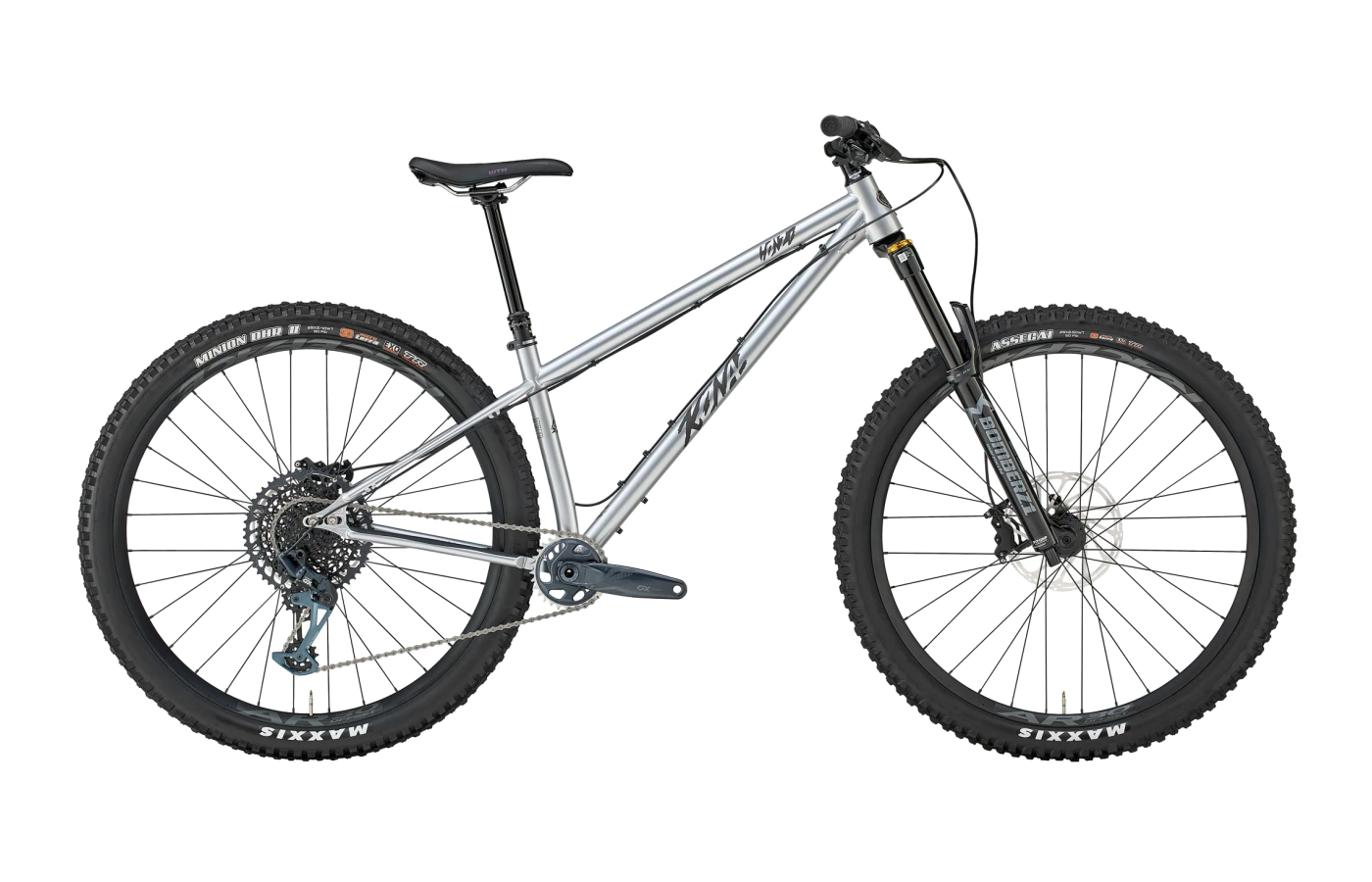
The component choices across these two models underscore their differing intentions, especially when comparing the Big Honzo 'Standard' build to the Honzo 'ESD 36SR' selected build. The Big Honzo 'Standard' comes equipped with a RockShox Recon RL Solo Air 130mm fork, a SRAM SX Eagle 12-speed drivetrain, and Shimano MT401 disc brakes with 180/160mm rotors. While reviewers found the SX Eagle surprisingly capable for its price, the MT401 brakes, with their 'resin pad only' rotors, were consistently flagged as underpowered, lacking the bite and modulation needed for aggressive riding. Moving to the Honzo ESD 36SR, the spec sheet takes a significant leap towards gravity-oriented performance. The Marzocchi Bomber Z1 fork with 150mm of travel is a major upgrade in stiffness and damping over the Big Honzo's Recon, offering superior performance on demanding trails. The SRAM GX Eagle 12-speed drivetrain provides a wider 10-52T cassette and improved shifting precision. Most strikingly, the Honzo ESD sports powerful SRAM DB8 hydraulic disc brakes with massive 200mm rotors front and rear, delivering far superior stopping power and modulation compared to the Big Honzo's basic Shimano stoppers. Even the base Honzo (2021) and Honzo DL (2021) with 120mm/140mm RockShox Recon/Revelation forks and Shimano Deore 11/12-speed drivetrains represent a distinct step up in intended trail aggression compared to the Big Honzo. The wheel and tire setup is arguably the most impactful spec difference. The Big Honzo rolls on 27.5-inch rims with plush 2.8-inch WTB Ranger plus-size tires, prioritizing cushioning and traction. The Honzo ESD, on the other hand, runs 29-inch Race Face AR 30 rims shod with highly aggressive Maxxis Assegai 2.5 WT and Minion DHR II 2.4 WT tires. These tires offer excellent grip for hard-charging, but their inherent damping is less than the higher-volume plus tires. Furthermore, the Big Honzo is an aluminum frame, while the Honzo ESD is a chromoly steel frame, contributing to different compliance characteristics. The aluminum Honzo (Base, DL) remains a stiff platform.
| Honzo | Honzo | |
|---|---|---|
| FRAMESET | ||
| Frame | — | Kona 6061 Aluminum Butted |
| Fork | — | RockShox Recon RL Solo Air, 130mm, tapered steerer, 110mm spacing (Boost) |
| Rear shock | — | — |
| GROUPSET | ||
| Shift levers | — | Shimano Deore, 11-speed |
| Front derailleur | — | — |
| Rear derailleur | — | Shimano Deore, 11-speed |
| Cassette | — | Shimano Deore, 11-speed, 11-51T |
| Chain | — | KMC X11 |
| Crankset | — | Shimano Deore crankarms, 30T chainring |
| Bottom bracket | — | Shimano Deore, 73mm |
| Front brake | — | Shimano MT410 hydraulic disc |
| Rear brake | — | Shimano MT410 hydraulic disc |
| WHEELSET | ||
| Front wheel | — | WTB ST i30 TCS; Shimano 110x15mm (Center Lock); Stainless black 14g |
| Rear wheel | — | WTB ST i30 TCS; Shimano 148x12mm (Center Lock); Stainless black 14g |
| Front tire | — | Vee Tire Flow Snap Tackee TR 29x2.35 |
| Rear tire | — | Vee Tire Crown Gem DCC TR 29x2.3 |
| COCKPIT | ||
| Stem | — | Kona XC/BC 35 |
| Handlebars | — | Kona XC/BC 35 |
| Saddle | — | Kona Trail |
| Seatpost | — | TranzX Dropper +RAD, internal routing, 31.6mm, with Shimano lever |
| Grips/Tape | — | Kona Key Grip |
Geometry and fit comparison
Understanding the geometry of these two Konas reveals their distinct performance profiles, though detailed comparative numbers are limited as Bike A's data comes primarily from review observations. Based on reviewer comments for a size Large 2020 Kona Big Honzo, it features a 475mm reach, a 67.5-degree head tube angle, a 75-degree seat tube angle, and 430mm chainstays. For a size Large Kona Honzo ESD, we see a 480mm reach, a slacker 66.5-degree head tube angle, a similar 75-degree seat tube angle, and slightly shorter 425mm chainstays, along with a 1205mm wheelbase and 60mm BB drop. The Honzo ESD's longer reach (480mm vs. 475mm) combined with its slacker head tube angle (66.5 degrees vs. 67.5 degrees) immediately points to a more stable, gravity-oriented ride. This slacker front end places the wheel further out, increasing confidence on steep descents and at high speeds, making it less prone to over-the-bars sensations. While both bikes share a steep 75-degree seat tube angle, positioning the rider efficiently for climbing, the Honzo ESD's overall longer wheelbase (1205mm for the L) further enhances its stability in rough terrain. Conversely, the Big Honzo's slightly steeper head tube angle contributes to quicker steering input, which, combined with its 27.5+ wheels, makes it feel more nimble and playful on less demanding trails. The Big Honzo's 430mm chainstays are slightly longer than the Honzo ESD's 425mm. While both are considered short for hardtails and contribute to a fun, poppy feel, the Honzo ESD's marginally shorter rear end, paired with its 29-inch wheels, further emphasizes its agility for manuals and bunny hops. This makes the Honzo ESD a bike that thrives on being thrown around and ridden actively, whereas the Big Honzo offers a more forgiving and balanced feel for diverse trail conditions. For riders, these geometry differences translate into distinct experiences. The Big Honzo, with its 27.5+ wheels and slightly steeper head angle, suits those looking for a confidence-inspiring hardtail with a forgiving ride that excels across a variety of trail types without feeling overly aggressive. It's a great choice for riders who want comfort and traction. The Honzo ESD, however, is for the hard charger who wants to push the limits of a hardtail, preferring outright stability on steep terrain and a highly responsive, playful rear end. Its geometry appeals to experienced riders who value a direct, assertive connection with the trail and don't shy away from challenging descents, often at the cost of some compliance.
| FIT GEO | Honzo | Honzo | |
|---|---|---|---|
| Stack | — | 655 | — |
| Reach | — | 480 | — |
| Top tube | — | 638 | — |
| Headtube length | — | 120 | — |
| Standover height | — | 728 | — |
| Seat tube length | — | 450 | — |
| HANDLING | Honzo | Honzo | |
|---|---|---|---|
| Headtube angle | — | 66.5 | — |
| Seat tube angle | — | 75 | — |
| BB height | — | 315 | — |
| BB drop | — | 60 | — |
| Trail | — | — | — |
| Offset | — | 42 | — |
| Front center | — | 787 | — |
| Wheelbase | — | 1205 | — |
| Chainstay length | — | 425 | — |
Who each one is for
Kona Big Honzo
The Kona Big Honzo is an excellent choice for the rider looking to bridge the gap between hardtail simplicity and full-suspension capability. If you often find yourself on technical trails with roots and rocks, but you also enjoy long, sustained climbs, the Big Honzo's plus-size tires and forgiving nature will shine. It's for someone who wants to feel confident descending without the harshness often associated with aluminum hardtails, appreciating the 'traction for days' and the 'bigger travel bike' feel that the 2.8-inch tires provide. This rider might be questioning the need for a full suspension, or simply wants a comfortable, versatile bike for exploring a wide range of trails without breaking the bank.
Kona Honzo
The Kona Honzo, particularly the ESD model, caters to the aggressive hardtail enthusiast who loves to push the limits on challenging terrain. If you're an experienced rider who finds satisfaction in actively riding through chunky descents, hitting dirt jumps, and shredding tight singletrack, this bike will reward your efforts. Its slack head tube angle and short chainstays make it ideal for those who want a 'playful, lively' bike that's 'easy to throw around,' manual, and bunny hop. Heavier riders might appreciate the inherent stiffness of the aluminum models for a 'less noodley' feel, while those opting for the steel ESD prioritize a slightly more supple ride without sacrificing an aggressive geometry ready to 'get away with a ton of poor decision making.'