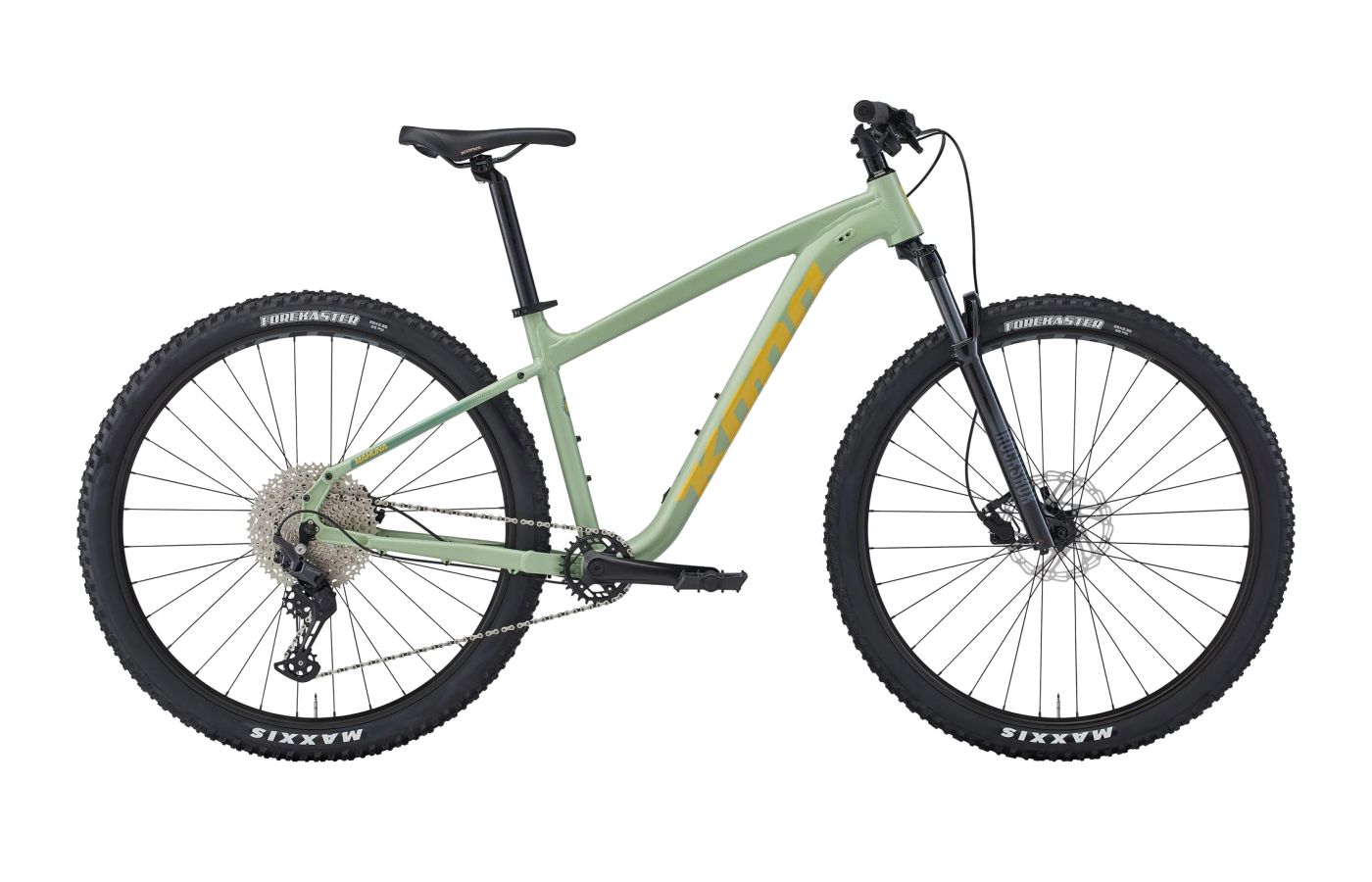
Kona MahunavsTrek Roscoe
Trek's Gen 4 Roscoe enters the scene with a Fox Rhythm 36 fork and 150mm of travel, a setup one reviewer called 'huge for this bike' and indicative of its 'hardcore hardtail' aspirations. By contrast, the Kona Mahuna, while lauded for its 'impressively smooth and naturally fast 29er' frame, consistently sees its 100mm fork 'struggle on tech terrain,' underscoring a clear divergence in their design philosophies. This comparison highlights a stark difference in intent between these two trail hardtails: one built to confidently descend aggressive singletrack, the other to efficiently cruise cross-country routes.

Overview
The Kona Mahuna and Trek Roscoe Gen 4 carve out distinct niches within the trail hardtail market, primarily differentiated by their core intentions and price points. The Mahuna, often found in the sub-$1200 range, positions itself as an approachable, highly versatile XC/light trail option that emphasizes a smooth ride and all-around utility. It uses a butted 6061 aluminum frame, shared across Kona's hardtail line, suggesting a focus on proven design and value for general trail riding and even commuting, backed by a limited lifetime warranty. The Roscoe Gen 4, with its starting price around $2,400 for the Roscoe 8, aims for a more aggressive, 'hardcore hardtail' persona, leveraging Trek's high-end Alpha Platinum Aluminum to deliver a burly, overbuilt platform designed to excel on genuinely challenging trails.
Ride and handling
The fundamental ride character of these two bikes diverges significantly, largely shaped by their respective forks. The Kona Mahuna is widely praised for its exceptionally smooth and compliant 6061 aluminum frame, which reviewers often describe as having a 'cultured feel that could easily be mistaken for a decent steel frame.' This inherent frame quality, bolstered by notably long 450mm chainstays, allows the Mahuna to 'smooth and glide over chatter and chunk,' making it a comfortable and less fatiguing ride on less aggressive terrain or long XC excursions. Its 100mm RockShox Judy Silver TK fork performs 'supple and acceptably controlled' on tamer trails, effectively taking the edge off. However, when the terrain becomes more demanding, the Mahuna's front end quickly shows its limitations. Reviewers consistently note the Judy's 'short, twisty' nature, with 30mm stanchions and a QR axle contributing to noticeable flex and a 'nervous' front-end feel during aggressive turning or heavy braking. One reviewer stated the bike felt like it was 'gagging for a 120mm fork' with a through-axle to unlock its full potential, as the front 'just can't keep up with what the rest of the bike is promising to deliver.' This contrasts sharply with the Trek Roscoe Gen 4's approach, where a 150mm Fox Rhythm 36 fork, with its stout 36mm stanchions, delivers a stiff and precise front end that 'absorbs significant trail chatter' and resists flex under heavy loads, providing a confidence-inspiring feel on rough trails. The Roscoe's handling is further defined by its modern, aggressive geometry, featuring a slack 65-degree head tube angle, which translates to exceptional stability at speed and on steep descents. The inclusion of a 200mm TransX dropper post allows riders an 'unprecedented range of motion,' letting them 'really get wild' and maneuver the bike more freely. The Roscoe's Bontrager Rapid Drive hub, with 108 points of engagement, provides nearly instantaneous power transfer, which is crucial for precise handling and quick bursts of speed in technical sections. This is a stark contrast to the Mahuna's more basic hubs and the noticeable flex from its square-taper bottom bracket, which detracts from its responsiveness under hard pedaling. While the Mahuna's handling is described by some as 'naturally quick and responsive' and even 'tight and almost a little nervy' in tight stuff, its inherent stability from the long chainstays still makes it 'surefooted' on less technical trails. Its Maxxis Forekaster tires are praised for fast-rolling and versatile grip. However, the 'numb' feel of the Mahuna's Tektro brakes further limits descending confidence compared to the Roscoe's 'insane' stopping power from its Shimano Deore 4-piston brakes and massive 203mm front rotor. Overall, the Mahuna prioritizes comfortable, efficient cruising, while the Roscoe is engineered for aggressive, confident trail attack.
Specifications
The most significant divergence in specifications between the Kona Mahuna and Trek Roscoe Gen 4 is evident in their front suspension and braking systems. The Roscoe 8 comes equipped with a formidable Fox Rhythm 36 fork offering 150mm of travel and stiff 36mm stanchions, a premium component that vastly elevates its trail capability. In stark contrast, all Mahuna builds feature a RockShox Judy Silver TK fork with a mere 100mm of travel, 30mm stanchions, and a quick-release (QR) axle, which reviewers universally identify as its primary performance bottleneck on challenging terrain. This difference alone points to radically different intended uses and confidence levels on descents. Drivetrain and braking also reveal substantial disparities. The Roscoe 8 uses a reliable Shimano Deore M6100 1x12 drivetrain with a 30-tooth chainring and a wide-range 10-51T cassette, providing extensive gearing for steep climbs and high-speed descents. Its stopping power is immense, courtesy of Shimano Deore 4-piston hydraulic disc brakes paired with a massive 203mm front rotor and 180mm rear rotor. The Mahuna, across its builds, runs an 11-speed Shimano Deore drivetrain (11-51T or 11-46T) with a 28-tooth chainring, which offers a decent range but is a step down in speed count. Crucially, its Alhonga HT472 or Shimano MT201 2-piston hydraulic brakes with 180mm/160mm rotors are described as 'numb' in feel, lacking the stopping confidence of the Roscoe. Furthermore, the Mahuna's 'skinny little square taper axle' bottom bracket is a significant detractor, adding flex and weight compared to the Roscoe's modern threaded bottom bracket. Wheelsets and tires further emphasize the performance gap. The Roscoe 8 boasts Bontrager Line TLR30 rims with a 30mm internal width, paired with a Bontrager Rapid Drive hub offering 108 points of engagement—a high-end feature for immediate power transfer—and aggressive 29x2.5-inch Bontrager Brevard Pro XR tubeless-ready tires. The Mahuna uses WTB ST i27 TCS 2.0 rims (27mm internal width) with more basic Formula/Shimano QR hubs and 29x2.35-inch Maxxis Forekaster tires, which are fast-rolling but less aggressive. The Roscoe's wheel and tire combo is clearly built for harder impacts and technical grip, while the Mahuna's is geared more towards efficiency and versatility. Beyond core components, the Roscoe excels with a 200mm TransX dropper post (on larger sizes), allowing the seat to 'essentially disappear,' a stark contrast to the Mahuna's fixed seatpost, which necessitates a stop-and-drop approach. The Roscoe also includes practical frame features like a bolt-on downtube guard and integrated frame bag mounts, offering greater utility and protection. While the Roscoe's stem and handlebars are noted as somewhat basic for its price, the overall package, despite a higher price tag, offers a significantly more capable and modern spec out of the box, whereas the Mahuna represents a solid frame with several clear upgrade paths for performance-minded riders.
| Mahuna | Roscoe | |
|---|---|---|
| FRAMESET | ||
| Frame | Kona 6061 Aluminum Butted | — |
| Fork | RockShox Judy Silver TK Solo Air, 100mm | — |
| Rear shock | — | — |
| GROUPSET | ||
| Shift levers | Shimano Deore 11-speed | — |
| Front derailleur | — | — |
| Rear derailleur | Shimano Deore 11-speed | — |
| Cassette | Shimano Deore 11-speed, 11-51T | — |
| Chain | KMC X11 | — |
| Crankset | Samox 11spd crankarms, 28T chainring | — |
| Bottom bracket | Feimin square taper, 73mm threaded | — |
| Front brake | Alhonga HT472 hydraulic disc (caliper/lever) | — |
| Rear brake | Alhonga HT472 hydraulic disc (caliper/lever) | — |
| WHEELSET | ||
| Front wheel | WTB ST i27 TCS 2.0; Formula 100x9mm; Stainless Black 14g | — |
| Rear wheel | WTB ST i27 TCS 2.0; Formula 135x10mm; Stainless Black 14g | — |
| Front tire | Maxxis Forekaster 29x2.35 | — |
| Rear tire | Maxxis Forekaster 29x2.35 | — |
| COCKPIT | ||
| Stem | Kona XC | — |
| Handlebars | Kona XC/BC Riser | — |
| Saddle | Kona XC | — |
| Seatpost | Kona Thumb, 31.6mm | — |
| Grips/Tape | Kona Key Grip Slip On | — |
Geometry and fit comparison
Comparing the geometry of the Kona Mahuna to the Trek Roscoe Gen 4 is limited by the absence of comprehensive geometry data for the Roscoe's Gen 4 models. However, the available review insights and specific numbers for the Mahuna (size Large: 465mm reach, 620mm stack, 75.0-degree seat tube angle) paint a clear picture of their differing philosophies. The Mahuna’s geometry, with a reported head tube angle of 68 degrees (though MBR suggests 66.5 degrees), is on the steeper side for a trail hardtail. This generally translates to quicker, more responsive steering but can feel 'nervous' on steep or fast descents, especially when combined with its 100mm fork. Its 450mm chainstays, consistently long across all sizes, contribute to a stable and 'cultured' ride, giving it a balanced weight distribution that aids climbing and general control, but potentially at the expense of agility in very tight switchbacks. The 75-degree seat tube angle is quite steep, positioning the rider effectively over the pedals for efficient seated climbing, making it well-suited for covering ground. Conversely, the Trek Roscoe Gen 4 is definitively a more aggressive machine. While full numbers are not available, reviews consistently cite a slack 65-degree head tube angle and a 76-degree seat tube angle. The 65-degree head angle is significantly slacker than the Mahuna's, resulting in much greater stability and confidence on high-speed descents and through rough terrain. Paired with a 150mm fork, this allows the Roscoe to charge down lines where the Mahuna would feel overwhelmed. A reported reach of 470mm for a size large on the Roscoe means a slightly longer cockpit than the Mahuna (465mm), offering more room for dynamic body movements during aggressive riding. The Mahuna's sizing has a notable jump between large (465mm reach, 470mm seat tube) and extra-large (500mm reach, 530mm seat tube), suggesting a potential 'missing size' for riders who want a bit more reach than the large but don't need the extreme length of the XL. This means riders at the cusp might find themselves between sizes, compromising on fit. The Roscoe's frame, by allowing for a massive 200mm dropper post, ensures that riders can achieve a truly unhindered descending position regardless of their leg length relative to the frame size, a significant practical advantage for aggressive riding. In essence, the Mahuna's geometry prioritizes a balanced, comfortable XC-oriented ride, while the Roscoe is built around the modern aggressive trail ethos of stability, control, and descending prowess.
| FIT GEO | Mahuna | Roscoe | |
|---|---|---|---|
| Stack | 620 | — | — |
| Reach | 465 | — | — |
| Top tube | 631 | — | — |
| Headtube length | 115 | — | — |
| Standover height | 738 | — | — |
| Seat tube length | 470 | — | — |
| HANDLING | Mahuna | Roscoe | |
|---|---|---|---|
| Headtube angle | 68 | — | — |
| Seat tube angle | 75 | — | — |
| BB height | 315 | — | — |
| BB drop | 60 | — | — |
| Trail | — | — | — |
| Offset | 51 | — | — |
| Front center | 749 | — | — |
| Wheelbase | 1195 | — | — |
| Chainstay length | 450 | — | — |
Who each one is for
Kona Mahuna
The Kona Mahuna is an ideal choice for the rider who prioritizes a smooth, comfortable experience on their local green and blue-grade singletrack, fire roads, and gravel paths. If you enjoy longer rides where smoothing out trail chatter and maintaining a consistent, efficient pace are key, this bike delivers with its standout frame compliance. It's a fantastic option for new mountain bikers seeking a reliable, upgradeable platform to build their skills, or for seasoned riders looking for a versatile hardtail that can handle weekend XC adventures, light bikepacking, or even double as a rugged commuter during the week, thanks to its integrated rack and mudguard mounts. This bike excels on terrain where its 100mm fork is adequate and the emphasis is on pedaling enjoyment rather than gravity-defying maneuvers.
Trek Roscoe
The Trek Roscoe Gen 4 is tailored for the aggressive trail rider who seeks to push their limits on technical and demanding singletrack, without the added complexity or cost of a full-suspension rig. This bike is for someone who frequently tackles steep, rooty, or rocky descents, enjoys jumps and drops, and values a robust, confidence-inspiring front end. If you're a hardtail enthusiast who wants to ride aggressively on terrain typically reserved for short-travel full-suspension bikes, appreciating features like a 150mm Fox 36 fork, 4-piston brakes, and a high-engagement hub for precise control and immediate power. It's also a great fit for riders who want an 'overbuilt' platform with modern geometry that encourages playful, dynamic riding on challenging enduro-style trails, making the most of every descent.