Pine Mountain
vsSan Quentin
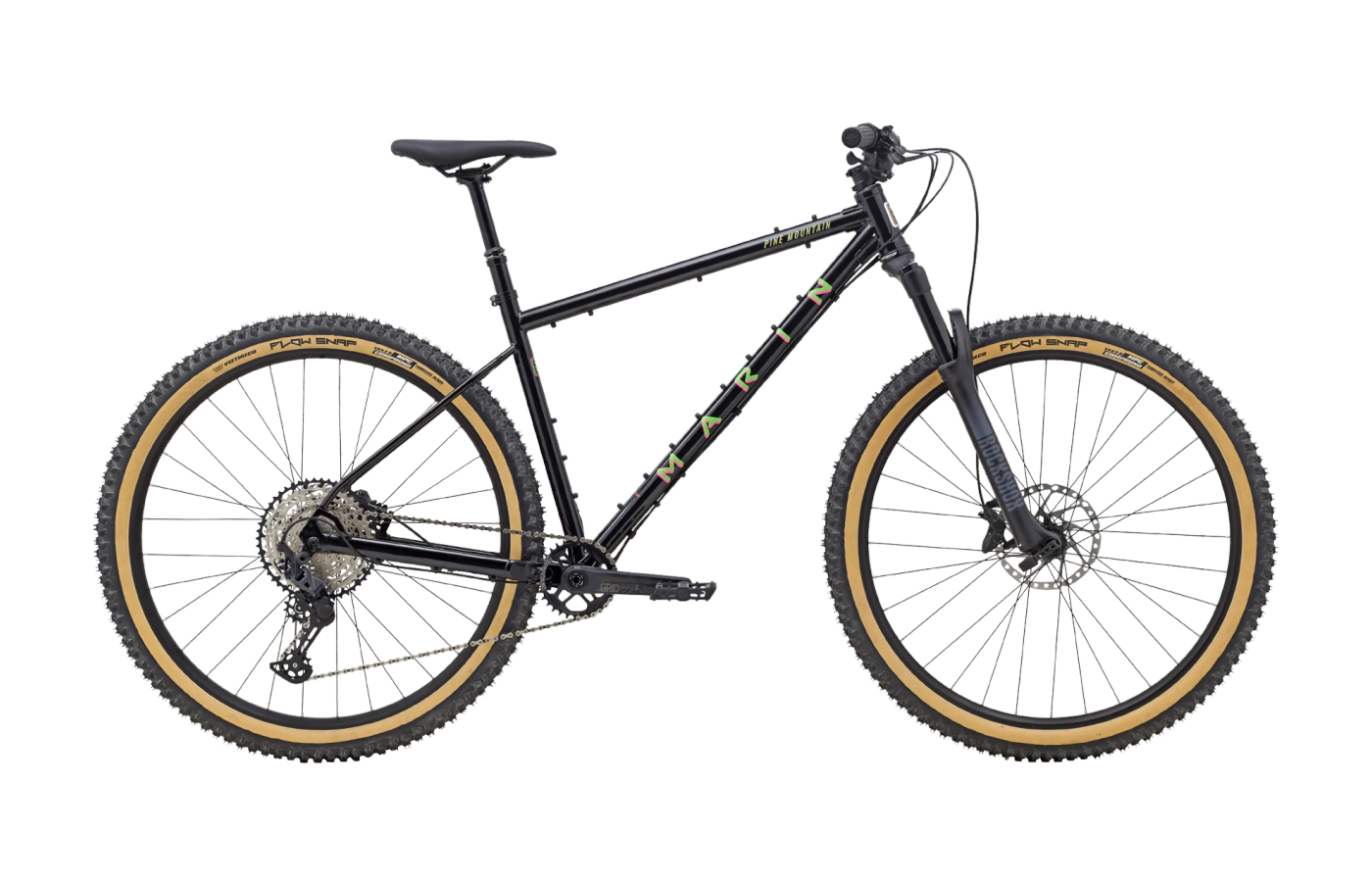
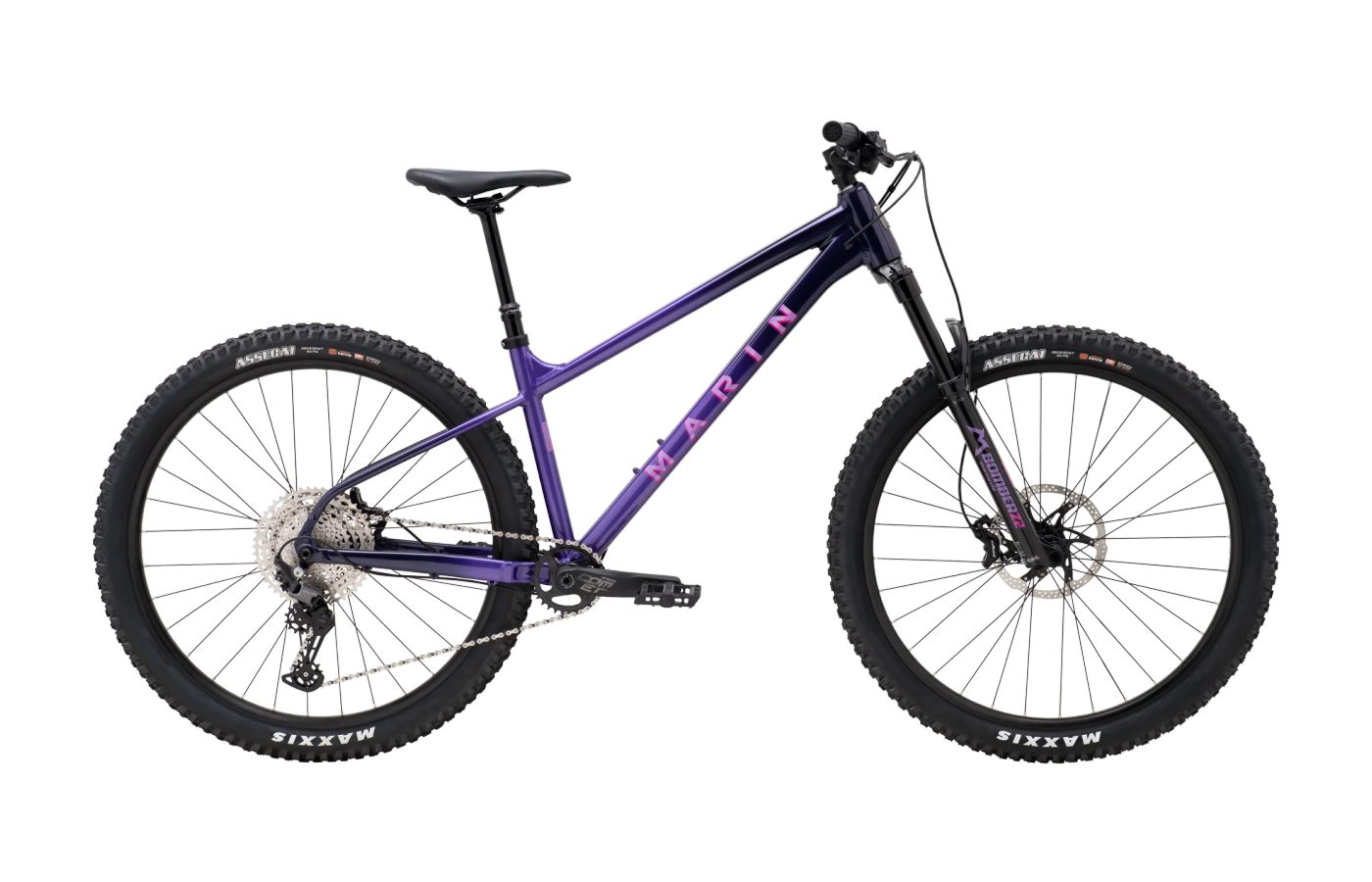
Two Marin hardtails, two very different missions.
The Pine Mountain is a steel do-it-all built around comfort. The San Quentin is an aggressive aluminum shredder with dirt-jump DNA.
Pine Mountain
- Steel-frame compliance — reviewers single out the ride as notably less harsh than aluminum hardtails in the same price bracket.
- Massive 66 mm tire clearance — makes it a credible bikepacking and mixed-surface rig, not just a trail bike.
- Modern 65-degree HTA on a budget steel frame — stable enough for real descending, not a touring relic.
- Heavier than aluminum alternatives — around 36 lb stock, per long-term review.
- 120 mm fork and 65-degree HTA are conservative if you mostly ride steep, aggressive trails.
San Quentin
- 140 mm Marzocchi Z2 fork on the SQ3 — a genuinely capable air fork that punches above the price tag.
- Aggressive 64-degree HTA and 425 mm chainstays — playful, jumpable, and stable on steep descents.
- Stock Maxxis Assegai tires — enough grip to push the bike on technical terrain right out of the box.
- Aluminum frame rides firmer than the Pine Mountain's steel — less forgiving on long days.
- Aggressive Assegai tires are draggy on flat ground; not the bike for fire-road miles.
Editor’s analysis
Same brand, same hardtail category — but one is built to absorb long days, and the other is built to send the next drop.
Both bikes are Marin's take on a sub-$2,500 trail hardtail, and both pull it off well. But the geometry, frame material, and stock parts split them into genuinely different tools. The Pine Mountain is a Series 3 double-butted CrMo steel frame with 120 mm of front travel and a 65 degree head angle. The San Quentin is a Series 3 6061 aluminum frame with 140 mm of fork and a slacker 64 degree head angle. That extra 20 mm of travel and one degree of slack add up to a much more descent-biased character.
The Marin Pine Mountain leans into compliance. Reviewers consistently flag the steel frame as feeling notably less harsh than aluminum hardtails at this price — one tester said it doesn't feel like "it's beating the crap out of me" even after coming off a full-suspension bike. The 76.5 degree seat tube angle and shorter 605 mm top tube on the M put you upright over the cranks, which works for technical climbs and long mixed-surface days. Tire clearance up to 66 mm (29x2.6) means the same frame swallows bikepacking loads and chunky trail tires with room to spare.
The Marin San Quentin trades that compliance for pop. The 77 degree seat tube, low-slung top tube, and 425 mm chainstays — 7 mm shorter than the Pine Mountain — give it the manual-happy, jump-happy feel reviewers describe as "dirt jumper DNA." The Marzocchi Bomber Z2 fork on the SQ3 is a real step up in damping over the RockShox 35 Gold on the Pine Mountain 2, and stock Maxxis Assegai 2.5" tires are grippy enough to push hard on technical descents — at the cost of rolling speed on flat ground.
Put another way: the Pine Mountain is the bike you buy when one bike has to do everything from a Sunday gravel loop to your local singletrack. The San Quentin is the bike you buy when you already have a commuter and you want a hardtail that punches above its weight at the bike park.
Where the builds differ.
Comparing our editor's-pick builds side-by-side. Winners highlighted row-by-row — lower price and weight, and the better-spec component, each mark a point.
Build variants & pricing
Both lineups stay under $2,500. The Pine Mountain is two builds; the San Quentin is three, including a sub-$1,100 entry point.
Prices are current US MSRP. The San Quentin 1 at $1,049 is the cheapest way into either platform — but reviewers warn that its SR Suntour XCM34 fork, MicroShift 9-speed drivetrain, and square-taper cranks will frustrate riders who push hard.
How they fit, how they steer.
Both at size M — the fit-picked size for a 5'8" rider on each bike. The San Quentin sits 23 mm lower at the stack with identical 450 mm reach, runs a 1-degree slacker head angle, and pulls the chainstays in 7 mm. Same rider, very different cockpit.
Which size should I buy?
Size recommendations based on stack, reach, and effective top tube. Both ranges overlap closely from S through L; the Pine Mountain L extends further at the tall end.
→These are starting points. Flexibility, riding style, and preferred position all shift the answer — if you’re between sizes, a professional fit beats a chart.
What the magazines said.
Published reviews from trusted cycling outlets. Click through for the full write-up.
Which one should you buy?
If you want one bike for trail, gravel, and the occasional bikepacking trip, get the Pine Mountain. If you want a hardtail built for descents and jumps, get the San Quentin.
Pine Mountain
If you want a single hardtail that handles trail riding, mixed-surface days, and bikepacking without beating you up, the steel Pine Mountain is hard to beat at the price. The frame compliance and 66 mm tire clearance give it a range nothing in the San Quentin lineup can match.
San Quentin
If your local trails are jump lines, rock gardens, and steep technical descents, the San Quentin is the sharper tool. The slacker head angle, longer-travel fork, and dirt-jump-inspired chassis reward an aggressive, playful style — and the SQ3 spec ships ready to ride hard out of the box.
Questions buyers actually ask.
Short answers to the things we get emailed about most often.
01Steel or aluminum — which actually rides better?
Different riders, different answers. Multiple reviewers describe the Pine Mountain's steel frame as notably more compliant than typical aluminum hardtails at the price — one said it doesn't feel like "it's beating the crap out of me" even after coming off a full-suspension bike.
The San Quentin's aluminum frame also gets praise for being less harsh than expected — Marin uses thin seat stays and tube selection that reviewers compared favorably to much pricier hardtails. But it still rides firmer than the Pine Mountain. If you ride long distances or mixed surfaces, the steel matters. If you mostly ride aggressive trail, you'll barely notice.
02Which climbs better?
Both climb well for hardtails, in different ways. The Pine Mountain uses a 76.5-degree seat tube angle and gets praise for surprising technical climbing ability — one reviewer cleaned a steep, rocky climb every time on it that they only manage 50% of the time on other bikes.
The San Quentin's steeper 77-degree seat tube and short cockpit put you more directly over the cranks, which reviewers find efficient on steep grades. The trade-off: the slack 64-degree head angle can wander a bit on long fire-road climbs, and the stock Maxxis Assegai tires drag noticeably on flat ground.
03What's the maximum tire clearance?
Pine Mountain: 66 mm (about 2.6"), per Marin's spec. The frame ships with Vee Flow Snap 29x2.6" tires and has room to spare — comfortable for bikepacking loads and chunky trail rubber.
San Quentin 3: ships with Maxxis Assegai 29x2.5" tires. The frame is purpose-built around a 2.5-inch tire spec for aggressive trail use. Both run wide alloy rims (29 mm ID on the SQ3, 32 mm ID on the Pine Mountain 2).
04How much suspension travel do they have?
Both are hardtails, so all the travel is up front.
Pine Mountain 2: 120 mm RockShox 35 Gold RL with DebonAir spring and 44 mm offset.
San Quentin 3: 140 mm Marzocchi Bomber Z2, also air-sprung, with rebound and compression adjustment. Reviewers praised the Z2 as feeling great and "appropriate for this bike" — it's the more capable fork of the two.
05Which is better for someone new to mountain biking?
It depends on what you want to ride. The Pine Mountain is the safer first bike for someone whose riding looks more like "trails plus gravel plus the occasional bikepacking weekend" — it's forgiving, comfortable, and the steel compliance reduces fatigue while you build skills.
The San Quentin is built for riders who already know they want to learn manuals, jumps, and aggressive descending. The frame rewards skill development, and the SQ3 spec is good enough to grow into. Newer riders on a tight budget should be cautious about the SQ1 — reviewers flagged the fork, drivetrain, and cranks as components likely to need upgrading.
06Which is heavier?
Both are on the heavier side for hardtails, which is normal at this price. The Pine Mountain 1 weighed in around 36 lb (16.3 kg) with pedals in one long-term review — the steel frame and budget components add up. The San Quentin 3 comes in around 31.9 lb (14.4 kg) for a size L per published reviews — lighter, but with much grippier and draggier tires that affect how the bike feels under power.
07Do either of them come with a dropper post?
Neither the Pine Mountain 2 nor the San Quentin 3 ships with a dropper post as listed in their stock build sheets. Reviewers consistently call out the lack of a dropper as the most-cited upgrade for both — the Pine Mountain's straight seat tube reportedly accepts up to 150 mm of dropper travel, and the San Quentin's short seat tube across the size range makes it dropper-friendly too. Budget around $150–$300 for a quality aftermarket unit.
08Are these bikes upgrade-friendly?
Yes — both have modern frame standards that don't lock you in. The Pine Mountain 2 runs a 148x12 mm Boost rear thru-axle and Boost front spacing, so any modern wheel or fork upgrade fits. (Note that the cheaper Pine Mountain 1 uses a 141 mm QR rear, which is harder to find aftermarket wheels for.)
The San Quentin 3 also runs 148x12 mm Boost front and rear with internal cable routing and ISCG mounts, making it well-suited for fork upgrades, dropper additions, and chain guides. Both frames are built to be lived with for years and upgraded over time.
Similar bikes
If your priorities don’t map cleanly onto either of these, one of these adjacent bikes probably fits better.
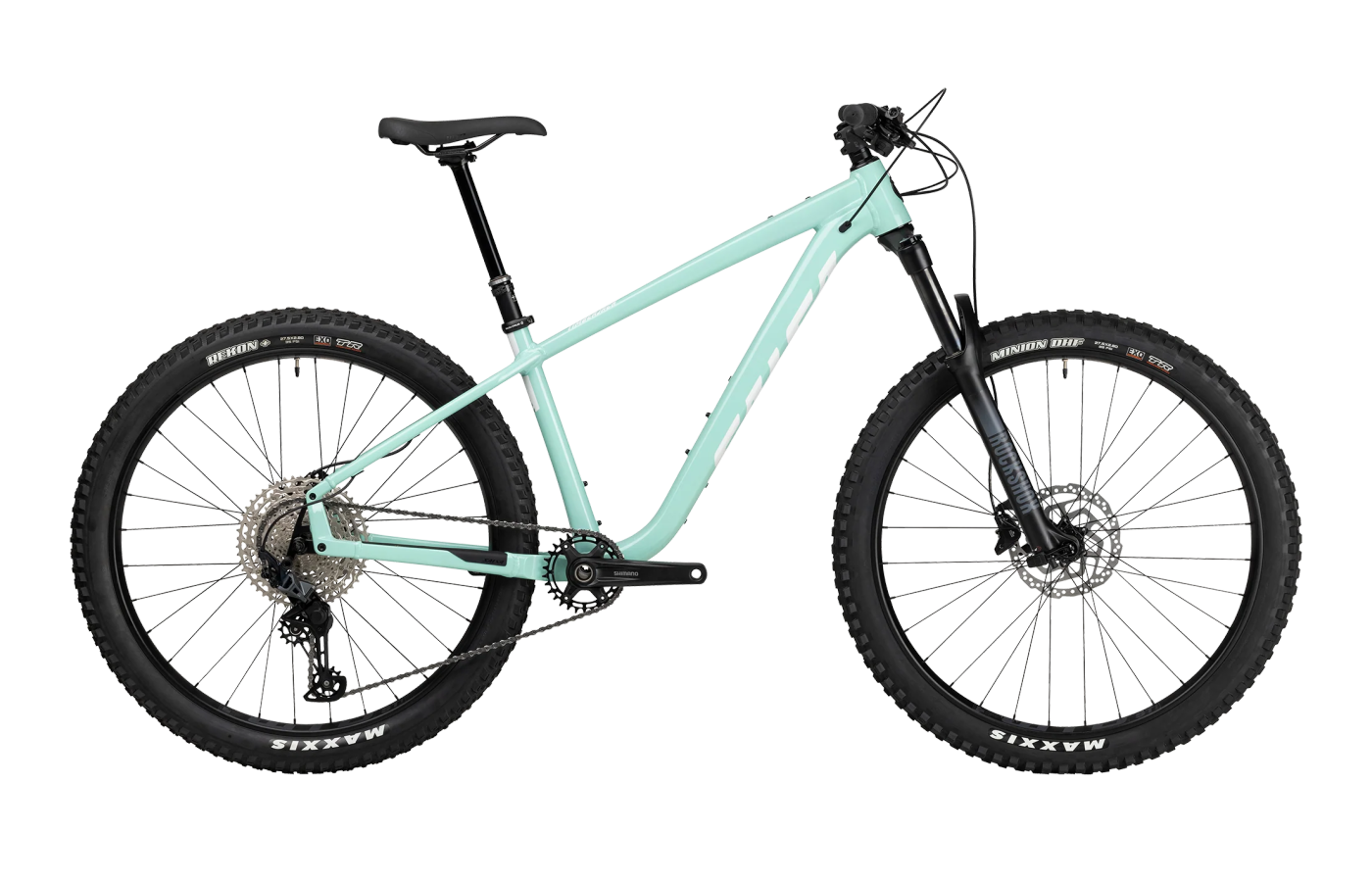
Timberjack
An aluminum hardtail with a strong bikepacking reputation — splits the difference between the Pine Mountain's all-day comfort and the San Quentin's trail aggression, with bottle and rack mounts for days.
Compare →Roscoe
Trek's aggressive aluminum hardtail in the same trail-shredder bracket as the San Quentin. Modern geometry, capable spec, and a dealer network if you want to demo before you buy.
Compare →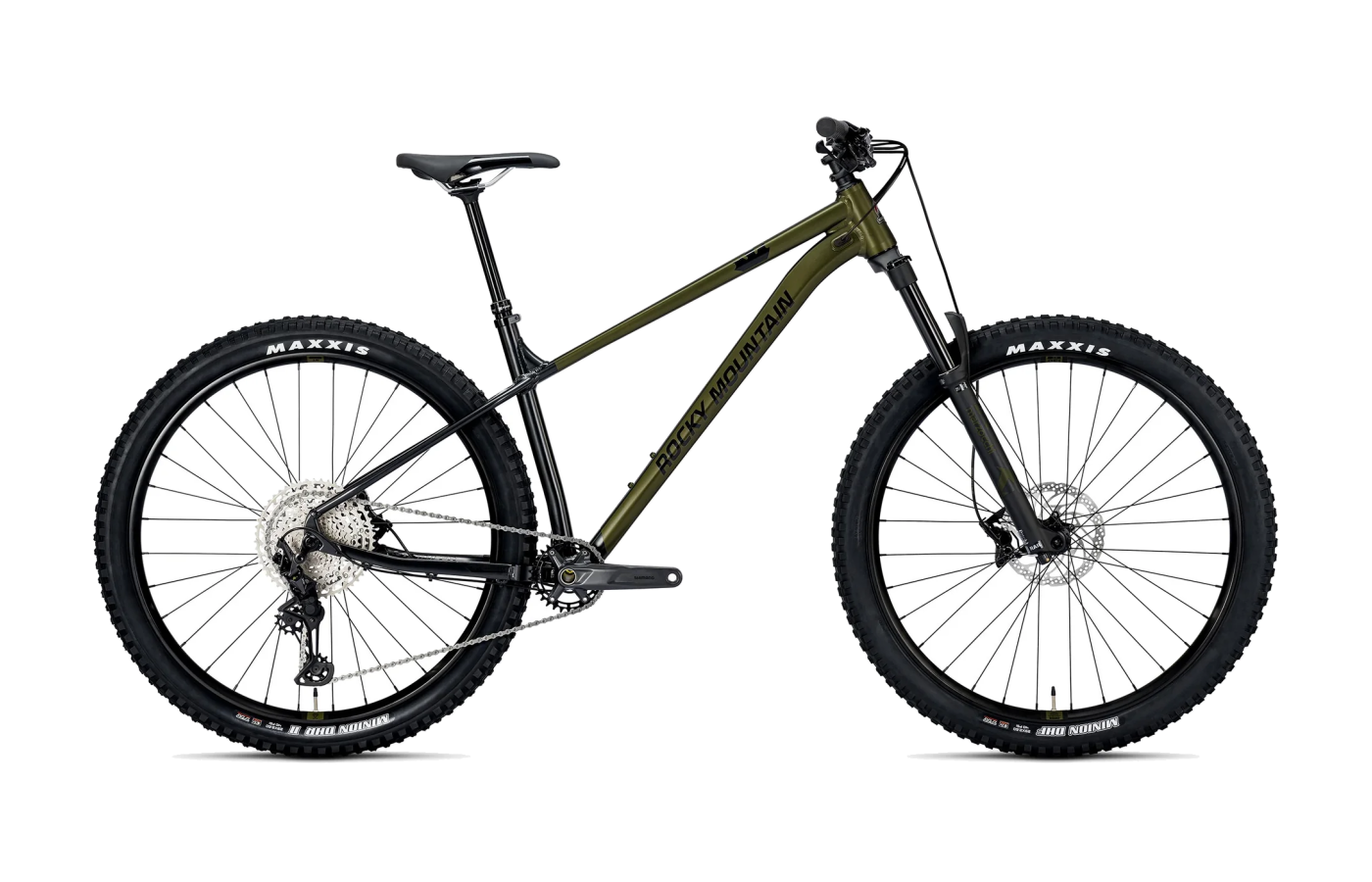
Growler
Another hardcore aluminum hardtail in the San Quentin's lane. Reviewers describe it as more planted at speed but a touch less playful at slower speeds — a more single-minded descender.
Compare →