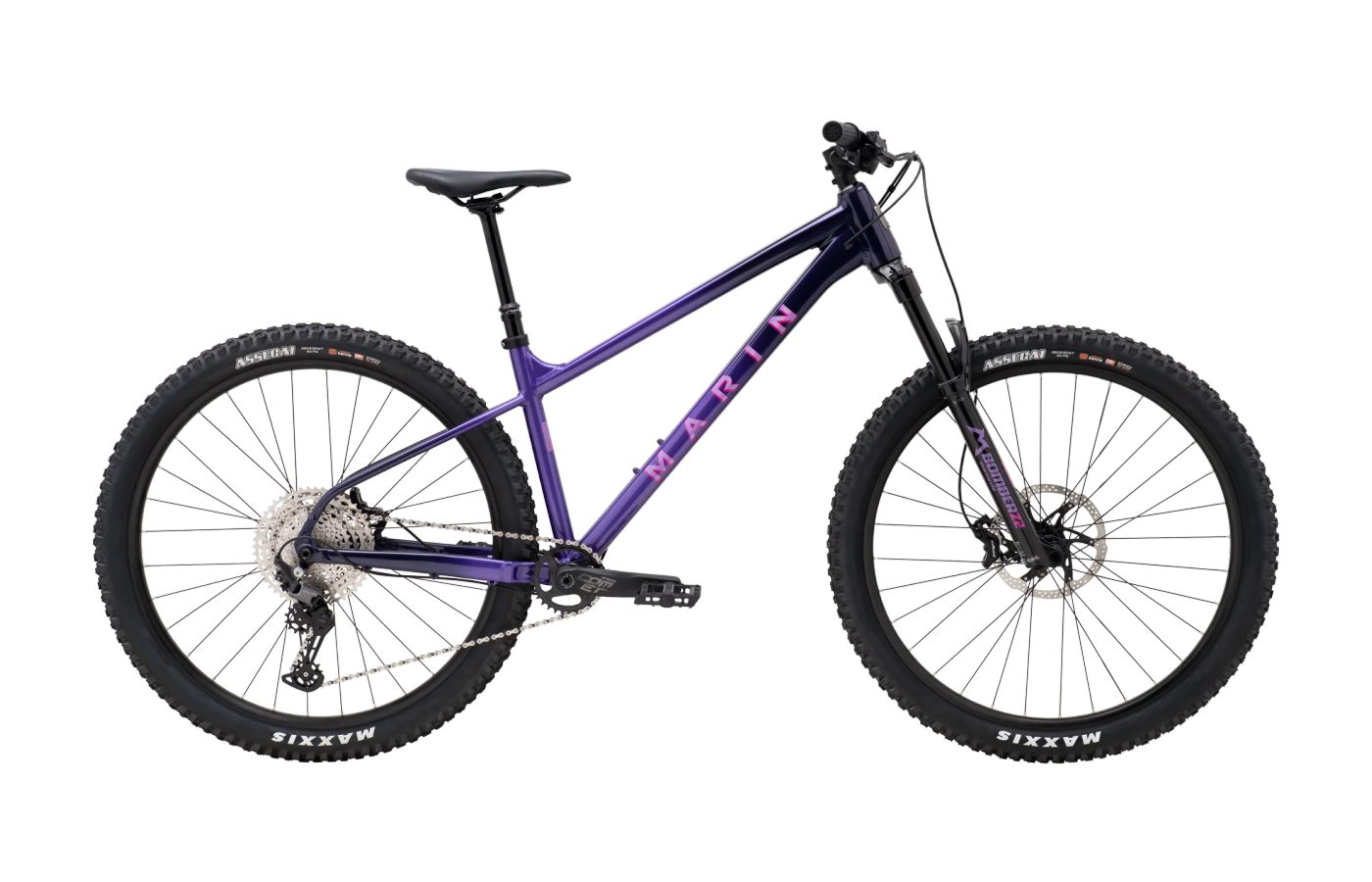
Marin San QuentinvsTrek Roscoe

For riders chasing gnarly descents, the Marin San Quentin's 64-degree head angle edges out the Trek Roscoe's 65 degrees, hinting at a more aggressive stance. Yet, this minor difference belies two distinct personalities: one a playful trail ripper, the other a burly, confidence-inspiring hardtail built for big hits. Deciding between them depends on whether you seek ultimate nimbleness or raw, hard-charging capability.

Marin San Quentin
Image pending

Overview

The Marin San Quentin and the Trek Roscoe Gen 4 both stake their claim in the aggressive aluminum hardtail category, but they do so with different philosophies and price points. The San Quentin, particularly the higher-spec San Quentin 3 model, is a value-driven machine that impresses with its thoughtful geometry and surprisingly compliant frame, aiming to deliver a lively, dirt-jumper-inspired ride without a premium cost. It's a bike that, as reviewers attest, provides an exceptional quality of ride for its segment, even hanging with bikes double its price. In contrast, the Trek Roscoe Gen 4, exemplified by the Roscoe 8, steps into a higher price bracket, using Trek's top-tier Alpha Platinum Aluminum. This positions it as a more premium, overbuilt hardtail that leverages a burlier fork and refined frame features to deliver a confident, almost short-travel full-suspension-like experience. While the San Quentin offers a range of builds from budget-friendly to well-appointed, the Roscoe Gen 4 appears to target riders willing to invest more for a frame and component package that promises immediate, high-performance capability on demanding trails, with a clear focus on integrated features and component robustness.

Ride and handling

The Marin San Quentin, particularly in its 29er San Quentin 3 configuration, earns consistent praise for a surprisingly comfortable and exceptionally fun ride. Reviewers found its aluminum frame unusually compliant, capable of taking the edge off harsh impacts, with one calling it "almost as smooth as the Banshee paradox"—high praise for an alloy hardtail. This frame quality significantly reduces rider fatigue on aggressive trails. Conversely, the Trek Roscoe Gen 4, built with Alpha Platinum Aluminum, leans into a "burly" and stable feel, prioritizing composure and capability on challenging terrain, though specific claims about its inherent frame compliance are not as prominent. In terms of handling, the San Quentin's "dirt jumper DNA" translates to immense playfulness. It's lauded for being "easy to manual," jumping effortlessly, and showing a clear "eagerness to get off the ground." This characteristic makes the bike feel nimble and allows riders to smooth out rough sections by floating over obstacles. The Roscoe, with its 150mm Fox Rhythm 36 fork and 29x2.5-inch tires, feels planted and capable of "insane" stopping power, suggesting a ride that is stable at speed and eager to plow through technical sections. While the Roscoe is described as "fast" and "playful," the San Quentin seems to offer a more pronounced

Specifications

Examining the componentry, the price difference between the selected Marin San Quentin 3 at $1999 and the Trek Roscoe 8 Gen 4 at $2400 immediately highlights divergent value propositions. The San Quentin 3 delivers an impressive package for its price, featuring a Marzocchi Bomber Z2 140mm fork, Tektro Slate EVO 4-piston brakes, and a Shimano Deore 12-speed drivetrain with Maxxis Assegai tires. Reviewers note that this build requires "no upgrades out of the box," with the shifting performance even compared favorably to Shimano GX. The Trek Roscoe 8 justifies its higher cost with some key component upgrades. The Fox Rhythm 36 150mm fork is a burlier, more adjustable option than the Z2, offering superior front-end stiffness and damping control. Braking power is also a strong point on the Roscoe, using Shimano Deore 4-piston brakes that reviewers call "insane," though the San Quentin's Tektro Slate EVO system is also a solid performer. A major differentiator is the Roscoe's Bontrager Rapid Drive hub, boasting 108 points of engagement, which provides nearly instantaneous power transfer—a significant upgrade over the lower engagement Shimano hubs found on the San Quentin 3. This rapid engagement is crucial for technical climbing and quick bursts of speed. However, the Roscoe 8 makes some surprising compromises in the cockpit for its price. The stem and handlebars are criticized as being "low-quality" or "Marlin-level" components, a notable letdown on a $2400 bike. In contrast, the San Quentin's house-brand cockpit, including its grips, receives praise for its quality and comfort. Both bikes offer generous dropper post travel, with the Roscoe's 200mm TransX dropper on medium/large frames being particularly noteworthy for enabling maximum rider movement. While the San Quentin 3's Maxxis Assegai tires are known for phenomenal grip but slower rolling speed, the Roscoe's Bontrager Brevard Pro XR tires aim for a more balanced performance.

QuentinRoscoe
FRAMESET
FrameSeries 2 6061 Aluminum, 27.5" or 29" wheel, double butted, internal cable routing, 141mm open dropout, 73mm threaded BB
ForkSR Suntour XCM34 Boost, 15x110mm, 130mm travel, coil spring, 27.5", bolt-on thru-axle
Rear shock
GROUPSET
Shift leversMicroShift SL-M9195-R, 1x9 (bearing)
Front derailleur
Rear derailleurMicroShift RD-M9195M, 9-speed, clutch
Cassette9-speed cassette (not specified)
ChainKMC X-9
CranksetMarin forged alloy crankset, integrated steel 32T narrow-wide chainring, Boost spacing
Bottom bracketSealed cartridge bearing, square taper
Front brakeTektro M275 hydraulic disc brake
Rear brakeTektro M275 hydraulic disc brake
WHEELSET
Front wheelMarin aluminum double wall, specific, 29mm internal, pinned joint, 32H, tubeless compatible; Forged alloy, 110x15mm, sealed cartridge bearing, 32H; 14g black stainless steel
Rear wheelMarin aluminum double wall, specific, 29mm internal, pinned joint, 32H, tubeless compatible; Forged alloy, quad sealed cartridge bearings, alloy axle, QR type, 141mm width, 32H, Shimano standard freehub body; 14g black stainless steel
Front tireDelium Vesatile, all-around construction, 2.5", wire-bead, tubeless
Rear tireDelium Vesatile, all-around construction, 2.5", wire-bead, tubeless
COCKPIT
StemMarin 3D forged alloy, 45mm
HandlebarsMarin Mini-Riser, 6061 double butted aluminum, 780mm width, 28mm rise, 5° up, 9° back
SaddleMarin Speed Concept
SeatpostMarin alloy, 30.9mm
Grips/TapeMarin MTN, closed end

Geometry and fit comparison

The geometry of these two hardtails reveals distinct biases, even with identical reach numbers on the selected size Large models. Both the Marin San Quentin (L) and the Trek Roscoe (L) share a 470mm reach, placing the rider in a modern, assertive position. However, the Marin pulls ahead in aggressive descending posture with a slacker 64.0-degree head tube angle compared to the Roscoe's 65.0 degrees. This extra degree of slackness, combined with a steeper 77.0-degree seat tube angle on the San Quentin (versus 76.0 degrees on the Roscoe), creates a more forward, centered climbing position that keeps the front wheel weighted, while still allowing the rider to get further behind the front axle on descents. The San Quentin's short 430mm chainstays are a key ingredient in its playful character, contributing to its "dirt jumper DNA" and making it eager to manual and hop. While the Roscoe's chainstay length isn't provided, its playful ride character suggests it's not excessively long. The San Quentin's 50mm bottom bracket drop (for the 29er L) is described by some as being "slightly higher BB than a lot of other aggressive enduro hardtails," which paradoxically makes it easier to get the front wheel off the ground for tricks and navigating terrain. For riders prioritizing high-speed stability and plow-through capability, the Roscoe's 150mm Fox 36 fork combined with a 65-degree head angle creates a formidable front end, though slightly less raked out than the San Quentin. The Roscoe's design also allows for an exceptionally long 200mm dropper post on its medium and large frames, providing unparalleled clearance for extreme body English on steep terrain. Ultimately, the San Quentin's geometry leans into ultimate playfulness and raw shredding for those who love to interact with the trail, while the Roscoe offers a slightly more balanced, confidence-inspiring geometry for powering through the rough stuff, backed by a burlier fork.

vs
FIT GEOQuentinRoscoe
Stack645
Reach470
Top tube619
Headtube length125
Standover height688
Seat tube length410
HANDLINGQuentinRoscoe
Headtube angle64
Seat tube angle77
BB height327
BB drop50
Trail
Offset44
Front center
Wheelbase1236
Chainstay length430

Who each one is for

Marin San Quentin

The Marin San Quentin 3 is for the rider who values aggressive, playful handling and wants a highly capable hardtail without spending full-suspension money. It's an ideal choice for someone who loves to manual, jump, and pump their way down technical trails and flow lines, relishing a bike that feels agile and responsive. This rider enjoys challenging themselves on raw, unbuffered terrain and appreciates a frame that, despite being aluminum, offers surprising comfort. It's also an excellent choice for a new rider eager to progress quickly on demanding singletrack, or for a seasoned enthusiast seeking a fun, skill-sharpening second bike for park laps or local enduro stages.

Trek Roscoe

The Trek Roscoe Gen 4, particularly the Roscoe 8, is for the hard-charging trail rider who demands unwavering confidence and a burly feel on the gnarliest descents. This rider prioritizes a strong, stiff front end to power through rock gardens and steep chutes, appreciating the 150mm Fox 36 fork and immense stopping power of 4-piston Shimano Deore brakes. It's perfect for someone who tackles big features and wants a hardtail that feels exceptionally stable and can handle significant impacts. The class-leading 200mm dropper post is a major draw for riders who use every inch of saddle clearance for aggressive body movement and navigating complex terrain, making it a serious contender for enduro-style riding without rear suspension.

Other bikes to consider

Rocky Mountain Growler
Norco Torrent
Norco Torrent
Santa Cruz Chameleon