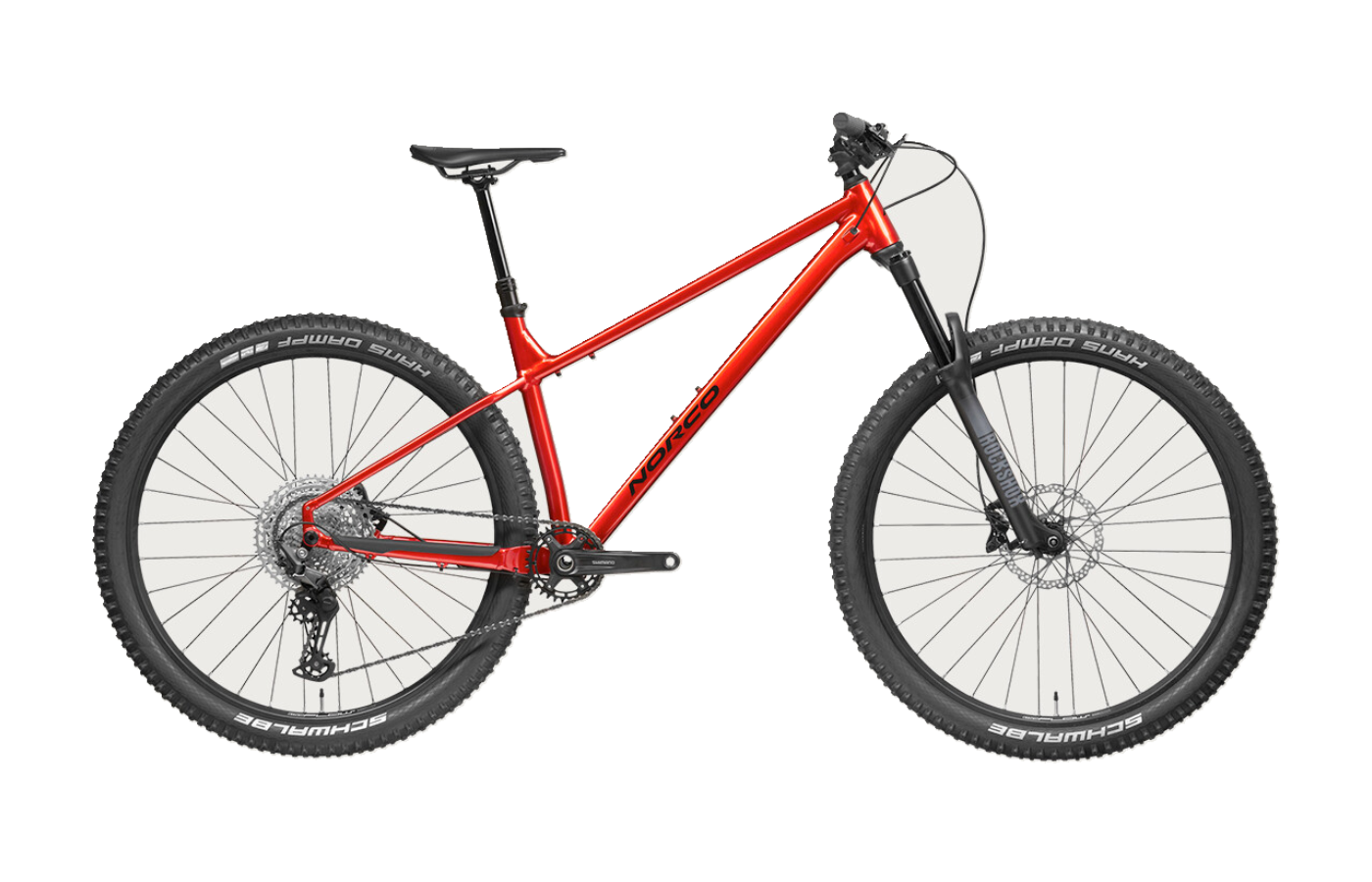
Norco TorrentvsTrek Roscoe

The Norco Torrent and the Trek Roscoe Gen 4 both stake their claim as formidable 'hardcore hardtails,' built to tackle aggressive trails without the complexities of rear suspension. Yet, a closer look reveals that while the Torrent leans into raw, ground-hugging stability, the Roscoe strives for a more balanced blend of burly capability and surprising agility.

Norco Torrent
Image pending

Overview

Norco's Torrent, particularly in its current iteration, has cemented its reputation as a no-nonsense, gravity-oriented hardtail. It's a bike designed to be pointed down the gnarliest descents, focusing on stability and confidence, with frame options in both robust aluminum and more compliant chromoly steel. Trek's Roscoe, on the other hand, has evolved significantly with its fourth generation, shedding some of its previous 'plus bike' identity to embrace a modern, aggressive trail hardtail persona, leveraging Trek's premium Alpha Platinum Aluminum. While both aim to excel in demanding terrain, the Torrent often feels like a purpose-built 'bruiser' for aggressive lines, whereas the Roscoe blends its newfound capability with a lively feel that’s still accessible for varied riding. The bikes differ subtly in their intended feel. Norco’s design often results in a more 'planted,' almost 'sled-like' ride at speed, encouraging riders to 'send it' with unwavering confidence. This character is amplified in its steel variants, which offer a noticeable damping effect. Trek’s approach with the Gen 4 Roscoe emphasizes a responsive front end and substantial dropper travel, creating a ride that feels robust but surprisingly eager to 'get wild' and play around, even within its burly geometry. Neither bike is a lightweight cross-country machine; they both accept a weight penalty in exchange for their downhill prowess, but the Roscoe might offer a slightly more 'fast' and less 'slow' feel on flatter sections than the heftier Torrent builds.

Ride and handling

Riding the Norco Torrent, especially the A1 HT build, often proves to be a mixed experience, heavily dependent on the terrain and the crucial front fork. On steep, technical descents, the Torrent comes alive. Its slack 64-degree head tube angle and generous 480mm reach (size L) contribute to a 'planted,' 'ground-hugging' feel that reviewers consistently praise for its 'excellent stability at speed.' It’s a bike that 'craves high speeds and steep, aggressive terrain,' making it a confidence-inspiring companion when dropping into challenging lines. However, the RockShox 35 Gold RL fork on the A1 is a noticeable weakness; it's frequently described as 'unrefined and poorly damped' with a 'tendency to dive,' forcing riders to compromise comfort for a stable ride height. This limitation can detract from the bike's otherwise aggressive intentions, leaving riders 'wanting' more forgiveness on chunky trails. On climbs, the aluminum A1 can feel 'stiff' and 'jarring' on rough terrain, making it less than ideal for long, sustained ascents. In contrast, the Trek Roscoe 8 Gen 4 enters with a significantly upgraded front end that immediately shapes its handling. The Fox Rhythm 36 fork with 150mm of travel provides a 'stiff, precise front end' that reviewers note 'absorbs significant trail chatter' with a level of confidence usually reserved for full-suspension bikes. This robust fork, paired with the Roscoe's 65-degree head tube angle and 470mm reach (size L), gives it a 'burly' yet surprisingly 'playful' character. It feels fast and retains agility, rather than feeling like a sluggish tank. The Roscoe’s handling is also greatly enhanced by its massive 200mm TransX dropper post, which allows the saddle to virtually disappear, giving the rider 'unprecedented range of motion to lean the bike in corners or navigate steep, technical drops.' This encourages a more dynamic, 'get wild' riding style than the Norco A1's 150mm dropper. Both bikes use a steep 76-degree seat tube angle, which positions the rider efficiently over the cranks for climbing, helping to counteract their long and slack front ends. However, the Torrent A1’s considerable weight (around 31-34 lbs) and less refined fork mean it can feel 'slow on the climbs,' preferring a steady grind. The Roscoe, while also a 'heavy-duty' hardtail at 32.5 pounds (size L), is noted for its surprising 'fast' feel on flats and efficient acceleration, partly due to the Bontrager Rapid Drive hub's 108 points of engagement. This immediate power transfer makes a real difference in technical climbing and quick bursts of speed. While the Norco A1 can be a 'handful in super tight terrain or at lower speeds,' the Roscoe’s blend of stability with quick engagement and ample dropper travel means it stays responsive even in tricky, low-speed sections. The Torrent's short 425mm chainstays do give it a playful, 'carve so well' characteristic, but the Roscoe's combination of fork, hub, and dropper arguably provides a more well-rounded and engaging ride on a wider variety of demanding trails. Ultimately, for pure, unadulterated high-speed descending on the roughest lines, a top-spec Norco Torrent S1 with a Lyrik fork is hard to beat, offering a unique compliant steel ride. However, comparing the specific builds, the Trek Roscoe 8 Gen 4's superior Fox Rhythm 36 fork and high-engagement hub give it a significant edge in overall ride quality, damping, and responsiveness over the Norco Torrent A1 HT, particularly when the terrain gets aggressive. The Roscoe delivers a more refined and capable ride out of the box for its intended hardcore hardtail purpose.

Specifications

Comparing the Norco Torrent A1 HT and the Trek Roscoe 8 Gen 4 reveals a significant disparity in component quality, especially in the crucial front suspension. The Norco A1 comes with a RockShox 35 Gold RL fork, a component widely criticized across reviews. Riders frequently describe it as 'unrefined and poorly damped' with a 'tendency to dive,' forcing compromises in setup that hinder performance. This is a notable weak point on an otherwise aggressive frame. The Trek Roscoe 8, by contrast, boasts a Fox Rhythm 36 fork with 150mm travel and 36mm stanchions, which is a substantial upgrade. Reviewers praise its 'stiff, precise front end' and superior damping, contributing greatly to confidence and control on aggressive trails. This fork alone gives the Roscoe a considerable performance advantage. Moving to braking systems, both bikes offer capable 4-piston hydraulic brakes. The Norco A1 uses TRP Slate EVO brakes with 180mm rotors, while the Trek Roscoe 8 features Shimano Deore 4-piston brakes with a massive 203mm front rotor and 180mm rear. Both provide ample stopping power, though Shimano Deore often earns praise for its consistent feel and modulation. Drivetrain performance is largely a tie, as both bikes are equipped with reliable Shimano Deore M6100 1x12 groupsets, offering a wide 10-51T cassette range and smooth, precise shifting suitable for various climbing demands. Wheelsets and tires also lean in the Roscoe's favor. The Norco A1 rolls on Stan's Flow D 29" rims with Schwalbe Hans Dampf 2.35" tires. While the Hans Dampfs are versatile, they are noted for having 'flimsy sidewalls' that may not hold up to truly aggressive riding. The Trek Roscoe 8 features Bontrager Line TLR30 rims (30mm internal width) paired with 2.5" Bontrager Brevard Pro XR tires, offering a more robust and higher-volume setup. Crucially, the Roscoe's Bontrager Rapid Drive hub provides 108 points of engagement, a significant upgrade over standard hubs, resulting in 'less delay when pedaling' and improved responsiveness in technical terrain. This is a premium feature rarely seen at this price point. Finally, cockpit components present a mixed bag. The Norco A1 includes a TranzX YSP18 dropper post, offering 150mm of travel for sizes M, L, and XL. The Trek Roscoe 8, however, stands out with an impressive 200mm TransX dropper post on its medium and larger sizes, a massive amount of travel that greatly enhances rider mobility. This is a huge value addition. However, Trek makes cost-saving compromises on the stem and handlebars, using 'low-quality' components shared with their entry-level Marlin series. While the Roscoe’s 780mm wide, 40mm rise handlebars provide a comfortable, upright position, their 31.8mm clamp diameter feels outdated compared to the 35mm standard. The Norco's 6061 alloy stem and 800mm bars are more generic but don't carry the 'low-quality' stigma of the Roscoe's. Overall, while the Norco A1's spec has some solid elements, its fork is a glaring weakness, whereas the Trek Roscoe 8 provides a superior fork and hub, compensating for some lesser cockpit parts.

TorrentRoscoe
FRAMESET
FrameButted 6061 Alloy
ForkRockShox 35 Gold RL, 150mm travel, 44mm offset
Rear shock
GROUPSET
Shift leversShimano Deore SL-M6100-R I-Spec (rear)
Front derailleur
Rear derailleurShimano Deore RD-M6100
CassetteShimano Deore CS-M6100-12, 12-speed, 10-51T
ChainShimano Deore CN-M6100
CranksetFSA V-Drive 1X DM, 30T, 170mm (S) / 175mm (M, L, XL)
Bottom bracketFSA MegaExo, BSA threaded
Front brakeTRP Slate EVO, 4-piston hydraulic, resin pads
Rear brakeTRP Slate EVO, 4-piston hydraulic, resin pads
WHEELSET
Front wheelStan's Flow D 29", 32H; Bear Pawls BMB-013, 15x110mm Boost, 6-bolt; Stainless spokes, black (nipples: black)
Rear wheelStan's Flow D 29", 32H; Bear Pawls MS12S, 12x148mm Boost, Micro Spline, 6-bolt; Stainless spokes, black (nipples: black)
Front tireSchwalbe Hans Dampf 2.35, Performance/Twinskin, TLR
Rear tireSchwalbe Hans Dampf 2.35, Performance/Twinskin, TLR
COCKPIT
Stem6061 Alloy, 50mm length, 35mm clamp
HandlebarsButted 6061 Alloy, 800mm, 25mm rise
SaddleFizik Taiga
SeatpostTranzX YSP18 dropper post, 31.6mm, 130mm (S) / 150mm (M, L, XL)
Grips/TapeDMR Deathgrip

Geometry and fit comparison

The Norco Torrent (size L) presents a distinctly aggressive and stretched-out geometry, prioritizing stability and confidence at speed. With a lengthy 480mm reach and an exceptionally slack 64.0-degree head tube angle, the Torrent positions the rider well behind the front axle. This combination results in a significant 138mm of trail, ensuring the bike tracks incredibly straight and remains composed through high-speed, demanding terrain. The 76.0-degree seat tube angle, combined with a 425mm chainstay length, aims for an efficient seated climbing position, though the long front-center can still make the front wheel feel light on very steep ascents. Unfortunately, detailed geometry numbers for the Trek Roscoe Gen 4 (size L) are not fully available, but key figures from reviews offer insight. The Roscoe features a 470mm reach and a 65.0-degree head tube angle for a size large. Comparing directly to the Norco, the Roscoe has a slightly shorter reach (10mm less) and a steeper head tube angle (1 degree less slack). Both bikes share a steep 76.0-degree seat tube angle, which is excellent for modern climbing dynamics. While the full picture of the Roscoe's trail, wheelbase, and front-center isn't available, the difference in reach and head tube angle suggests a bike that, while still aggressive, will feel marginally more agile and less stretched out than the Torrent. In practice, the Norco Torrent's geometry screams 'descend fast.' Its extreme slackness and length are ideal for riders who attack steep, technical downhill trails, providing a 'behind-the-front-wheel' confidence that reduces the sensation of going over the bars. This geometry particularly suits taller riders or those who prefer a more stable, 'ground-hugging' feel on challenging terrain, and its ample standover height (679mm for L) allows good freedom of movement. The Trek Roscoe, with its slightly less extreme head tube angle and reach, likely offers a touch more responsiveness and playfulness without sacrificing much in terms of stability for aggressive riding. This makes it a compelling choice for riders who want to balance hardcore descending capabilities with the ability to flick the bike around and maintain a more dynamic riding style. Both bikes, with their steep seat tube angles, put riders in an effective pedaling position for grinding uphill, though neither is built to be a fast climber.

vs
FIT GEOTorrentRoscoe
Stack637
Reach480
Top tube639
Headtube length115
Standover height679
Seat tube length435
HANDLINGTorrentRoscoe
Headtube angle64
Seat tube angle76
BB height333
BB drop45
Trail138
Offset42
Front center
Wheelbase1238
Chainstay length425

Who each one is for

Norco Torrent

The Norco Torrent A1 HT is for the rider who lives for steep, chunky descents and isn't afraid to bash through rough terrain. If you regularly seek out black diamond trails, enjoy the challenge of 'winch and plummet' riding, and prioritize unflappable stability over quick accelerations or plush comfort, this bike is a strong contender. It's for the rider who understands the trade-offs of a hardcore hardtail and views a direct connection to the trail as an engaging experience, rather than a drawback. This bike particularly appeals to those who are willing to upgrade key components, especially the fork, to unlock its full aggressive potential, or to riders looking for a burly second bike for park laps and gravity-focused shredding.

Trek Roscoe

The Trek Roscoe 8 Gen 4 is aimed at the aggressive trail rider who wants a highly capable hardtail that feels both burly and surprisingly agile. If you tackle technical climbs where quick pedal engagement matters, relish bombing down challenging descents with a stiff, precise front end, and appreciate maximum dropper post travel for unhindered body movement, the Roscoe is built for you. It suits riders who enjoy a playful yet confident ride, blending the ability to 'get wild' on features with efficient pedaling for earning those descents, all within a premium aluminum frame platform with excellent upgrade potential.

Other bikes to consider

Rocky Mountain Growler
Kona Big Honzo
Santa Cruz Chameleon