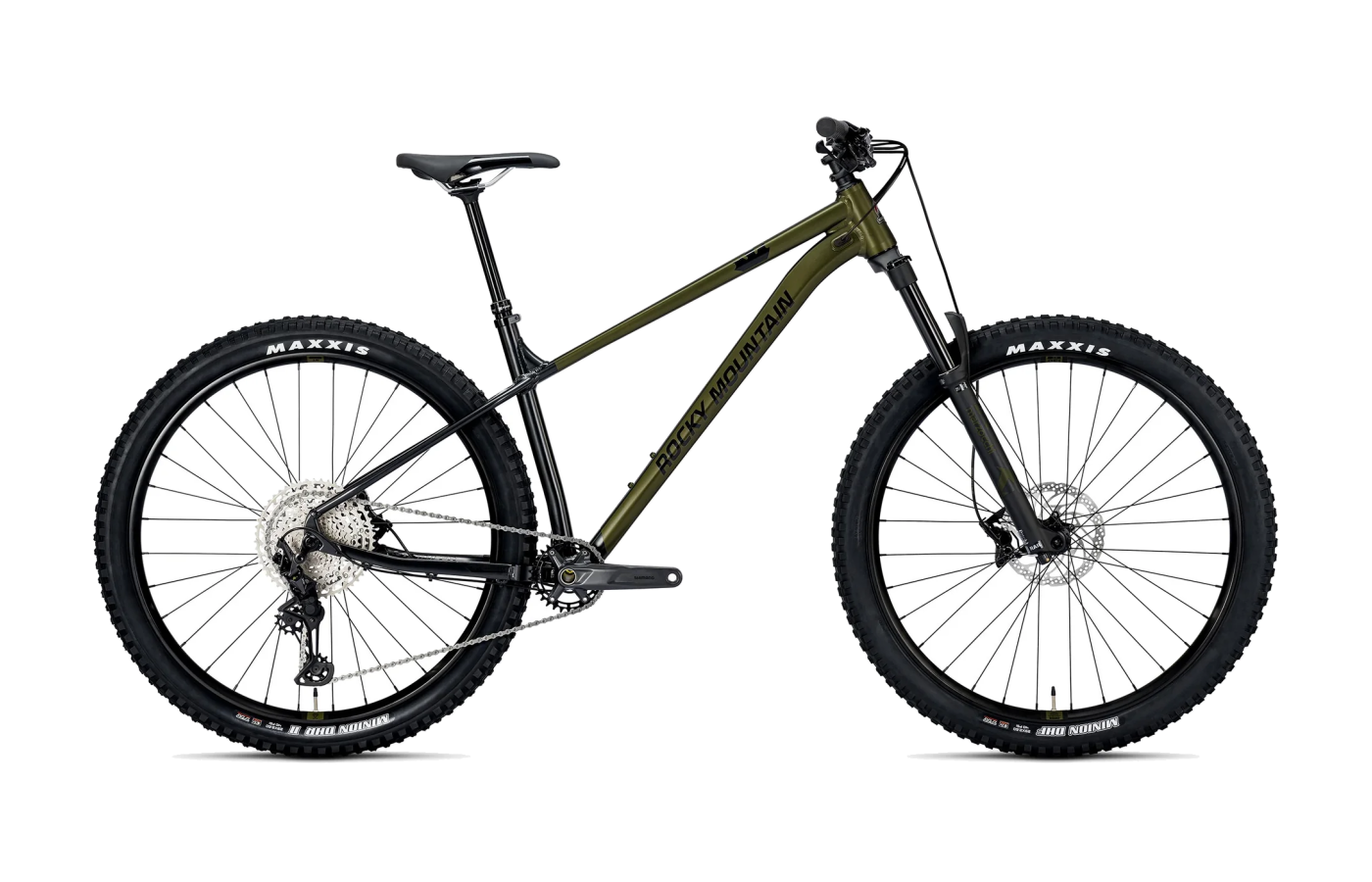
Rocky Mountain GrowlervsTrek Roscoe
The Rocky Mountain Growler and Trek Roscoe Gen 4 stand as two of the most compelling contenders in the hardtail market, pushing the boundaries of what a rigid rear end can achieve. One doubles down on unapologetic downhill capability, offering a full-suspension feel on descents, while the other refines the aggressive hardtail formula with premium components and thoughtful integration. Choosing between them means deciding whether raw, unadulterated speed is paramount, or if a more balanced, albeit still burly, approach to trail riding is a better fit.

Overview
The Rocky Mountain Growler, especially in its 50 trim, is a value-driven gravity machine. Rocky Mountain engineered it with an "enduro-esque geometry" to be "an incredibly capable hardtail" that thrives when pointed downhill, making it a standout for aggressive riders on a budget. Conversely, the Trek Roscoe Gen 4, particularly the Roscoe 8, signals a substantial upgrade in Trek's hardtail philosophy, moving firmly into the "hardcore hardtail" category with higher-end materials and components. This isn't just an iteration; it's a re-imagining, aiming for refined performance that justifies its steeper price tag. Where the Growler focuses on delivering maximum bang for your buck through its progressive frame, allowing riders to "charge through chunk more recklessly" than typical hardtails, the Roscoe 8 Gen 4 invests in a more premium experience. It uses Trek's Alpha Platinum Aluminum, the same alloy found on their full-suspension bikes, and integrates features like extensive frame storage. Both bikes aim for a hardtail that can tackle demanding trails, but the Growler achieves this with a no-frills, downhill-first mentality, while the Roscoe offers a more polished package that still retains a playful edge, despite its burlier appearance. It's the difference between a blunt instrument and a finely crafted tool, both capable of similar feats.
Ride and handling
Riding the Rocky Mountain Growler is like uncorking a bottle of raw downhill ambition. Reviewers consistently describe it as the most capable hardtail they've tested, often stating they rode it "like a full suspension bike" on descents, taking "similar lines" with "similar commitment." Its 64-degree head angle and long wheelbase instill immense confidence, making the bike feel "more stable and relaxed" on rough, fast trails. This composure gives you precious "more time to prepare and think ahead" when things get chaotic. However, that unwavering stiffness from its aluminum frame, described as feeling "like talking to a wall," means you'll still get bounced around, demanding "singular focus" to maintain high speeds. The 2.6-inch tires are crucial here, providing "all the suspension you got" to take the edge off. The Trek Roscoe Gen 4, particularly the Roscoe 8, offers a ride quality that balances aggression with surprising refinement. Despite its "burly" build and 150mm Fox Rhythm 36 fork, initial impressions suggest it "feels fast" and retains a playful character. The Fox 36, with its 36mm stanchions and adjustable compression/rebound, provides a stiff and precise front end that absorbs significant trail chatter, a marked improvement in damping over many hardtails. This, combined with 29x2.5-inch tires, creates a front-end feel that inspires confidence without resorting to the Growler's outright unyielding frame stiffness. The Roscoe's high-rise 40mm handlebars also contribute to a comfortable, upright riding position, making it a "comfy bike" that's "nice to ride" even on tamer paths, which is a rare compliment for such an aggressive machine. When it comes to handling, the Growler's extreme stability on descents means a trade-off in low-speed agility. Its "long wheelbase makes the bike difficult to handle in tough spaces" and it feels "sluggish in tight spaces" or on mellower trails, making it "not such an enthusiastic partner in the dance." While it rails berms at speed, correcting a botched line can be tricky due to its length. The Roscoe Gen 4, however, seems to mitigate some of these hardtail limitations. Its 108-point engagement Rapid Drive hub minimizes pedal lag, crucial for navigating "technical and tricky terrain" with precision. The 200mm TransX dropper post, a direct result of removing seat tube bottle bosses, allows riders to "really get wild" and move the bike freely, enhancing maneuverability and control in steep sections. On the whole, the Growler is a one-trick pony, albeit a very good trick; the Roscoe attempts to be a more versatile, albeit still gravity-focused, performer.
Specifications
Comparing the Growler 50 (2025) to the Roscoe 8 Gen 4, the fork choice presents the most significant performance difference. The Growler 50 comes with a Marzocchi Z2 Float EVOL Rail 150mm fork. While Marzocchi Z2s are capable forks, the Roscoe 8 Gen 4 boasts a Fox Rhythm 36 150mm fork, a clear step up in stiffness, damping, and adjustability due to its 36mm stanchions. This Fox fork is a standout component, delivering a more precise and composed front end experience. Drivetrain and braking components are fairly evenly matched at their respective price points. Both bikes feature reliable Shimano Deore 1x12 drivetrains with wide 10-51T or 10-51T cassettes, ensuring ample gear range for climbing. The Growler 50 pairs this with an XT rear derailleur, a nice touch. For stopping power, the Growler 50 uses Shimano MT4120 4-piston brakes front and rear. The Roscoe 8 Gen 4 also uses Shimano Deore 4-piston brakes, but ups the ante with a massive 203mm front rotor (paired with 180mm rear), giving it "insane stopping power" that can make it "stop on a dime." This larger rotor provides a tangible advantage for aggressive descending. Wheelsets and tires reveal differing philosophies. The Growler 50 rolls on WTB ST i30 Tough TCS 2.0 rims paired with generic Shimano TC500 hubs, with Maxxis Minion DHF/DHR II 2.6 EXO tires. These Maxxis tires are aggressive, grippy, and durable, perfectly suiting the Growler's downhill intentions. Older reviews, however, noted potential freehub slop issues on the Shimano MT400 hub, which might be a concern for longevity. The Roscoe 8 Gen 4 uses Bontrager Line TLR30 rims and a Bontrager Rapid Drive hub with 108 points of engagement. This high-engagement hub is a significant upgrade, offering nearly instant power transfer vital for technical climbing and responsive acceleration, something the Growler's hubs can't match. Its Bontrager Brevard Pro XR 2.5-inch tires are designed for a balance of durability, traction, and rolling speed, potentially making them less aggressive than the Minions but better all-rounders. Finally, the cockpit shows a clear quality gap. The Growler 50 uses Rocky Mountain-branded AM components, which are generally well-regarded for their width and rise. The Roscoe 8 Gen 4, despite its higher price, features a stem and handlebar described as "low-quality" and shared with Trek's entry-level Marlin bikes. While the 780mm wide, 40mm rise bar is functionally aggressive, its material quality is a clear disappointment for a $2,400 bike. Both bikes include competent dropper posts, with the Roscoe's 200mm TransX unit offering impressive travel, facilitated by smart frame design. The Growler also notably omits chainstay protection, a minor but essential detail for quiet riding and frame longevity.
| Growler | Roscoe | |
|---|---|---|
| FRAMESET | ||
| Frame | Rocky Mountain 6061 Alloy | Threaded BB | Boost 148mm | Tapered Zerostack Headtube | Dropper Post Compatible | — |
| Fork | Marzocchi Z2 Float EVOL Rail 150mm | 44mm Offset | — |
| Rear shock | — | — |
| GROUPSET | ||
| Shift levers | Shimano Deore 12spd | — |
| Front derailleur | — | — |
| Rear derailleur | Shimano XT | — |
| Cassette | Shimano Deore 10-51T 12spd | — |
| Chain | Shimano M6100 | — |
| Crankset | Shimano Deore | 30T | 24mm Spindle | Crankarm Length: SM - MD = 170 | LG - XL = 175mm | — |
| Bottom bracket | Shimano SM-BB52 | — |
| Front brake | Shimano MT4120 4 Piston | Resin Pads | — |
| Rear brake | Shimano MT4120 4 Piston | Resin Pads | — |
| WHEELSET | ||
| Front wheel | WTB ST i30 TOUGH TCS 2.0 | 32H; Shimano TC500 | 15mm Boost; 2.0 Stainless | — |
| Rear wheel | WTB ST i30 TOUGH TCS 2.0 | 32H; Shimano TC500 Boost 148mm; 2.0 Stainless | — |
| Front tire | Maxxis Minion DHF 2.6 EXO Tubeless Ready | — |
| Rear tire | Maxxis Minion DHR II 2.6 EXO Tubeless Ready | — |
| COCKPIT | ||
| Stem | Rocky Mountain 35 AM | 0° Rise | All Sizes = 40mm | — |
| Handlebars | Rocky Mountain AM | 780mm Width | 38mm Rise | 9° Backsweep | 5° Upsweep | 35 Clamp | — |
| Saddle | Rocky Mountain 148 Cromo | — |
| Seatpost | X Fusion Manic Composite 30.9mm | XS - SM = 125mm | MD = 150mm | LG - XL = 170mm | — |
| Grips/Tape | Rocky Mountain Lock On Ergo | — |
Geometry and fit comparison
Geometry is where the Rocky Mountain Growler truly defines itself as a downhill-biased hardtail. For a size large, the Growler features a notably slack 64.0-degree head tube angle, a 75.0-degree seat tube angle, a generous 475mm reach, and short 435mm chainstays resulting in a 1239mm wheelbase. This "progressive geometry" aims to replicate the stable, confidence-inspiring feel of a full-suspension enduro bike, pushing the front wheel far out ahead for control on steep descents. This setup is ideal for riders who prioritize bombing down trails and desire a bike that makes "things… come at you a little bit slower," allowing for more commitment. Unfortunately, comprehensive geometry data for the Trek Roscoe Gen 4 is not available, but reviews indicate it also embraces modern, aggressive numbers. For a size large, the Roscoe 8 Gen 4 is reported to have a 65.0-degree head tube angle, a steeper 76.0-degree seat tube angle, and a 470mm reach. Comparing these figures to the Growler, the Roscoe features a slightly steeper head tube angle, suggesting it might be a touch more nimble in tighter turns and at lower speeds than the Growler, which can feel "sluggish in tight spaces." The Roscoe's steeper seat tube angle positions the rider more directly over the pedals, enhancing climbing efficiency, especially on sustained or technical ascents. The difference in head tube angle alone (64.0° vs. 65.0°) means the Growler will feel noticeably more planted and stable at high speeds and on very steep terrain, truly excelling when gravity takes over. The Roscoe, with its slightly steeper front end and reported 470mm reach (for a large), combined with a high-rise handlebar, offers a comfortable and upright cockpit. This could make it more suitable for riders who appreciate a commanding position without the absolute forward-geometry commitment of the Growler. For those who frequently navigate tight, technical climbs or prefer a bike that feels more responsive to steering inputs, the Roscoe's geometry, while still aggressive, is likely a more versatile compromise.
| FIT GEO | Growler | Roscoe | |
|---|---|---|---|
| Stack | 652 | — | — |
| Reach | 475 | — | — |
| Top tube | 647 | — | — |
| Headtube length | 120 | — | — |
| Standover height | 804 | — | — |
| Seat tube length | 445 | — | — |
| HANDLING | Growler | Roscoe | |
|---|---|---|---|
| Headtube angle | 64 | — | — |
| Seat tube angle | 75 | — | — |
| BB height | — | — | — |
| BB drop | 60 | — | — |
| Trail | — | — | — |
| Offset | — | — | — |
| Front center | — | — | — |
| Wheelbase | 1239 | — | — |
| Chainstay length | 435 | — | — |
Who each one is for
Rocky Mountain Growler
The Rocky Mountain Growler 50 is for the rider who lives for the descent and wants to push the limits of what a hardtail can do, without breaking the bank. If your local trails involve fast, rough, and steep descents where confidence and stability are paramount, and you don't mind a slightly less agile ride on the climbs, this bike is built for you. It's an excellent choice for budget-conscious riders looking for a primary trail bike that can handle bike park laps and enduro-style terrain, or for an experienced rider seeking an "n+1" hardtail to reconnect with the raw feel of the trail, valuing aggressive geometry over component flash.
Trek Roscoe
The Trek Roscoe 8 Gen 4 is tailored for the aggressive trail rider seeking a refined, capable hardtail that excels across a variety of conditions. If you demand a premium front suspension with precise damping, appreciate the immediate engagement of a high-end hub for technical climbing, and value integrated storage solutions for longer rides, this bike delivers. It's ideal for someone who tackles demanding trails but also wants a comfortable, versatile hardtail that retains a playful character at slower speeds and offers excellent maneuverability for technical sections, even if it means investing a bit more upfront.