Bronson
vsStumpjumper Evo
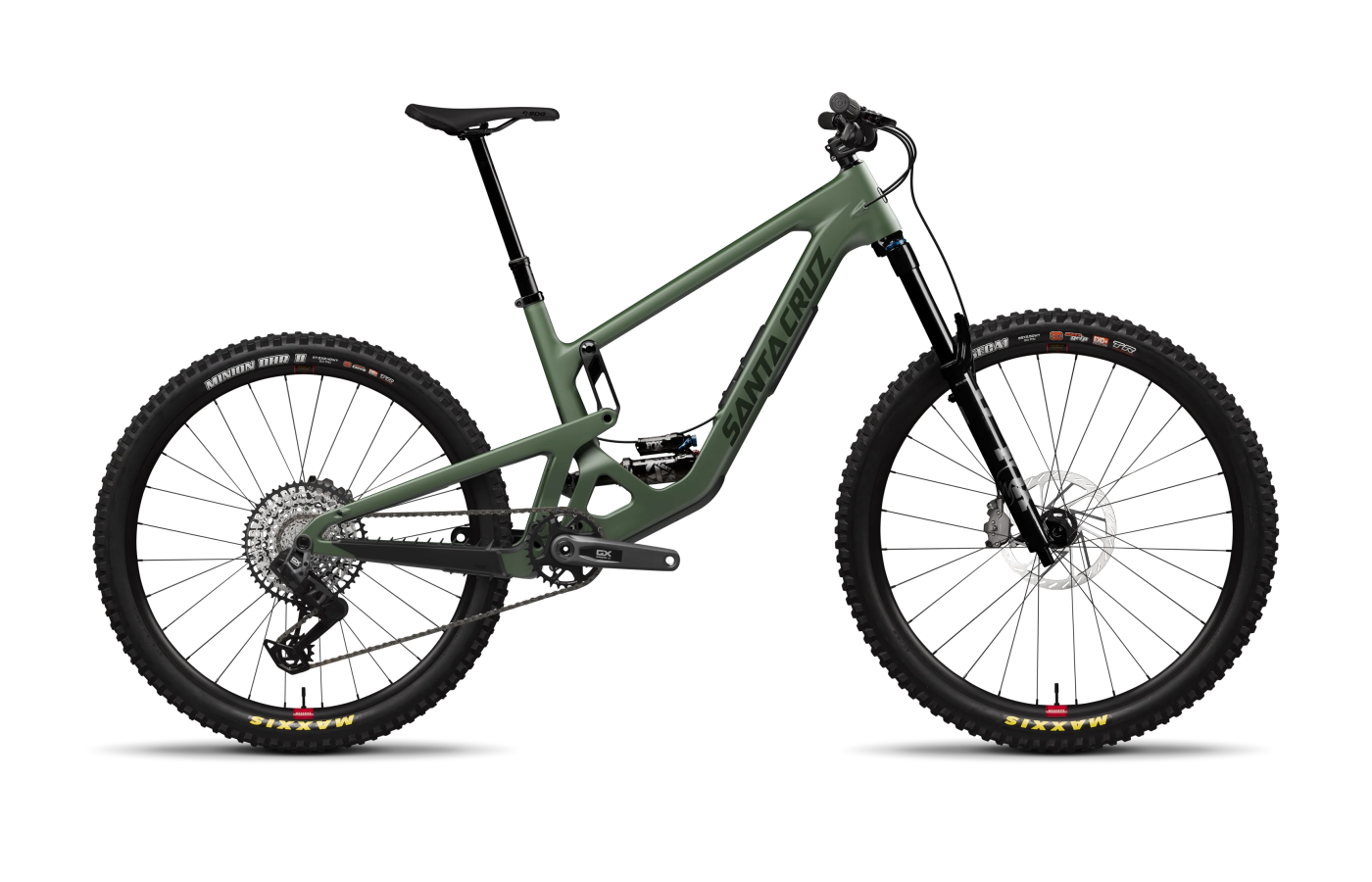
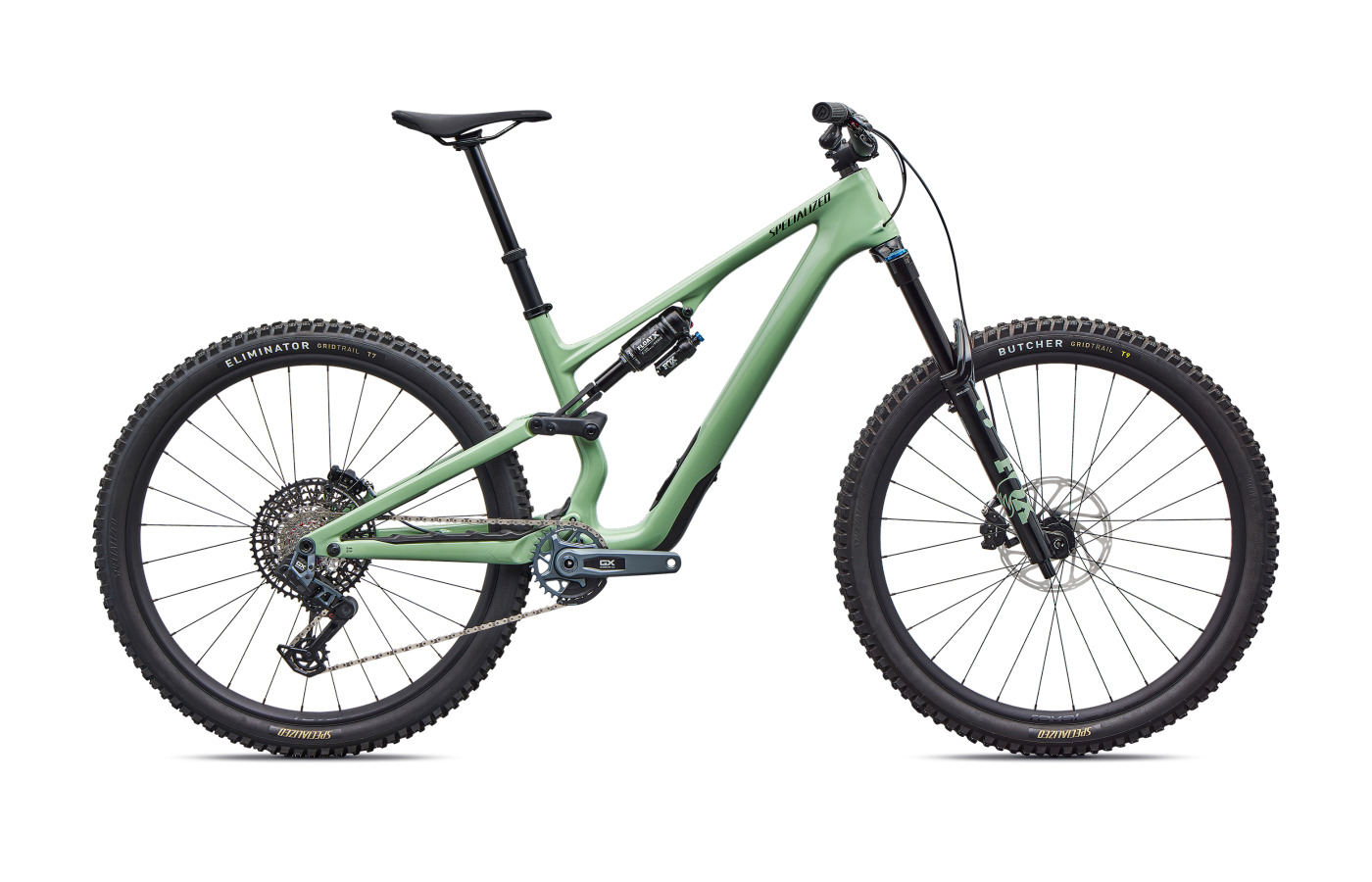
Two trail bikes, two suspension philosophies.
The Bronson commits to a mullet for snap and pop. The Stumpjumper Evo throws a dual-chamber shock at every other problem.
Bronson
- Mullet snap — 27.5 rear paired with a 29 front gives the easiest manual and tightest cornering radius in this travel bracket.
- Size-specific chainstays (437 → 448 mm) keep weight balance consistent for short and tall riders alike.
- Lifetime bearing warranty — Santa Cruz replaces every pivot bearing on the frame for life, free.
- 27.5 rear can hang up on square-edged hits where a 29-inch wheel would roll through.
- Tall stack (632 mm on M, 641 mm on L) plus 35 mm-rise bars makes the front end feel light on steep climbs.
Stumpjumper Evo
- GENIE shock — supple coil-like first 70%, hard ramp at the end; reviewers report not bottoming out on hucks-to-flat.
- Adjustable geometry — headset cups and a flip chip let you swing the head angle 63°/64.5°/65.5° without buying a new frame.
- SWAT down-tube storage swallows a tube and tools, keeps the pack off your back on long days.
- Carbon frames are wireless-only — no mechanical-shifting fallback.
- Stock GRID TRAIL casing tires are widely flagged as under-gunned for the bike's descending capability.
Editor’s analysis
This isn't a head-to-head on travel numbers — it's a question of how you want a 145–150 mm trail bike to feel underneath you.
On paper, these two sit in the same trail bracket: 150 mm rear / 160 mm fork on the Santa Cruz Bronson, 145 mm rear / 160 mm fork on the Specialized Stumpjumper Evo, 64.2° vs 64.5° head angles, both pitched as do-it-all platforms a single rider can ride to the local jump line and a singletrack epic in the same week. But the engineering choices behind those numbers point in different directions.
The Bronson commits to a mullet — 29 front, 27.5 rear — and lets the smaller rear wheel define the character. Reviewers consistently call out a snappy, manualable, hooligan rear end with size-specific chainstays (439 mm on the M, 448 mm on the XXL) that keeps the weight balance honest as you go up frame sizes. The trade-off is square-edge composure: the 27.5 hangs up where the 29-inch front wheel keeps rolling, and BikeRadar specifically called out that towering front end on the largest sizes.
The Stumpjumper Evo throws engineering at the same problem. The Fox GENIE shock runs a big air volume for the first 70% of the stroke, then closes off into a hard ramp — reviewers describe a coil-like initial feel with bottom-out resistance you can't blow through. Pair that with adjustable headset cups (63°/64.5°/65.5° HTA) and a flip chip, and you can dial the bike from XC tour pace to bike-park ripper without changing the build. The catch: the carbon frame is wireless-only, so you're committed to SRAM AXS or Shimano Di2 forever.
Put another way: the Santa Cruz Bronson asks how playful you want it. The Specialized Stumpjumper Evo asks how technical you want to get with setup. If you'd rather pop off every root than fiddle with volume bands, the Bronson. If you want one frame that can be retuned mid-season for a different trail, the Stumpjumper Evo.
Where the builds differ.
Comparing our editor's-pick builds side-by-side. Winners highlighted row-by-row — lower price and weight, and the better-spec component, each mark a point.
Build variants & pricing
The Bronson starts at $4,999 and tops out at $9,349. The Stumpjumper Evo opens lower at $3,999 (alloy) and reaches $11,299 for S-Works.
Editor's picks are tier-matched at SRAM GX Eagle AXS Transmission so the spec table is apples-to-apples. Note the platform-level price gap: the GX-AXS Bronson is $7,249 vs $6,199 for the equivalent Stumpjumper Evo Expert — a real $1,050 difference for comparable componentry, on a slightly lower-grade carbon frame (Carbon C vs FACT 11m).
How they fit, how they steer.
Bronson size M and Stumpjumper Evo S3 are the fit-picked sizes for a 5'8" rider. Reach is close (460 vs 450 mm), but the Bronson sits 5 mm taller in stack, runs a 0.3° slacker head angle, and stretches its wheelbase 27 mm longer (1240 vs 1213 mm).
Which size should I buy?
Specialized's S-sizing intentionally overlaps — most riders fit two adjacent sizes; Santa Cruz uses traditional S/M/L/XL/XXL where you usually only fit one.
→These are starting points. Flexibility, riding style, and preferred position all shift the answer — if you’re between sizes, a professional fit beats a chart.
What the magazines said.
Published reviews from trusted cycling outlets. Click through for the full write-up.
Which one should you buy?
If you ride for the playful line, get the Bronson. If you want one frame you can retune for any trail, get the Stumpjumper Evo.
Bronson
If your favorite trails are tight, twisty, or jib-heavy and you'd rather manual a roller than plough through it, the Bronson's mullet rear end and supportive VPP suspension reward that style. Pair that with Santa Cruz's lifetime bearing warranty and you've got a frame built to live with for a decade.
Stumpjumper Evo
If you want one frame that can morph from XC tour pace to bike-park ripper via headset cups, flip chips, and GENIE volume bands, the Stumpjumper Evo is the most adjustable platform in the bracket. It rewards riders who actually use those adjustments — and who don't mind committing to wireless drivetrains.
Questions buyers actually ask.
Short answers to the things we get emailed about most often.
01Mullet vs full 29 — which is faster?
Depends on the trail. The Bronson's 27.5 rear wheel accelerates harder out of corners and is easier to throw around in tight switchbacks — multiple reviewers (Pinkbike, BikeRadar) report it 'rocketing up' technical climbs. The Stumpjumper Evo in its full-29 S3–S6 sizes carries more momentum on flow-trail rollers and rolls over square-edged hits the Bronson hangs up on.
In a stopwatch race on a smooth, fast trail the 29er usually wins. On a tight, janky enduro stage with lots of direction changes, it's a wash and rider preference dominates.
02Which has more rear travel?
The Bronson has 150 mm of rear travel; the Stumpjumper Evo has 145 mm. Both run a 160 mm fork on the M / S3 sizes we compared.
In practice the Stumpjumper Evo feels deeper than the 5 mm gap suggests because the GENIE shock's first 70% is so supple — Flow Mountain Bike said they 'were never able to hit full travel despite all of my awful line choices and ugly hucks-to-flat.' The Bronson's VPP feels more supportive and less bottomless.
03How adjustable is the geometry?
Bronson: a single flip chip changes the head angle by ~0.3° and BB height by a few millimeters. Otherwise the geometry is fixed — 64.2° HTA in Low.
Stumpjumper Evo: three eccentric headset-cup positions (63° / 64.5° / 65.5° HTA) and a Horst-link flip chip. You can take the same frame from a slack park-ish setup to a steeper, taller XC-style setup without buying anything. Reviewers describe it as moving 'from a mild-mannered mile muncher to a bikepark-friendly ripper.'
If adjustability matters to you, this is a one-sided fight.
04Carbon-only, or is there an alloy option?
Bronson: carbon-only this generation. Santa Cruz dropped the alloy frame for the V4, so the floor is the $4,999 Carbon C 'R' build.
Stumpjumper Evo: both. The 15 EVO Alloy Comp starts at $3,999 (M5 alloy frame), and carbon FACT 11m builds run from $4,999 (Comp) up to $11,299 (S-Works). The alloy frame is heavy — Pinkbike measured the frameset at 9.5 lb — but $1,000 cheaper into the lineup and retains mechanical cable routing.
05Is the GENIE shock proprietary? Can I swap it?
Yes and yes. The GENIE is a Specialized + Fox collaboration with a dual-chamber air spring — it's not a standard Fox Float X. But the frame uses a standard 210x55 mm trunnion mount, so you can drop in a regular shock if you don't get along with the GENIE.
Specialized says GENIE service uses standard Fox internals plus one extra seal, and most suspension shops can handle it. There's some lingering skepticism in reviewer comments (Specialized's history with proprietary tech like Brain has been mixed), but no reliability complaints have surfaced in long-term reviews so far.
06What about long-term ownership and warranty?
Both come with a lifetime frame warranty to the original owner. Santa Cruz adds free lifetime pivot-bearing replacement — Vital MTB cited this as part of the case for treating the Bronson as a 'forever frame,' likening Santa Cruz's support to 'the Volvos of yesteryear.'
Specialized matches the lifetime frame warranty and lifetime pivot bearing replacement as well, plus a lifetime warranty on Roval wheels. Both crash-replacement programs offer discounted frames after a wreck. On long-term support, it's effectively a tie.
07Which is better at climbing technical trails?
Different strengths. The Stumpjumper Evo's supple GENIE initial stroke generates 'all-out grip' on rooty and rocky climbs (Loam Wolf), and the steeper effective seat tube angle keeps you centered. The trade-off is some 'wallow' if you don't engage the climb switch on long fire-road grinds.
The Bronson climbs efficiently — Vital MTB went so far as to say the climb switch is 'for decorative purposes.' The 27.5 rear is easier to spin up around tight switchbacks. The catch is the tall front end on steep pitches: BikeRadar and others noted the front wandering, and recommended dropping spacers or sliding the saddle forward.
08What sizes do I have to choose from?
Bronson: five sizes — S, M, L, XL, XXL. Conventional sizing where most riders fit one.
Stumpjumper Evo: six sizes — S1 through S6. Specialized's S-sizing intentionally overlaps so reach and stack progress in tighter steps; most riders fit two adjacent sizes and choose based on whether they want a longer or shorter cockpit. Sizes S1 and S2 ship as mullet (29 front / 27.5 rear); S3–S6 are full 29.
For the default 5'8" rider in our context, the fit algorithm picks the Bronson size M and the Stumpjumper Evo S3.
Similar bikes
If your priorities don’t map cleanly onto either of these, one of these adjacent bikes probably fits better.
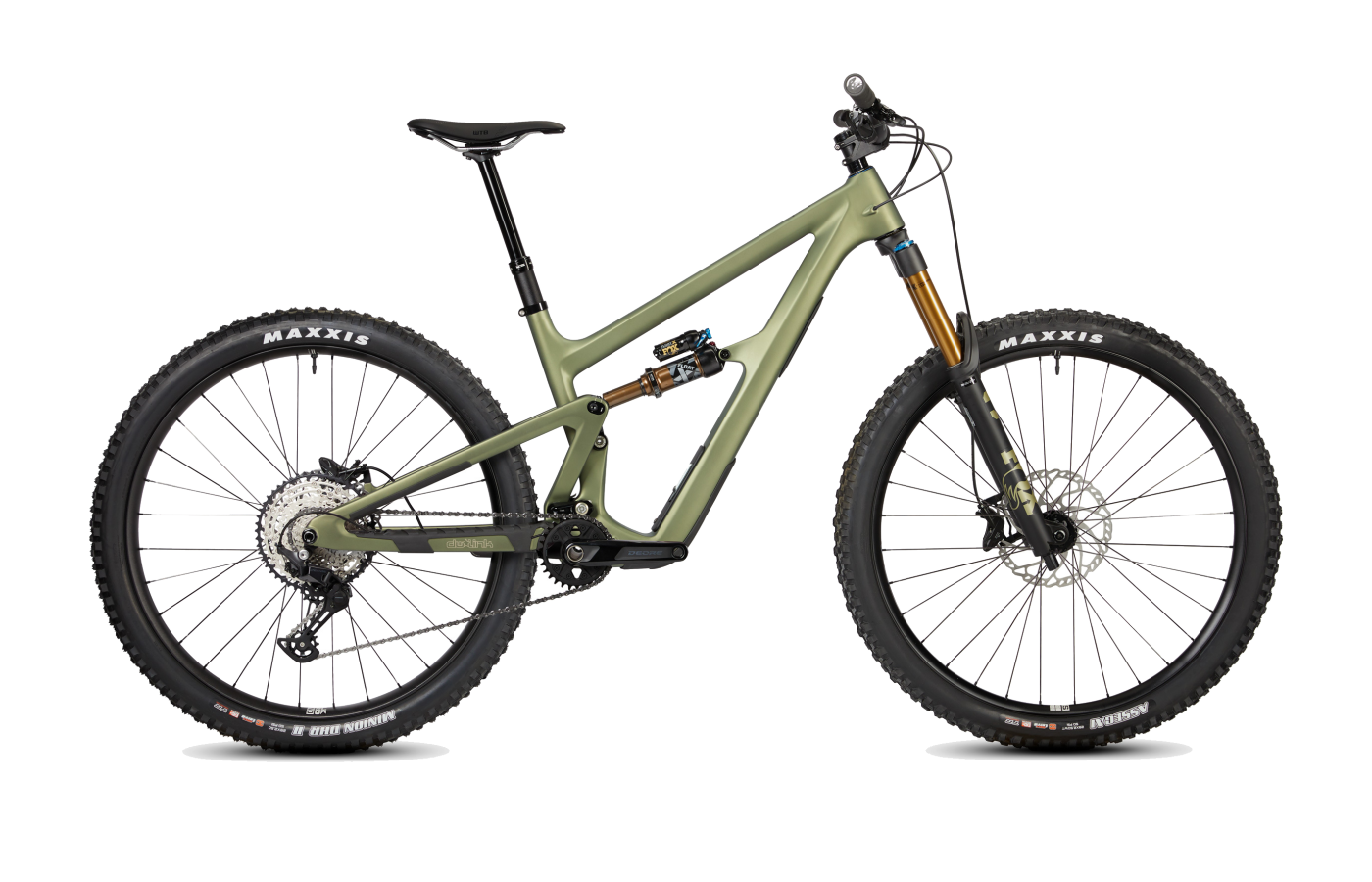
Ripmo
The DW-link, dual-29 alternative — 147 mm of rear travel that pedals as efficiently as the Bronson without the mullet trade-off. If you want full 29-inch composure and a poppy feel, this is the third side of the triangle.
Compare →Patrol
Take the Bronson's mullet philosophy and push it further into gravity-bike territory. Slacker, longer-travel, less interested in pedaling efficiency — pick this if the Bronson sounds right but you wish it were even more committed.
Compare →
Fuel EX
Trek's answer to the Stumpjumper Evo's adjustability brief — Mino Link flip chip, internal storage, and the option to run full 29 or MX from the same frame. Less radical suspension tech than GENIE, but a known quantity.
Compare →