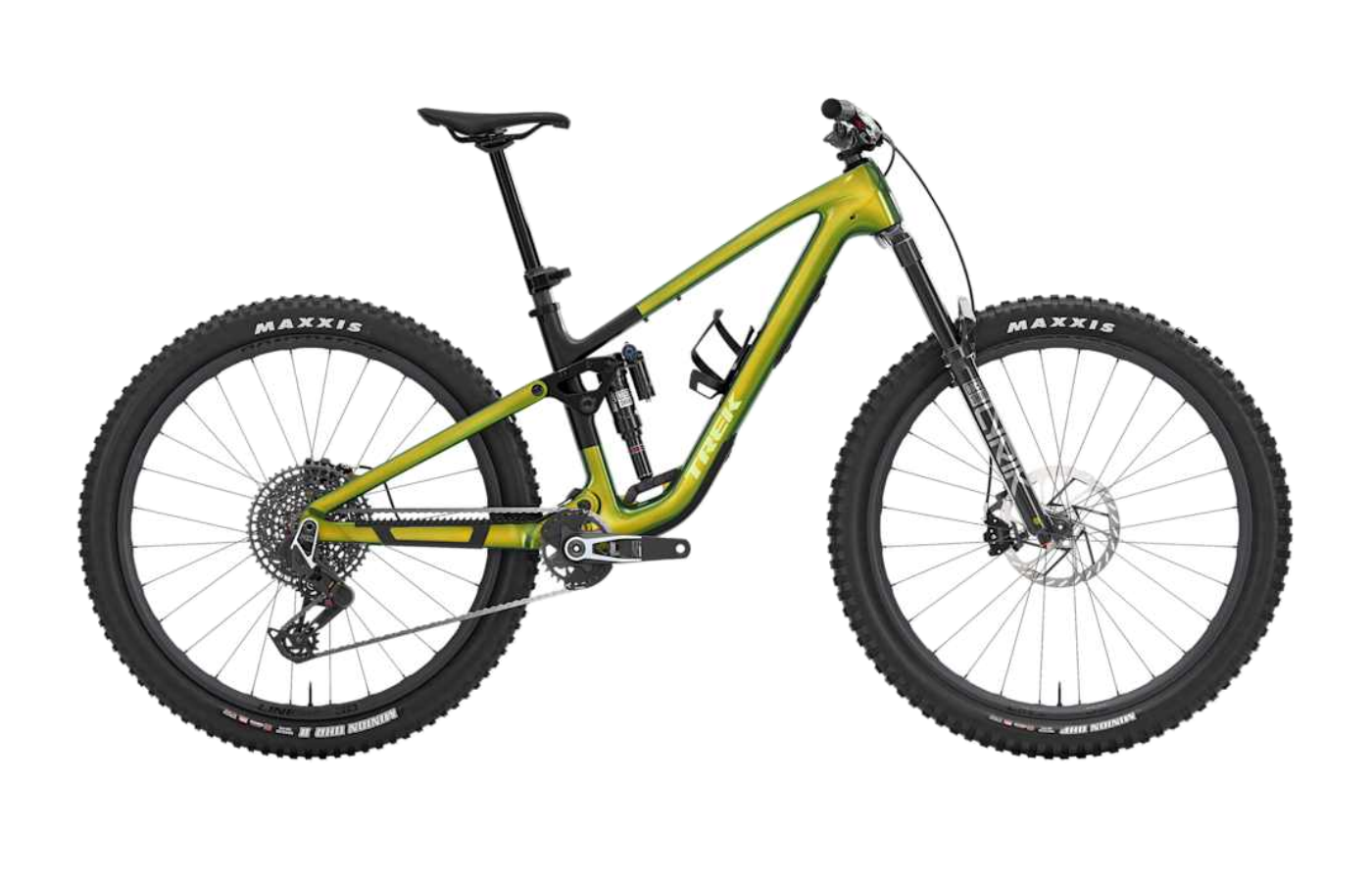
Trek Fuel EXvsRemedy
Can Trek's latest Fuel EX truly be a quiver-killer for the modern trail rider, or does the legacy Remedy still hold its own as the ultimate fun-first machine? The Fuel EX (Gen 7) arrives as a versatile platform, stepping deeper into aggressive territory, while the 2019-2022 Remedy refined its playful, all-mountain spirit on 27.5-inch wheels. One seeks broad adaptability, the other, pure unadulterated shred-ability.

Overview
Trek's Fuel EX (Gen 7) reimagines what a trail bike can be, shedding its more XC-oriented past to embrace a decidedly aggressive, adaptable platform. Trek has designed one core frame that, through swappable rocker links and shock mounts, can morph into three distinct personalities: the 145mm-travel Fuel EX, the 150mm-travel mixed-wheel Fuel MX, and the burly 160mm-travel Fuel LX. This modularity is a direct response to riders over-forking and mulleting previous Fuel EX generations, offering a robust, 'future-proof' chassis that aims for versatility. The 2019-2022 Remedy, by contrast, remained steadfast in its identity as a playful, 27.5-inch wheeled all-mountain slayer. With 150mm of rear travel and 160mm up front, it leaned into agility and rider engagement, often described as a 'big BMX bike.' While the Fuel EX pushes boundaries with its adaptable travel and progressive geometry, the Remedy held onto a more conservative, yet highly effective, geometry that prioritizes an 'exuberant, twinkle-toed' ride. The Fuel EX is a calculated evolution aiming to be many things to many riders, whereas the Remedy was a refined, focused tool for delivering maximum smiles per mile.
Ride and handling
The ride quality difference between these two bikes is stark: the Fuel EX Gen 7 embodies an 'unshakeably anchored' feel, delivering composure and a 'butter smooth' experience over challenging terrain, while the Remedy prioritizes a 'whippy' and 'snappy' ride. Reviewers consistently note the Fuel EX's transformation into a heavier, more planted bike that feels 'glued to the ground,' absorbing hits with a 'Sherman tank' calmness. This is a deliberate shift from the Gen 6, which was sometimes called harsh. The Remedy, however, is all about dancing on the trail. Its 'twinkle-toed' responsiveness makes it easy to pop over obstacles and flick around, earning it the 'big BMX bike' moniker. Suspension performance on both bikes benefits from Trek’s ABP design, which maintains active rear suspension under braking. The Fuel EX’s revised kinematic, with a lower leverage ratio, provides more grip and comfort while retaining enough 'pop' to work the terrain. Even mid-tier builds, like the EX 8 with its Fox 36 Rhythm and Float X, perform 'superb,' feeling like they have more than 145mm of travel. The Remedy, meanwhile, impressed with its RE:aktiv and Thru Shaft shock technology, often described as 'noise-canceling' and 'seemingly bottomless.' This setup provides a supportive pedaling platform that 'automatically reacts' to impacts, eliminating the need for constant lever-flipping. However, the Remedy's inherent playfulness means some riders found it could feel 'squirrely' or 'nervous' when charging through heavy, high-speed chop, where the Fuel EX's extra heft and geometry would provide more stability. Cornering performance sees the Fuel EX as intuitive and 'ego-pumping,' encouraging riders to 'corkscrew' through turns with a strong, assertive stance, thanks to its low bottom bracket. The Remedy's shorter wheelbase and nimble 27.5-inch wheels mean 'lightning-fast' turn-in and effortless negotiation of tight berms and switchbacks. However, the Remedy's notorious 'Knock Block' steering stop could be an 'annoying' limitation for extreme lean angles or in tight, low-speed maneuvers, a non-issue on the Fuel EX. Conversely, some noted the Fuel EX, in its full 29er guise, can feel a bit long in the 'niggling' tightest turns, suggesting the MX (mullet) configuration could offer a more Remedy-like agility. Both bikes deliver on comfort for their intended use, but the Fuel EX's steep effective seat angle, while great for technical climbing, could lead to wrist and shoulder fatigue on long, flatter days, a trade-off for its aggressive descending posture.
Specifications
Component specification reveals the Fuel EX Gen 7's broader and more modern approach, contrasting with the Remedy's refined but slightly older-generation offerings. For higher-end Fuel EX builds, like the selected 9.9 X0 AXS, you get top-tier SRAM AXS Transmission, RockShox Lyrik Ultimate forks, and powerful SRAM Maven Silver brakes, along with carbon wheels and Maxxis Minion DHF/DHR II tires – a significant departure from Trek's historical reliance on house-brand rubber. Even the alloy Fuel EX 8 offers 'stonking value' with SRAM Eagle 70 Transmission and capable Fox Rhythm/Float X suspension, placing it competitively against rivals. The Remedy, while lauded for its performance, often faced critique for its stock component choices. Its most capable builds, like the 9.9, featured Fox Factory 36 or RockShox Lyrik RCT3 forks and SRAM X01 Eagle drivetrains. However, mid-range Remedy 8 models often came with SRAM Guide R brakes, which reviewers frequently described as 'underpowered' for the bike’s 150/160mm travel, necessitating upgrades for aggressive riders. The Remedy also often shipped with Bontrager SE4/XR4 2.6-inch tires, which, while providing good initial traction, were sometimes deemed flimsy or 'vague' for hard charging, leading to recommendations for immediate swaps to thicker-casing alternatives. The Fuel EX’s frame features also highlight its updated design, including a straight seat tube for longer dropper post insertion and a standard ZS49/ZS56 headset for easy aftermarket customization, bypassing the proprietary 'Knock Block' system found on the Remedy. While the Remedy's carbon builds were praised for including Bontrager Line Carbon 30 wheels, the Fuel EX’s overall spec packages across its varied price points, from alloy to carbon, feel more cohesive and dialed for its intended aggressive trail riding, often providing superior braking and more robust tire choices from the factory, especially on higher-end configurations.
| EX | Remedy | |
|---|---|---|
| FRAMESET | ||
| Frame | Alpha Platinum Aluminum, internal storage, angle-adjust headset, Mino Link adjustable geometry, adjustable leverage rate, guided internal routing, magnesium rocker link, 34.9mm seat tube, ISCG 05, 55mm chainline, BSA 73, downtube guard, shuttle guard, ABP, UDH, Boost148, 140mm travel | — |
| Fork | RockShox Recon Silver / Recon Silver RL (size-dependent), Solo Air spring, Motion Control damper, lockout, tapered steerer, Boost110, Maxle Stealth; 140mm travel (XS/S, 46mm offset) or 150mm travel (S-XXL, 42mm offset) | — |
| Rear shock | X-Fusion Pro 2, 2-position damper, 185mm x 55mm | — |
| GROUPSET | ||
| Shift levers | Shimano Deore M6100, 12-speed | — |
| Front derailleur | — | — |
| Rear derailleur | Shimano Deore M6100, long cage | — |
| Cassette | Shimano Deore M6100, 12-speed, 10-51T | — |
| Chain | Shimano Deore M6100, 12-speed | — |
| Crankset | Shimano MT512, 30T ring, 55mm chainline, 170mm length | — |
| Bottom bracket | Shimano BB-MT501 (BSA threaded) | — |
| Front brake | Shimano hydraulic disc, MT201 lever, MT200 caliper | — |
| Rear brake | Shimano hydraulic disc, MT201 lever, MT200 caliper | — |
| WHEELSET | ||
| Front wheel | Bontrager Line TLR 30, Tubeless Ready, 32-hole, Presta valve; Bontrager alloy, 6-bolt, Boost110, 15mm thru axle | — |
| Rear wheel | Bontrager Line TLR 30, Tubeless Ready, 32-hole, Presta valve; Bontrager alloy, sealed bearing, 6-bolt, Shimano Micro Spline freehub, Boost148, 12mm thru axle | — |
| Front tire | Bontrager Gunnison Elite XR, Tubeless Ready, wire bead, 60 tpi (27.5x2.40 on XS/S; 29x2.40 on S-XXL) | — |
| Rear tire | Bontrager Gunnison Elite XR, Tubeless Ready, wire bead, 60 tpi (27.5x2.40 on XS/S; 29x2.40 on S-XXL) | — |
| COCKPIT | ||
| Stem | Bontrager Comp, 31.8mm, 7° (35mm length on XS/S; 50mm length on M/ML/L/XL/XXL), Blendr compatible on M-XXL | — |
| Handlebars | Bontrager alloy, 31.8mm, 15mm rise, 750mm width | — |
| Saddle | Bontrager Arvada, steel rails, 138mm width OR Bontrager Verse Short, stainless steel rails (spec varies) | — |
| Seatpost | TranzX JD-YSI-22PLQ dropper, internal routing, 34.9mm (100mm travel/346mm length XS/S; 150mm travel/454mm length M/ML; 170mm travel/497mm length L/XL/XXL) | — |
| Grips/Tape | Bontrager XR Trail Comp, nylon lock-on | — |
Geometry and fit comparison
Direct numerical comparison for geometry is challenging as specific Remedy data for the 2019-2022 generation was not provided; however, reviews consistently characterize it, allowing for a qualitative comparison to the Fuel EX Gen 7, for which we have full data, including the XXL size (Reach: 530mm, Stack: 665mm, Head Angle: 64.5°, Seat Angle: 72.6°, Chainstay: 452mm, Wheelbase: 1330mm). The Fuel EX Gen 7, especially in larger sizes, showcases modern aggressive geometry with a longer reach and notably higher stack heights. The XXL's 530mm reach and 665mm stack (up from 621mm on the Gen 6 Large) contribute to a more upright, centered riding position. The 64.5° head tube angle and 129mm trail (on the XXL) indicate a bike designed for high-speed stability and confidence on steep descents. The effective seat tube angle is quite steep, around 76-78° depending on size and saddle height, further aiding a powerful climbing posture. Chainstay lengths are size-specific, ranging from 437mm on smaller sizes to 452mm on the XXL, maintaining balanced handling across the range. The Remedy, in contrast, maintained a more conservative geometry with a shorter reach (around 455-461mm for a size large) and a steeper head tube angle (typically 65.5-66.5°). Its shorter wheelbase (around 1206mm for a size large) combined with 27.5-inch wheels yields a significantly more agile and 'whippy' feel, prioritizing quick turn-in over straight-line stability. The effective seat tube angle for the Remedy was around 74.5-75°, which was considered good for climbing at the time but less aggressive than the Fuel EX Gen 7. While the Remedy featured a Mino Link flip chip for minor geometry adjustments (half a degree in head angle and 10mm in BB height), the Fuel EX Gen 7 offers more fundamental geometry shifts through its modular platform, allowing for more dramatic changes to suit a broader range of terrain and rider preferences. For riders who gravitate towards a planted, composed feel on fast, rough terrain and appreciate a roomy cockpit, the Fuel EX Gen 7’s geometry will be a better fit. Its generous stack height is particularly beneficial for taller riders or those who prefer a less aggressive attack position. The Remedy's more compact geometry and 27.5-inch wheels suited riders who enjoy a highly responsive, playful bike that's easy to throw around and navigate tight, technical trails. However, some riders found the Remedy's bottom bracket height relatively high, leading to a feeling of being 'on top of the bike' rather than 'in it,' a sentiment less common with the Fuel EX's lower BB drop (35mm).
| FIT GEO | EX | Remedy | |
|---|---|---|---|
| Stack | 638 | — | — |
| Reach | 485 | — | — |
| Top tube | 617 | — | — |
| Headtube length | 125 | — | — |
| Standover height | 749 | — | — |
| Seat tube length | 420 | — | — |
| HANDLING | EX | Remedy | |
|---|---|---|---|
| Headtube angle | 64.5 | — | — |
| Seat tube angle | 72.6 | — | — |
| BB height | 339 | — | — |
| BB drop | 35 | — | — |
| Trail | 129 | — | — |
| Offset | 44 | — | — |
| Front center | — | — | — |
| Wheelbase | 1262 | — | — |
| Chainstay length | 442 | — | — |
Who each one is for
Trek Fuel EX
The Trek Fuel EX (Gen 7) is for the aggressive trail rider who seeks a highly versatile, composed machine capable of pushing into enduro territory without committing to a full-blown downhill rig. This rider values stability and confidence on rowdy, technical descents, appreciating the bike's 'anchored' feel at speed, even if it comes with a weight penalty. They might frequent bike parks, challenging singletrack with significant elevation changes, or plan multi-day trips where adaptability (via the MX or LX configurations) for different terrain is a significant draw. It’s also for the rider who appreciates a refined climbing position and suspension that eats up technical ascents, prioritizing comfort and momentum over pure uphill sprinting speed.
Trek Remedy
The Trek Remedy (2019-2022) is for the rider who prioritizes a 'big BMX bike' feel and a 'twinkle-toed' agility on the trail. This rider loves to 'pop, jump, and go fast' through tight singletrack, berms, and playful terrain, preferring to 'dance on the trail' and flick the bike around rather than relying on brute force. They are likely comfortable with 27.5-inch wheels and enjoy a highly responsive, spirited ride that makes average trails feel more exciting. It’s ideal for someone who enjoys technical climbs where traction is paramount but truly comes alive on descents, rewarding an active and creative riding style rather than a 'monster truck' approach to smashing through obstacles.