Trek ProcalibervsRoscoe
Stop looking at these as just two Trek hardtails. One is a surgical tool for clearing climbs and hunting podiums, while the other is a sledgehammer built to survive lines that usually require a rear shock. Choosing between them depends entirely on whether you measure success in seconds saved or features sent.

Overview
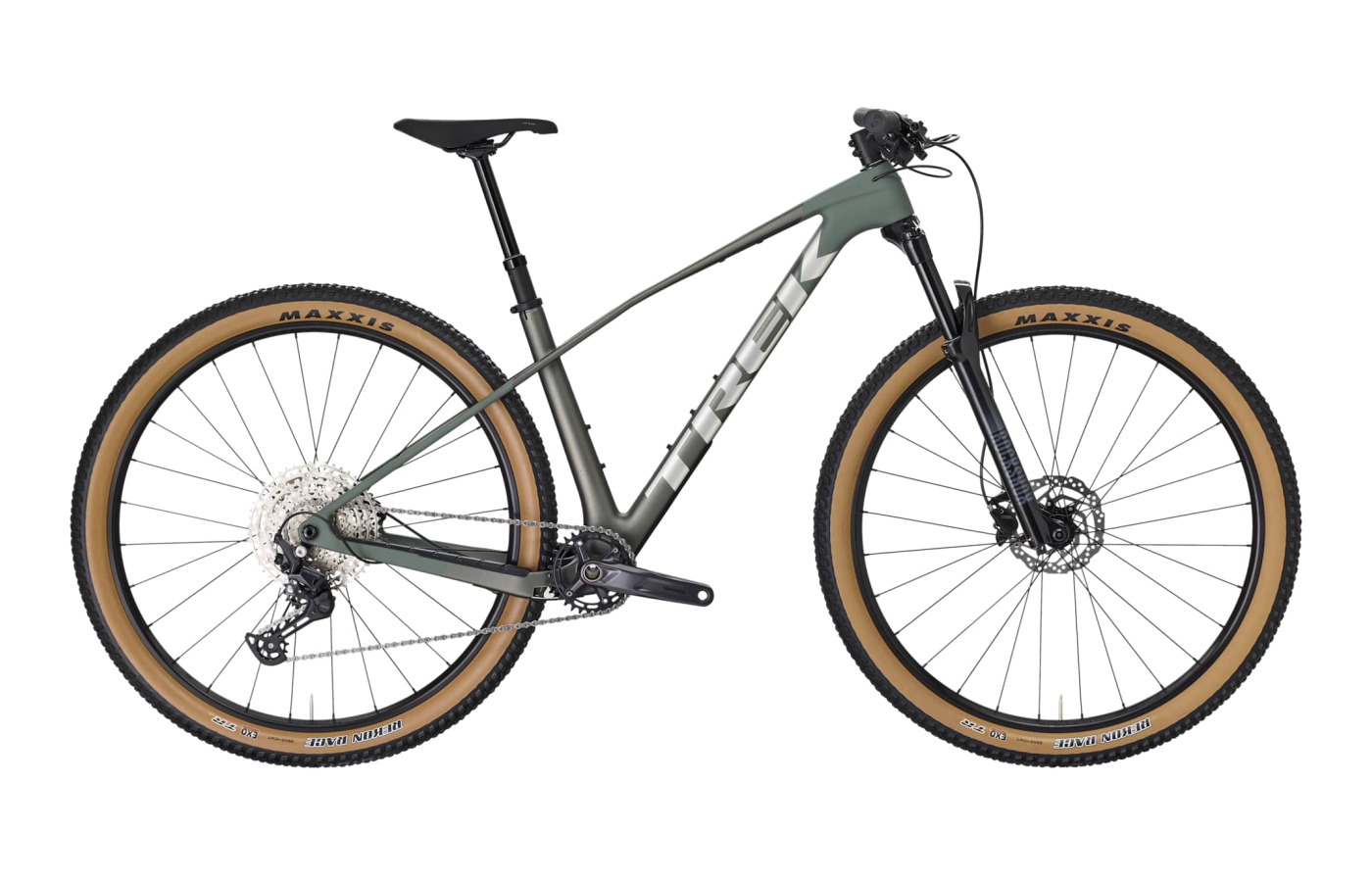
Trek has drawn a hard line in the dirt between these two designs. The Procaliber Gen 3 is a purebred cross-country machine that has grown up slightly with 120mm of travel, but its heart remains at the starting gate. It uses a high-end OCLV carbon frame featuring the IsoBow design—a literal hole in the top tube that allows the seatstays to flex for comfort without the weight or complexity of the old IsoSpeed pivot system. It is light, stiff, and built for those who find the uphill grind just as rewarding as the descent. In contrast, the Roscoe Gen 4 has fully embraced its role as a hardcore hardtail. By moving to Alpha Platinum Aluminum—the same high-grade alloy Trek uses on its downhill bikes—and spec'ing a massive 150mm travel fork, this bike signals it isn't for casual bike paths. It is significantly heavier and burlier than the Procaliber, trading away pedaling efficiency for the ability to plow through rock gardens and steep chutes. While the Procaliber wants to be the fastest bike on the course, the Roscoe wants to be the most capable bike on the mountain.
Ride and handling
The Procaliber feels like it is constantly egging you on to pedal harder. On punchy climbs, the rear end has an energetic snap that makes every watt feel productive. Reviewers describe it as the quintessence of nimbleness; it is a bike you can flick through tight switchbacks with a level of precision that feels almost telepathic. However, that agility comes with a trade-off in the form of a low 309mm bottom bracket. You will need to time your pedaling carefully in technical terrain to avoid smashing your cranks into stumps and rocks. Dropping into a descent on the Roscoe feels like a different sport entirely. With a slack 65-degree head angle and a 150mm Fox 36 fork on the Roscoe 8, the front end feels unshakeable. It does not skip over trail chatter; it eats it. The massive 200mm dropper post on size ML and larger allows the saddle to essentially disappear, giving you room to use your legs as secondary suspension. It is stable at speeds that would make a Procaliber rider sweat, though you will feel every bit of that 32.5-pound weight the moment the trail turns back upward. Compliance is handled differently by both frames. The Procaliber's IsoBow system provides a subtle dulling of hard impacts, but it remains a race bike at its core; you are largely relying on high-volume tires to save your lower back on long days. The Roscoe relies on sheer tire volume and that beefy fork to manage vibration. While the Roscoe is more comfortable on big hits, the aluminum frame can feel a bit more dead on high-frequency chatter compared to the Procaliber's sophisticated carbon layup.
Specifications
The drivetrain and braking specs highlight two very different philosophies for the price. On the Procaliber 9.5 Gen 3, you get a lightweight Shimano Deore 12-speed setup paired with XC-specific Sainte-Anne tires. It is a functional build, but the inclusion of basic Shimano MT200 two-piston brakes is a real weakness on a bike at this price point. You are clearly paying for the premium carbon chassis and the 120mm RockShox Judy Gold fork rather than the components hung on them. Roscoe 8 Gen 4 buyers receive a much more robust kit for their money. Trek spec'd this build with 4-piston Shimano Deore brakes and a massive 203mm front rotor, which provides stopping power that is worlds apart from the Procaliber's 160mm setup. You also get the Bontrager Rapid Drive 108 hub, which offers nearly instant engagement. This is a massive win for technical climbing. While the Procaliber wins on the scale, the Roscoe wins on component durability and heavy-duty performance, especially with that stiff 36mm stanchion Fox fork.
| Procaliber | Roscoe | |
|---|---|---|
| FRAMESET | ||
| Frame | Alpha Platinum Aluminum, tapered head tube, internal routing, BSA 73, hidden rack and kickstand mounts, UDH, Boost148, 12mm thru axle | — |
| Fork | RockShox Judy Silver, Solo Air spring, TurnKey lockout, tapered steerer, 42mm offset, Boost110, 15mm Maxle Stealth, 120mm travel | — |
| Rear shock | — | — |
| GROUPSET | ||
| Shift levers | Shimano Deore M6100, 12-speed | — |
| Front derailleur | — | — |
| Rear derailleur | Shimano XT M8100, long cage | — |
| Cassette | Shimano Deore M6100, 12-speed, 10-51T | — |
| Chain | Shimano Deore M6100, 12-speed | — |
| Crankset | Shimano MT512, 30T ring, 55mm chainline (Size S,M: 170mm length; Size ML,L,XL: 175mm length) | — |
| Bottom bracket | Shimano BB-MT501 BSA | — |
| Front brake | Shimano MT200 hydraulic disc | — |
| Rear brake | Shimano MT200 hydraulic disc | — |
| WHEELSET | ||
| Front wheel | Bontrager Kovee, double-wall, Tubeless Ready, 28-hole, 23mm internal width, Presta valve; Shimano TC500 alloy, Center Lock, 110x15mm thru axle | — |
| Rear wheel | Bontrager Kovee, double-wall, Tubeless Ready, 28-hole, 23mm internal width, Presta valve; Shimano TC500 alloy, Center Lock, 148x12mm thru axle | — |
| Front tire | Maxxis Rekon Race, Tubeless Ready, EXO casing, folding bead, 60tpi, 29x2.40 (Sizes S/M/ML/L/XL) | — |
| Rear tire | Bontrager Sainte-Anne Pro XR, Tubeless Ready, dual compound, aramid bead, 60tpi, 29x2.20 (Sizes S/M/ML/L/XL) | — |
| COCKPIT | ||
| Stem | Bontrager Comp/Elite, 31.8mm, Blendr compatible, 7° (Size S: 50mm; M/ML: 60mm; L: 70mm; XL: 80mm) | — |
| Handlebars | Bontrager alloy / Bontrager Comp alloy, 31.8mm (Size S/M: 5mm rise, 720mm width; Size ML/L/XL: 15mm rise, 750mm width) | — |
| Saddle | Verse Short, steel rails, 145mm width | — |
| Seatpost | Bontrager Line Dropper, MaxFlow, internal routing, 31.6mm (Size S/M: 100mm travel, 310mm length; Size ML/L: 150mm travel, 410mm length; Size XL: 170mm travel, 450mm length) | — |
| Grips/Tape | Bontrager XR Trail Comp / Trek Line Comp, nylon lock-on | — |
Geometry and fit comparison
These bikes live in different zip codes when it comes to fit and stability. The Procaliber in size ML has a 445mm reach and a 67-degree head tube angle, which is modern for XC but still keeps the wheelbase short enough at 1155mm to feel reactive. It puts the rider in an aggressive, forward-leaning stance. Even with the move to longer forks, the head tube remains short, keeping your weight low and over the front wheel to prevent it from wandering on steep climbs. The Roscoe pushes the reach out and slacks the head angle to 65 degrees, creating a much longer wheelbase that resists tipping forward on steep descents. To keep it from feeling like a bus, Trek used a steeper 76-degree seat tube angle, which centers your weight over the pedals. This upright position is significantly more comfortable for your back during long days in the saddle, but it feels less efficient when you are trying to put the power down on flat fire roads. A notable quirk on the Roscoe is the stock 40mm rise handlebar. It makes the cockpit feel incredibly high and trail-ready, which might feel foreign to anyone coming from a traditional cross-country background. The Procaliber sticks to a conventional 15mm rise, keeping the rider tucked and aerodynamic. If you have long legs and a short torso, the Roscoe's upright geometry might actually be the more ergonomic choice, whereas flexible riders who want to hammer will prefer the Procaliber's aggressive drop.
| FIT GEO | Procaliber | Roscoe | |
|---|---|---|---|
| Stack | 614 | — | — |
| Reach | 460 | — | — |
| Top tube | 628 | — | — |
| Headtube length | 90 | — | — |
| Standover height | 763 | — | — |
| Seat tube length | 460 | — | — |
| HANDLING | Procaliber | Roscoe | |
|---|---|---|---|
| Headtube angle | 67 | — | — |
| Seat tube angle | 72.5 | — | — |
| BB height | 309 | — | — |
| BB drop | 64 | — | — |
| Trail | — | — | — |
| Offset | 43 | — | — |
| Front center | — | — | — |
| Wheelbase | 1171 | — | — |
| Chainstay length | 435 | — | — |
Who each one is for
Trek Procaliber
The Procaliber is for the rider who treats every Sunday morning like a qualifying lap. If your local trails are fast, flowy, and involve a lot of elevation gain, the lightweight carbon frame and efficient IsoBow flex will be your best friends. It is for those who want to sharpen their technical skills on a bike that demands precise input and rewards it with raw speed.
Trek Roscoe
The Roscoe is for the rider who views the climb as a necessary evil to reach the rowdiest descent possible. If your trails are full of rock gardens, drops, and steep chutes, the 150mm fork and massive dropper post will give you the confidence to stay off the brakes. It is a rugged, low-maintenance option for someone who wants to ride enduro-style terrain without the cost or complexity of a full-suspension rig.