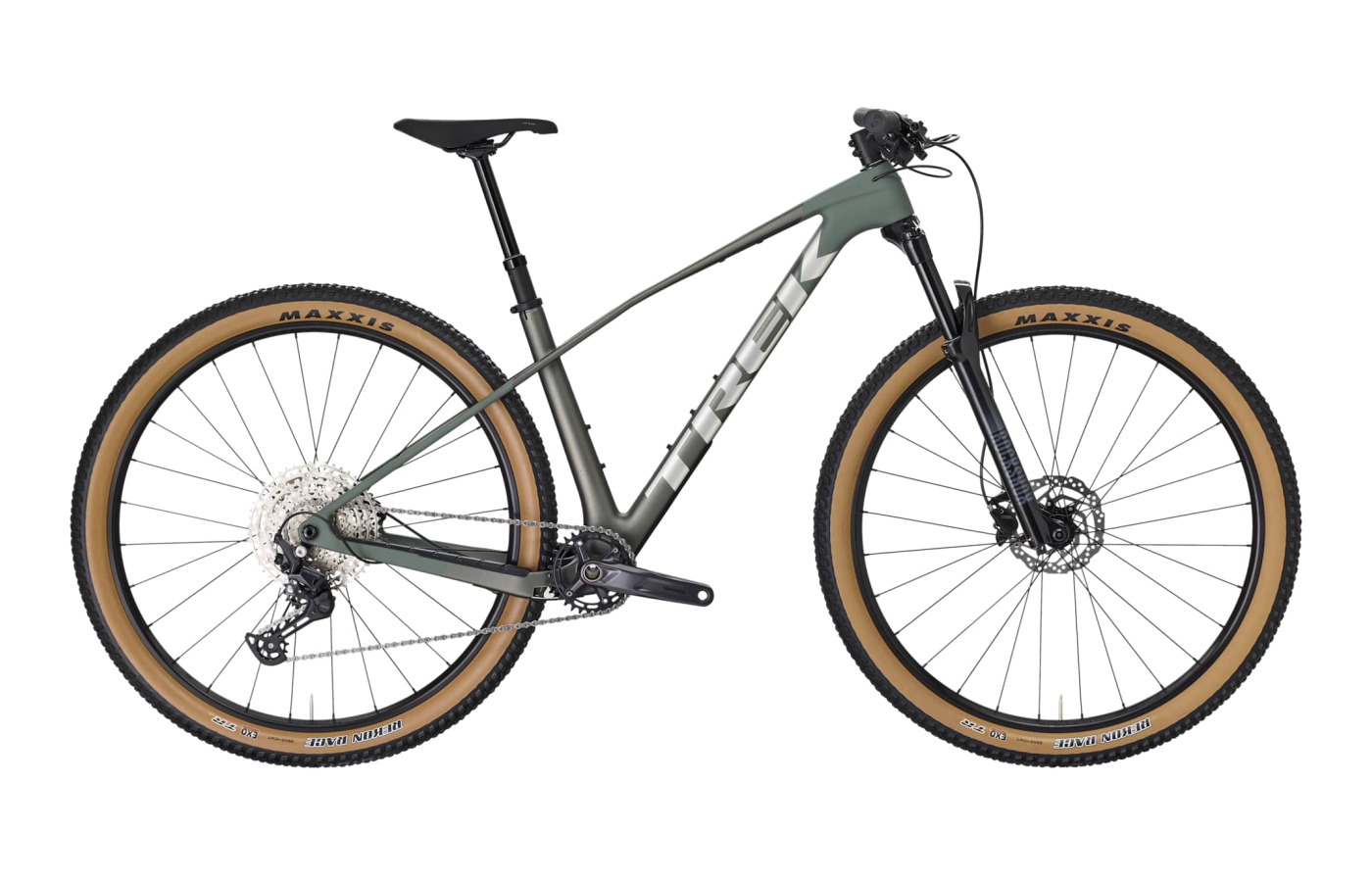
Trek ProcalibervsStache
The Procaliber's fixed 435mm chainstays on a size ML are actually longer than the shortest setting on the massive 29+ Stache, a geometry flip that tells you everything about these bikes. One is a surgical instrument for cross-country efficiency, while the other is a balloon-tired experiment in physics-defying agility.

Overview
Trek designed the third-generation Procaliber to survive the increasingly technical landscape of modern XC racing without losing the energetic snap of a hardtail. It uses the new IsoBow system—a structural design that lets the seatstays flex past the seat tube—to dull trail chatter while staying lighter and simpler than the previous IsoSpeed pivot. It is a bike built for high-speed climbing and reactive handling on courses where every gram counts. The Stache exists in a space Trek has largely moved away from, using 3-inch-wide 'plus' tires to act as a form of suspension. It trades the surgical precision of the Procaliber for a 'monster truck' personality that flattens rocks and roots. While the Procaliber is about raw speed and pedaling efficiency, the Stache is a momentum machine that requires significant effort to get moving but becomes nearly unstoppable once it hits a rolling 'tipping point' on technical terrain. Positioning differs significantly across the builds. The Procaliber 9.5 Gen 3 uses a single frame strategy, meaning the entry-level carbon build shares the same 1,200g frame as the flagship models. The Stache was offered in both Alpha Platinum Aluminum and carbon versions, with the carbon 9.8 models being highly sought after for shedding the rotational weight that can make the alloy builds feel like a chore on sustained climbs.
Ride and handling
Stamping on the pedals of the Procaliber yields an immediate, direct-drive sensation. Reviewers note an 'energetic snap' when sprinting, as the OCLV Mountain Carbon frame prioritizes lateral stiffness. The IsoBow tech is subtle; it doesn't offer the plushness of a rear shock, but rather a 'slight dulling' of hard impacts. It rewards a rider who stays active, using the 120mm RockShox SID or Judy fork to navigate technical sections while relying on the frame's efficiency to gap competitors on the climbs. The Stache handles like a hovercraft. With 3-inch Bontrager Chupacabra tires aired down to roughly 12-15 psi, it provides a 'pillowy goodness' that isolates the rider from trail feedback. You don't pick surgical lines on a Stache; you barge through them. However, that traction comes with a learning curve. If tire pressures are off by even 2 psi, the bike can feel 'squirrely' or 'floaty' in high-speed corners. While the Procaliber is nippy and precise, the Stache is stable and planted, using its massive gyroscopic inertia to hold a line through loose scree. Descending reveals the biggest gap in character. The Procaliber's 67-degree head angle and four-piston brakes provide a safety net for steep chutes, but the rear end remains a true hardtail that demands technical skill. The Stache bridges the gap toward a full-suspension feel, with its massive tires absorbing drops and jumps with a 'cushy' sensation that masks the lack of a rear pivot. It makes old, familiar trails feel new by opening up lines that would stall a standard 29er.
Specifications
The Procaliber 9.5 Gen 3 is a frame-first build, offering a world-class OCLV carbon chassis paired with more modest components like a RockShox Judy Gold fork and Shimano MT200 brakes. These brakes are a weak link for aggressive riders, as they lack the bite needed for the high speeds the geometry encourages. In contrast, the top-tier Procaliber 9.7 (often cited in reviews) steps up to a SRAM GX Transmission and carbon wheels to fully realize the frame's 'zingy' potential. Stache specs were often more adventurous, reflecting its trail-riding intent. The Stache 9 and 9.8 builds featured the Manitou Magnum Pro, a fork specifically built with a wider crown to clear plus-sized tires. This fork's Dorado air spring is a highlight, offering a supple top end that cancels out the natural 'bounce' of high-volume rubber. Many Stache owners immediately ditched the heavy stock tubes; converting to tubeless is mandatory here, as it can shed nearly 700g of rotational mass from the massive 50mm SUNringlé Mulefüt rims. Value at the entry level is surprisingly competitive on the Procaliber 9.5 at $2,699, though the Stache 5 was a standout for simplicity, often coming with a rigid carbon 'Bowie' fork. That rigid build relied entirely on tire volume for damping, creating a low-maintenance bikepacking rig that few modern bikes can match. For riders who want a 'do-it-all' tool, the Stache's Stranglehold dropouts allowed it to swap between 29+, standard 29er, or even 27.5+ wheels, a level of versatility absent from the Procaliber's racing-focused design.
| Procaliber | Stache | |
|---|---|---|
| FRAMESET | ||
| Frame | Alpha Platinum Aluminum, tapered head tube, internal routing, BSA 73, hidden rack and kickstand mounts, UDH, Boost148, 12mm thru axle | — |
| Fork | RockShox Judy Silver, Solo Air spring, TurnKey lockout, tapered steerer, 42mm offset, Boost110, 15mm Maxle Stealth, 120mm travel | — |
| Rear shock | — | — |
| GROUPSET | ||
| Shift levers | Shimano Deore M6100, 12-speed | — |
| Front derailleur | — | — |
| Rear derailleur | Shimano XT M8100, long cage | — |
| Cassette | Shimano Deore M6100, 12-speed, 10-51T | — |
| Chain | Shimano Deore M6100, 12-speed | — |
| Crankset | Shimano MT512, 30T ring, 55mm chainline (Size S,M: 170mm length; Size ML,L,XL: 175mm length) | — |
| Bottom bracket | Shimano BB-MT501 BSA | — |
| Front brake | Shimano MT200 hydraulic disc | — |
| Rear brake | Shimano MT200 hydraulic disc | — |
| WHEELSET | ||
| Front wheel | Bontrager Kovee, double-wall, Tubeless Ready, 28-hole, 23mm internal width, Presta valve; Shimano TC500 alloy, Center Lock, 110x15mm thru axle | — |
| Rear wheel | Bontrager Kovee, double-wall, Tubeless Ready, 28-hole, 23mm internal width, Presta valve; Shimano TC500 alloy, Center Lock, 148x12mm thru axle | — |
| Front tire | Maxxis Rekon Race, Tubeless Ready, EXO casing, folding bead, 60tpi, 29x2.40 (Sizes S/M/ML/L/XL) | — |
| Rear tire | Bontrager Sainte-Anne Pro XR, Tubeless Ready, dual compound, aramid bead, 60tpi, 29x2.20 (Sizes S/M/ML/L/XL) | — |
| COCKPIT | ||
| Stem | Bontrager Comp/Elite, 31.8mm, Blendr compatible, 7° (Size S: 50mm; M/ML: 60mm; L: 70mm; XL: 80mm) | — |
| Handlebars | Bontrager alloy / Bontrager Comp alloy, 31.8mm (Size S/M: 5mm rise, 720mm width; Size ML/L/XL: 15mm rise, 750mm width) | — |
| Saddle | Verse Short, steel rails, 145mm width | — |
| Seatpost | Bontrager Line Dropper, MaxFlow, internal routing, 31.6mm (Size S/M: 100mm travel, 310mm length; Size ML/L: 150mm travel, 410mm length; Size XL: 170mm travel, 450mm length) | — |
| Grips/Tape | Bontrager XR Trail Comp / Trek Line Comp, nylon lock-on | — |
Geometry and fit comparison
Modern XC geometry has finally caught up to trail bikes, with the Procaliber sporting a 67-degree head angle that is actually slacker than the Stache's 68.4 degrees. This makes the Procaliber surprisingly capable on steep, technical descents. However, the Procaliber’s 309mm bottom bracket height is a double-edged sword. While it provides a low center of gravity for 'on-rails' cornering, it makes the bike prone to pedal strikes in chunky terrain where the Stache simply rolls over obstacles. The Stache's defining geometry trait is its 405-420mm adjustable chainstay length. Achieving this with 29+ tires required an elevated 'mid-stay' design. This ultra-short rear end makes the Stache 'BMX-like' in its ability to manual and bunnyhop, despite the giant wheels. On the size ML Procaliber, the 435mm chainstays feel more traditional, focusing on stability and climbing traction rather than the playful 'flickability' of the Stache. Fit-wise, the Procaliber's 445mm reach (size ML) and 72-degree seat tube angle put the rider in an efficient, aggressive pedaling position. The Stache feels more upright and 'in the bike,' a sensation aided by the massive tire circumference which effectively raises the hubs relative to the bottom bracket. While the Procaliber is optimized for a 'stretched out' racing tuck, the Stache suits a more neutral, trail-oriented body position that works well for long days in the saddle or bikepacking adventures.
| FIT GEO | Procaliber | Stache | |
|---|---|---|---|
| Stack | 614 | — | — |
| Reach | 460 | — | — |
| Top tube | 628 | — | — |
| Headtube length | 90 | — | — |
| Standover height | 763 | — | — |
| Seat tube length | 460 | — | — |
| HANDLING | Procaliber | Stache | |
|---|---|---|---|
| Headtube angle | 67 | — | — |
| Seat tube angle | 72.5 | — | — |
| BB height | 309 | — | — |
| BB drop | 64 | — | — |
| Trail | — | — | — |
| Offset | 43 | — | — |
| Front center | — | — | — |
| Wheelbase | 1171 | — | — |
| Chainstay length | 435 | — | — |
Who each one is for
Trek Procaliber
Riders who live for the local Tuesday night race series or want a gravel bike that can actually handle singletrack will prefer the Procaliber. It is a tool for the person who values raw climbing speed and wants a lightweight carbon frame that rewards out-of-the-saddle efforts. If your trails are fast, flowy, and technical in a 'cross-country' sense, the Procaliber's surgical handling is the right choice.
Trek Stache
The Stache is for the technical trail rider who wants to clear ledgey, root-infested climbs without the complexity of a rear shock. It is ideal for bikepackers who need a platform that can roll through sand or mud while carrying a load, or for anyone who values 'hooting with delight' on a rowdy descent more than chasing a Strava PR. It's the perfect choice if your local terrain is chunky and requires a bike that can 'barge' through line choices.