Habit
vsStumpjumper
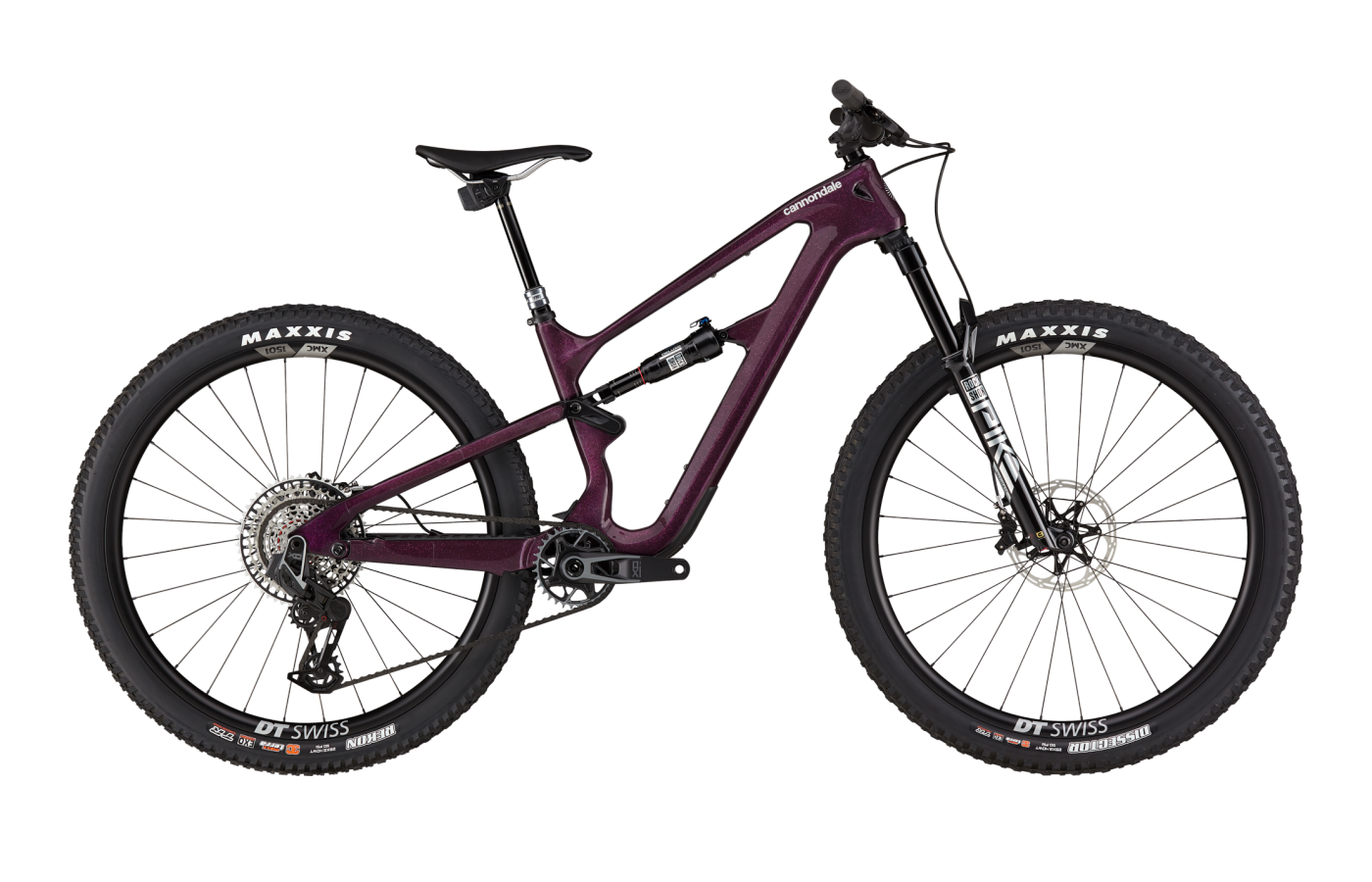
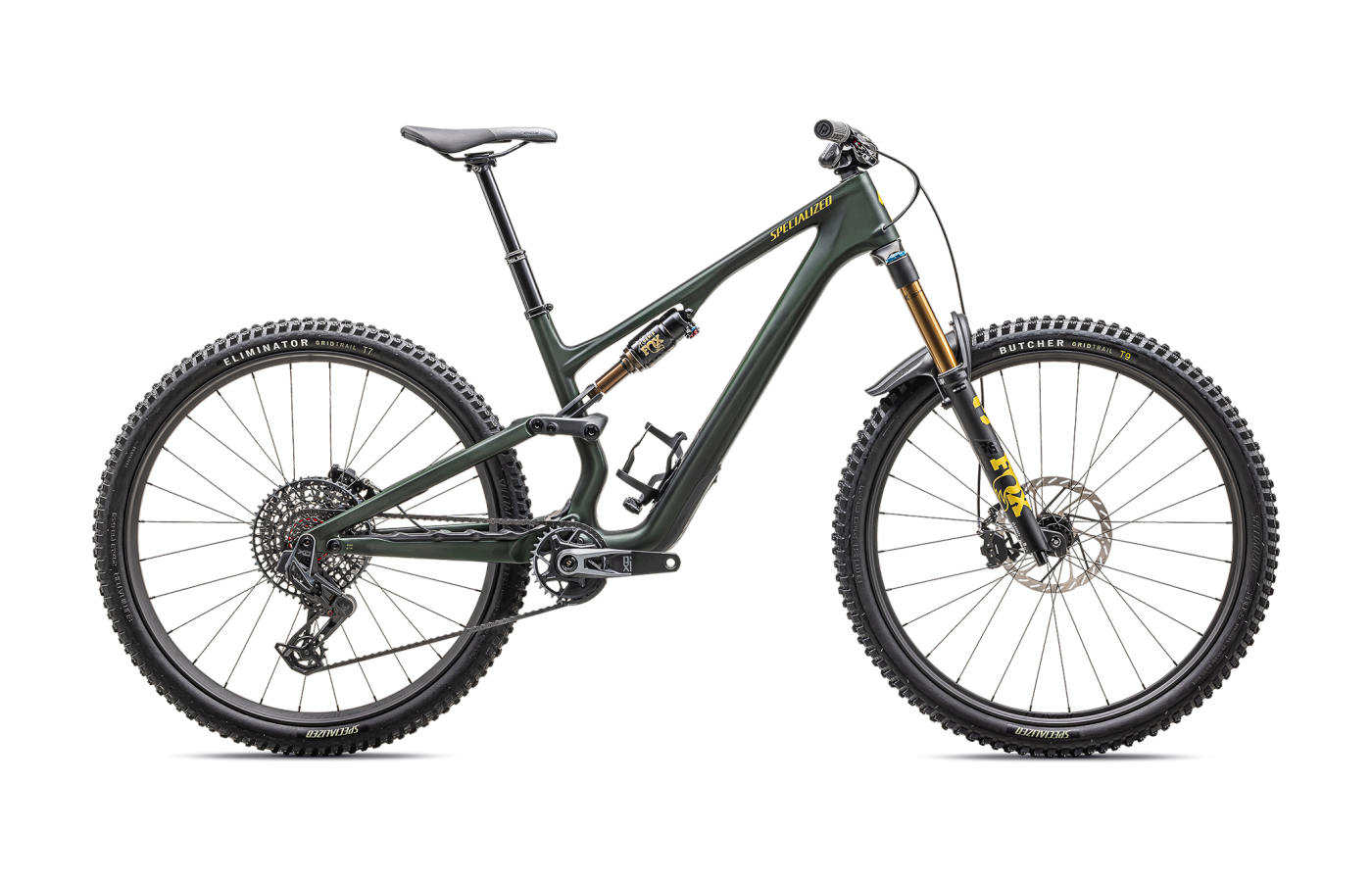
Two trail bikes, two answers to the same question.
The Habit keeps it simple — a 130 mm Horst-link with no proprietary parts. The Stumpjumper 15 throws everything at the wall: 145 mm, GENIE shock, adjustable everything.
Habit
- Simpler everything — standard shock, standard cable routing, no proprietary parts to age out.
- Per-size tuning — chainstays grow 434 to 445 mm with frame size, so balance stays consistent across XS to XL.
- Friendlier price floor — the alloy Habit 4 starts at $2,300 and the carbon LTD tops out at $6,800.
- Less travel (130 / 140 mm) means less bike-park headroom than the Stumpy.
- Conservative 65.5-degree head tube angle feels nervous on the steepest, fastest descents.
Stumpjumper
- More travel, more range — 145 mm rear / 150 mm fork covers everything from XC to enduro-light without flinching.
- Adjustable geometry — headset cups swing the head angle from 63° to 65.5°; a flip chip drops the BB. One frame, three personalities.
- GENIE shock — supple in the early stroke, ramped at the end; reviewers consistently call out exceptional traction and bottom-out resistance.
- Carbon frames are wireless-only — no mechanical drivetrain compatibility, full stop.
- Pricing scales hard: Pro and S-Works builds run $8,000 to $12,000.
Editor’s analysis
One bike trusts geometry to do the work. The other engineers around it — and asks you to pay for the privilege.
Both bikes live in the modern trail-bike core: 29-inch wheels (or mullet on the smaller Stumpjumper sizes), four-bar Horst-link suspension, sub-66-degree head tube angles, dropper-friendly geometry. From across the trailhead they look like the same bike, painted different colors. Spend a session on each and the philosophies couldn't be further apart.
The Cannondale Habit is the conventional play — 130 mm rear, 140 mm fork, a clean four-bar with one rear shock setting per build and not much else to fiddle with. Cannondale's pitch is Proportional Response: chainstays grow with frame size (434 mm on small, 445 mm on XL), and the suspension kinematics are tuned per size so a tall rider and a short rider get the same balance. It's a bike that asks you to ride it, not configure it. The carbon LTD tops out at $6,800 — a relative bargain for a flagship trail build.
The Specialized Stumpjumper 15 commits to the opposite premise. 145 mm of rear travel, 150 mm fork, adjustable head angle (63° / 64.5° / 65.5° via three headset cups), a flip chip, and the proprietary GENIE shock — a dual-chamber air spring that runs supple-to-coil-like for the first 70% of stroke, then ramps hard to prevent bottom-outs. Reviewers describe the rear end as "glued" to rough ground; some complain the mid-stroke feels wallowy until you add volume bands. Either way, the bike rewards riders who tinker. The Pro build is $8,000.
Put another way: the Habit is the bike for the rider who already knows what they want from a trail bike. The Stumpjumper 15 is the bike for the rider who wants one machine that can be a different bike depending on the weekend — XC marathon, bike-park lift laps, and everything between.
Where the builds differ.
Comparing our editor's-pick builds side-by-side. Winners highlighted row-by-row — lower price and weight, and the better-spec component, each mark a point.
Build variants & pricing
The Habit spans $1,599 to $6,799 — the widest entry-to-flagship range in this class. The Stumpjumper 15 starts at $2,999 and reaches $11,999.
Editor's picks here are the Habit LTD and the Stumpjumper 15 Pro — both run SRAM AXS Transmission (XO and X0) on full carbon frames, the closest apples-to-apples pairing between the two lineups. Cannondale doesn't offer an X0 AXS-equivalent below the LTD; Specialized doesn't sell the Stumpjumper 15 below $3,000.
How they fit, how they steer.
Habit MD vs Stumpjumper 15 S3 — fit-picked sizes for a 5'8" rider on each bike. Reach is essentially identical (455 vs 450 mm); the Stumpy sits 5 mm lower in the stack, runs a full degree slacker up front (64.5° vs 65.5°), and parks the rider 6 degrees more forward (77° vs 71° seat tube angle).
Which size should I buy?
Habit sizes XS through XL; Stumpjumper sizes S1 through S6. The Stumpjumper's S-sizing decouples reach from seat tube length, so picking a size is closer to picking a reach number.
→These are starting points. Flexibility, riding style, and preferred position all shift the answer — if you’re between sizes, a professional fit beats a chart.
What the magazines said.
Published reviews from trusted cycling outlets. Click through for the full write-up.
Which one should you buy?
If you want a quiet, reliable trail bike that just works, get the Habit. If you want one platform that adapts from XC to bike park, get the Stumpjumper 15.
Habit
If you ride local woods, value standard parts, and want a bike that works the same on year five as it did on day one — the Habit is the cleaner choice. The Proportional Response per-size tuning is genuinely useful at the size extremes. Skip the Stumpy's gadget cost.
Stumpjumper
If you want one bike for XC days, after-work trail laps, and bike-park weekends — the adjustable geometry and 145 mm GENIE platform genuinely cover that range. You'll pay for it, and you'll learn to live with the proprietary shock and wireless-only carbon frames.
Questions buyers actually ask.
Short answers to the things we get emailed about most often.
01Which bike has more travel?
The Stumpjumper 15 by 15 mm out back and 10 mm up front — 145 mm rear / 150 mm fork vs 130 mm rear / 140 mm fork on the Habit. That's enough difference to feel on bigger hits, drops, and bike-park terrain.
If you want more cushion from Cannondale, look at the Habit LT, which uses the same frame with 10 mm more travel at both ends. Specialized used to split the Stumpjumper and Stumpjumper EVO but consolidated them into the 15 for 2025.
02How adjustable is each bike's geometry?
Stumpjumper 15: three headset cups swing the head tube angle between 63°, 64.5°, and 65.5°. A flip chip in the rear linkage adjusts BB height. You can run mixed wheels (29 front / 27.5 rear) on S3-S6 with an aftermarket link.
Habit: no headset cup adjustment, no flip chip. What you see in the geometry chart is what you get. Cannondale's argument is that Proportional Response — per-size chainstay length and tuned suspension kinematics — already does the per-rider tailoring that flip chips approximate.
03Which has better small-bump compliance?
The Stumpjumper 15, by most reviewer accounts. The GENIE shock's dual-chamber design gives the first 70% of travel a large air volume and a coil-like initial stroke — Flow Mountain Bike called the rear wheel "glued-like" to the ground on chunky climbs. Specialized claims 57% more traction; the real-world reviews back the direction even if the number is marketing.
The Habit's RockShox Deluxe shock is conventional — perfectly competent, not a standout. If small-bump tracking matters more than anything else on your trails, the Stumpy wins.
04What about climbing?
The Stumpjumper 15 has a steeper effective seat tube angle (76.5° to 77°) that puts you more squarely over the bottom bracket on steep climbs — the Habit's 71° actual STA on size MD feels more relaxed and rearward by comparison.
Where the Habit pulls back ground: it's lighter (the Carbon 1 around 13.4 kg measured vs 14.15 kg for the Stumpjumper Pro), has a simpler suspension that wastes fewer watts on smooth climbs, and runs less travel to bob through. Net: the Stumpy climbs technical terrain better, the Habit climbs smooth fire roads more efficiently.
05Are the carbon frames wireless-only?
Stumpjumper 15 carbon: yes. The carbon frames have no internal routing for mechanical derailleur cable, which means SRAM AXS Transmission only. Shimano XT mechanical, Shimano Di2, and any cable-shifted setup are off the table on carbon.
Stumpjumper 15 Alloy: retains mechanical routing — the alloy builds ship with Shimano SLX or Deore.
Habit: all builds (alloy and carbon) have conventional internal routing and accept mechanical or wireless drivetrains. If you want to run XT cable-shift on a carbon trail bike, the Habit is your option here.
06How serviceable is the GENIE shock long-term?
Specialized states the GENIE uses mostly standard Fox internals with one additional seal beyond a normal Fox Float — meaning any qualified suspension shop can service it. The shock body sits in a standard 210x55 mm format, so swapping back to a conventional Fox Float or DHX is mechanically possible if Specialized ever stops supporting the platform.
That said, reviewer skepticism around proprietary Specialized suspension (Brain, Autosag, etc.) is fair history. If you want to never think about whether your shock is still in the parts catalog in 2032, the Habit's standard RockShox Deluxe is the safer bet.
07Which is the better bike-park bike?
The Stumpjumper 15, by a clear margin. 15 mm more rear travel, 10 mm more fork travel, slacker head tube angle (down to 63° in the slack headset cup setting), and the GENIE shock's progressive ramp specifically targets hucks and big hits without bottoming out.
The Habit can survive a bike-park day on a 130 mm chassis but it's outside the design intent. If most of your riding involves chairlifts, look at the Habit LT (140/150 mm) instead — same Cannondale frame philosophy, more travel.
08What's the warranty situation?
Specialized: lifetime frame warranty and lifetime pivot bearing replacement to the original owner. Crash replacement pricing available.
Cannondale: lifetime frame warranty to the original owner. Crash replacement available through the dealer network.
Both platforms have established dealer networks, which matters more than the warranty fine print — having a shop that knows your bike makes a meaningful difference on a full-suspension platform.
Similar bikes
If your priorities don’t map cleanly onto either of these, one of these adjacent bikes probably fits better.
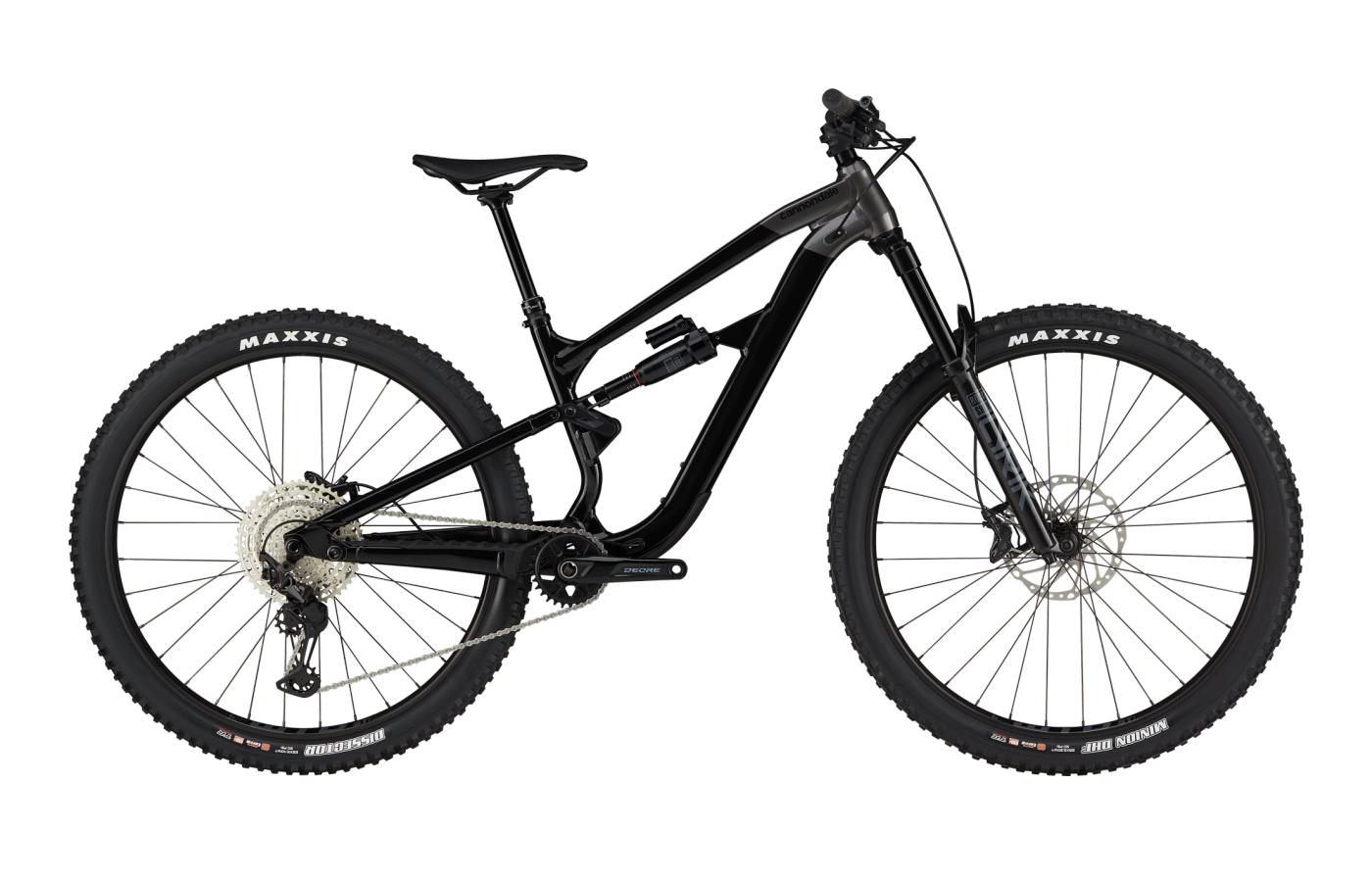
Habit LT
The Habit's longer-travel sibling — same frame, 10 mm more at each end. The right move if the regular Habit feels under-gunned for your trails but you want to stay in the Cannondale lineup.
Compare →
Ripmo AF
DW-link suspension, alloy frame, fully cable-friendly. For riders who want Stumpjumper-tier traction without the proprietary shock or the wireless-only mandate.
Compare →
Fuel EX
Trek's adjustable trail bike with downtube storage and a Mino Link flip chip. Less aggressive than the Stumpjumper 15 in stock trim but covers similar do-it-all ground with a more conventional shock.
Compare →