Sender
vsDemo
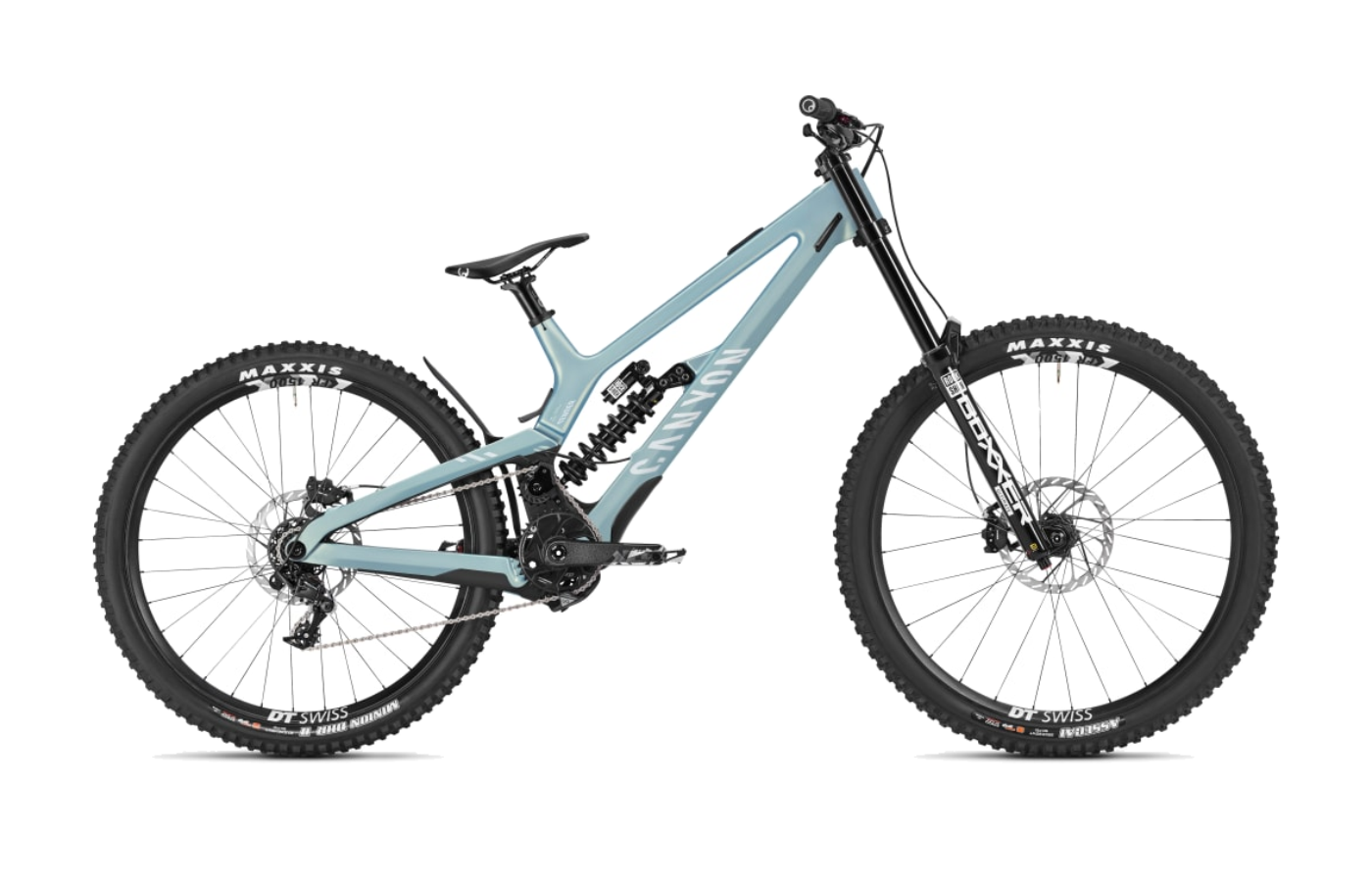
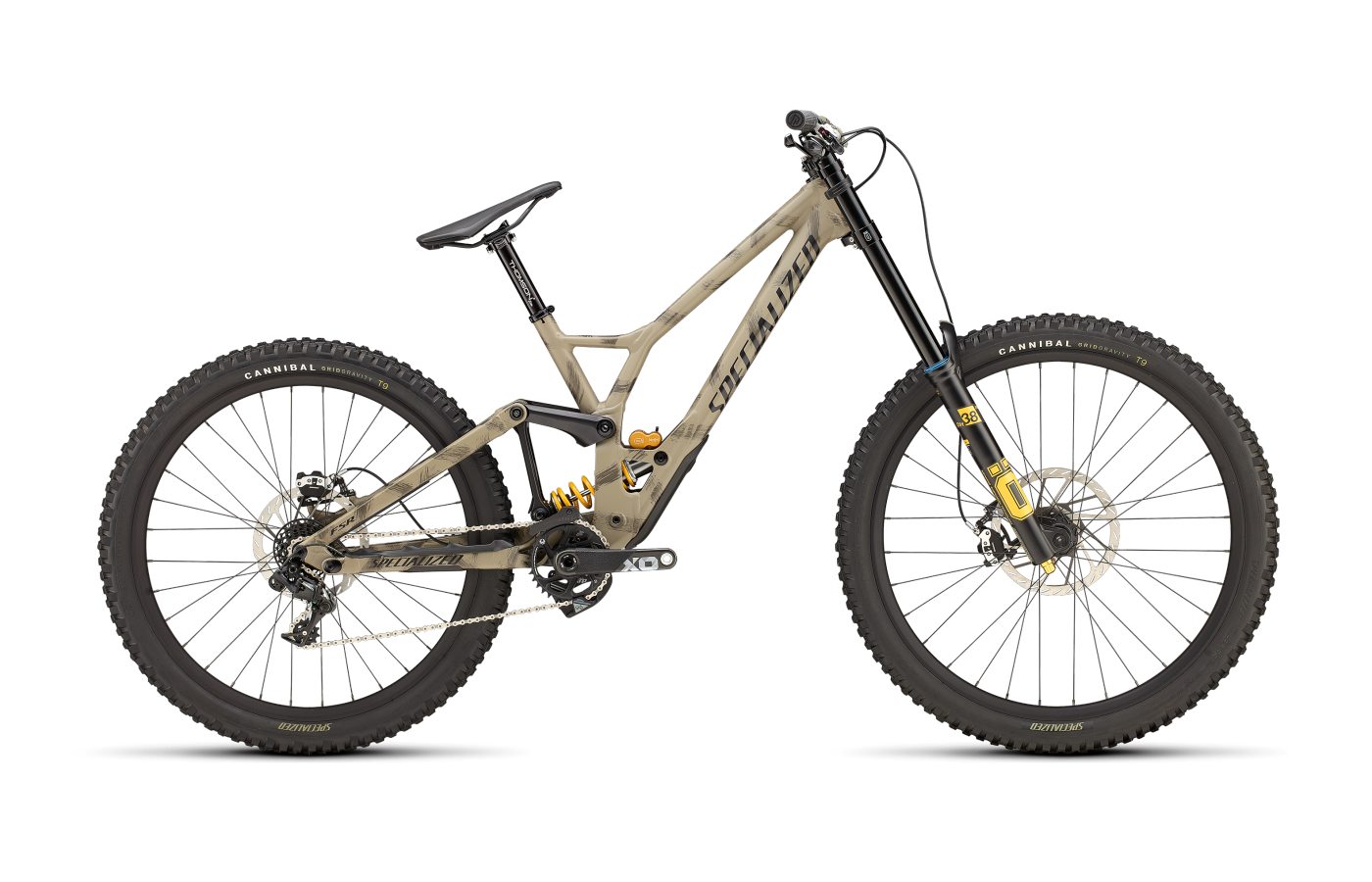
Two World Cup race sleds, two design religions.
The Canyon Sender is a carbon high-pivot built to chase tenths. The Specialized Demo is an alloy Horst-link tank built to survive a season.
Sender
- High-pivot momentum carry — 17.5 mm rearward axle path lets the rear wheel get out of the way of square-edged hits, exactly what wins on rough World Cup tracks.
- Frame adjustability — +/- 8 mm reach-adjust headset cups, 5 mm BB flip-chip, and a rotatable shock mount that swaps between linear and progressive curves.
- Lighter for the class — Canyon's CFR carbon frame undercuts the Demo's alloy chassis and ships at the same $7,799 ballpark.
- Demands an active, committed rider — multiple reviewers noted it feels underutilized when ridden passively.
- Pedal strikes are common even in the high-BB setting; some testers stiffened the spring to mitigate.
Demo
- Confidence from the first lap — neutral, intuitive attack position; testers consistently call it the easiest DH bike to jump on and ride fast.
- Maven Ultimate brakes + Ohlins DH38/TTX22 — a sharper top-tier braking and damping package than the Sender's Maven Silver and RockShox Vivid Coil.
- Mechanic-friendly build — threaded BB, sealed cartridge pivots with proper lip seals, optional external brake routing, and standard 148 mm Boost rear spacing for easy wheel swaps.
- Alloy frame at a carbon-bike price — heavier (17.6 kg) than the Sender for the same money.
- Reach maxes at 466 mm on size S4; riders over 6'2" may find all three sizes cramped.
Editor’s analysis
This isn't a fight over which bike is faster on a stopwatch. It's a question of what kind of fast you want — the high-pivot freight train, or the intuitive plow.
Both the Canyon Sender and the Specialized Demo are 200/200 mm downhill bikes, both run mullet wheels, both come specced with SRAM X01 DH 7-speed and Maven 4-piston brakes, and both have World Cup wins on the resume. From across the pit, they look like the same kind of weapon. Spend any time on the geometry sheets and the build manifests, and the philosophies pull apart fast.
The Canyon Sender is the uncompromised race-only thesis. Carbon CFR frame, high-pivot MX-Link with an idler and a 17.5 mm rearward axle path, +/- 8 mm reach-adjust headset cups, a 5 mm flip-chip BB, and 468 mm of reach in size M (essentially Demo S4 territory). Reviewers are unanimous: it thrives when you hit things hard and fast, and feels underutilized when you don't. It rewards an active, committed rider with freight-train composure through chunder — and punishes passive ones.
The Specialized Demo takes the opposite bet. M5 alloy, classic Horst-link FSR (no idler, no rearward axle path), a flip-chip for 27.5 or 29 rear, and Specialized's compressed S2/S3/S4 sizing that maxes out at 466 mm reach. Where the Sender asks for commitment, the Demo is described over and over as a confidence machine — neutral attack position, planted under braking thanks to a 70% anti-rise bump, and easy to jump on and go fast immediately. The trade is less momentum carry through square-edged hits and a heavier 17.6 kg curb weight.
Spec-wise the Demo's Race build edges ahead on two race-day details: Maven Ultimate brakes (vs. the Sender's Maven Silver) and the Ohlins DH38/TTX22 suspension package, which testers consistently rate above the RockShox Vivid Coil for damping refinement. The Sender claws back integration and frame tech — Hit Carbon downtube, comprehensive integrated armor, Canyon's K.I.S. steering stabilizer. Put another way: the Canyon Sender is the bike you buy when the result sheet is the only thing that matters. The Specialized Demo is the bike you buy when you want to race weekends and survive bike park Mondays without rebuilding it.
Where the builds differ.
Comparing our editor's-pick builds side-by-side. Winners highlighted row-by-row — lower price and weight, and the better-spec component, each mark a point.
Build variants & pricing
Both platforms ship a single top build in North America. Canyon's CFR Team is $7,799; Specialized's Demo Race is $7,099.
Prices are current US MSRP. Canyon offers a more affordable CFR build with Fox Performance and SRAM GX DH outside North America; in the US, the CFR Team is the only Sender on offer. Specialized historically offered a cheaper Expert build, but the current lineup is Race-only.
How they fit, how they steer.
Sender M vs. Demo S3 — the fit-picked sizes for a 5'8" rider on each. The Sender is 22 mm longer in reach (468 vs. 446 mm) and a hair slacker on paper, while the Demo runs 5 mm longer chainstays. Same head-angle ballpark; very different cockpit length.
Which size should I buy?
Size recommendations based on stack, reach, and effective top tube. The Sender runs S/M/L/XL, the Demo uses Specialized's S2/S3/S4 — pick by reach, not letter.
→These are starting points. Flexibility, riding style, and preferred position all shift the answer — if you’re between sizes, a professional fit beats a chart.
What the magazines said.
Published reviews from trusted cycling outlets. Click through for the full write-up.
Which one should you buy?
If you're chasing a result sheet on rough, high-speed tracks, get the Canyon Sender. If you want a DH bike that's easy to live with and feels fast from your first run, get the Specialized Demo.
Sender
If your weekends are timing beams at Windrock or Snowshoe and you want a carbon high-pivot that'll happily eat the roughest sections of any World Cup-grade track, the Canyon Sender is built for you. It demands commitment — and rewards it with momentum almost no Horst-link bike can match.
Demo
If you want a DH bike that'll survive a heavy bike park season, feel intuitive from the first run, and let you spec spare wheels off your enduro bike thanks to standard 148 mm Boost spacing, the Demo is the smarter pick. Top-tier brakes and Ohlins suspension out of the box, no compromise on race pedigree.
Questions buyers actually ask.
Short answers to the things we get emailed about most often.
01Which is the faster race bike?
On stopwatch terms, both have World Cup wins to their name in the last two seasons, so the answer is genuinely rider-dependent. The Canyon Sender's high-pivot MX-Link with a 17.5 mm rearward axle path is engineered to carry momentum through square-edged hits in a way the Demo's Horst-link FSR can't quite match — on rough, high-speed tracks like Val di Sole or Snowshoe, that's where it pulls ahead.
The Specialized Demo is consistently described as easier to find speed on quickly. Reviewers across Pinkbike, Vital MTB, and Loam Wolf all note testers riding the Demo full-tilt on their first run. The Sender gives you more raw ceiling; the Demo lets you find your ceiling sooner.
02Carbon or aluminum — does it matter here?
It matters less than the marketing suggests. The Canyon Sender CFR is full carbon (with Hit Carbon in the downtube for impact resistance). The Specialized Demo is M5 aluminum throughout. Despite the material gap, real-world weights are close: the Sender is roughly 18.4 kg in size L (per Enduro MTB) versus 17.6 kg for the Demo Race in size S3 (per the build sheet) — small enough that it disappears under a 200 mm DH bike's overall mass.
Where the difference matters: the Demo's alloy chassis is genuinely more forgiving of crashes and easier for a privateer to crack-inspect. The Sender's carbon enables tighter tube shapes and the Hit Carbon impact zone, but a rock strike to the downtube is a more anxious moment.
03How does the suspension actually compare?
Two completely different platforms.
The Sender runs Canyon's high-pivot MX-Link with an idler pulley and a 17.5 mm rearward axle path from 0% travel to sag. That layout decouples chain tension from suspension activity and lets the rear wheel move backward on impacts, which is why it feels so composed in chunder. Anti-squat sits around 120-125% at sag, so it pedals well between sections; anti-rise is 124-130%, keeping the geometry stable under braking.
The Demo uses an updated Horst-link FSR with a more rearward axle path than the previous Demo 8 (but no idler), a 70% increase in anti-rise versus the prior gen, and a 300% increase in anti-squat. It pedals out of start gates well, plants under braking, but doesn't have the Sender's continuous square-edge munching.
04Do both have 27.5 / 29 mullet setups?
The Canyon Sender is mullet-only — 29" front, 27.5" rear, no flip-chip option to convert.
The Specialized Demo is genuinely flexible. Its frame includes a Horst-pivot flip-chip that lets you run either a full 29" rear or a 27.5" rear (mullet). Reviewers describe the full 29" config as the "monster truck" that maxes high-speed momentum carry, and the mullet as the more playful, corner-railing setup. The Race build ships mullet from the factory.
05Which has better brakes out of the box?
The Specialized Demo Race, by a clear margin. It ships with SRAM Maven Ultimate four-piston brakes — Maven's top tier, with the most refined lever feel and the best heat management in the family.
The Canyon Sender CFR Team ships with SRAM Maven Silver — same four-piston caliper, similar peak power, but a step down on lever modulation and finish. Both are powerful enough to lock the wheel on most descents; the Ultimate is the smoother, longer-lasting tool for sustained alpine runs.
06How serviceable are these for a home-mechanic privateer?
Both brands have done deliberate work to make a complex DH bike serviceable, but they get there differently.
The Sender has plenty of pivot points (high-pivot single-pivot with a multi-link rocker), but Canyon spec'd large pivot hardware, accessible non-drive-side bearings, threaded aluminum inserts at every bolt point (so you can't strip carbon), and fully guided internal cable routing. Spare parts were available at launch.
The Demo's Horst-link is mechanically simpler and uses 20 oversized cartridge bearings with proper lip seals to keep grease clean. The threaded BSA bottom bracket is a privateer-friendly choice, and the frame includes optional external brake routing — a clear nod to racers who need to swap a hose between runs without bleeding. One known issue: testers report internal cable rattle that often needs a foam-sleeve fix.
07What sizes do they come in, and which fits a 5'8" rider?
Canyon Sender: four sizes — S, M, L, XL. M (468 mm reach, 630 mm stack) is the fit-picked size for a 5'8" rider.
Specialized Demo: three S-sizes — S2, S3, S4. S3 (446 mm reach, 632 mm stack) is the fit-picked size for the same rider.
The geometry is very different. The Sender M and the Demo S4 are roughly comparable in reach (468 vs. 466 mm), while the Demo S3 sits closer to the Sender S in cockpit length. If you're between sizes on the Sender, the +/- 8 mm reach-adjust headset cups give you a real third option without changing frames. Riders over 6'2" should look closely at the Demo S4 reach — 466 mm is short for a modern DH bike and several reviewers found it cramped.
08Which one would survive a full bike park season better?
Both are built for it, but the Specialized Demo has a slight edge for the bike-park-every-weekend rider. M5 alloy is more forgiving of crashes, the threaded BSA BB is privateer-friendly, the 12x148 mm Boost rear hub lets you swap in a wheel from your enduro bike in a pinch, and the pivot bearings are designed around easy long-term service.
The Sender is hardly fragile — Hit Carbon downtube, integrated TPU armor everywhere, fenders, threaded inserts at every bolt — but it's a more complex linkage with an idler that adds wear points, and a carbon frame is always a more anxious thing to crash into a rock. Reviewers also flagged frequent pedal strikes that wear bash guards faster than you'd expect.
Similar bikes
If your priorities don’t map cleanly onto either of these, one of these adjacent bikes probably fits better.
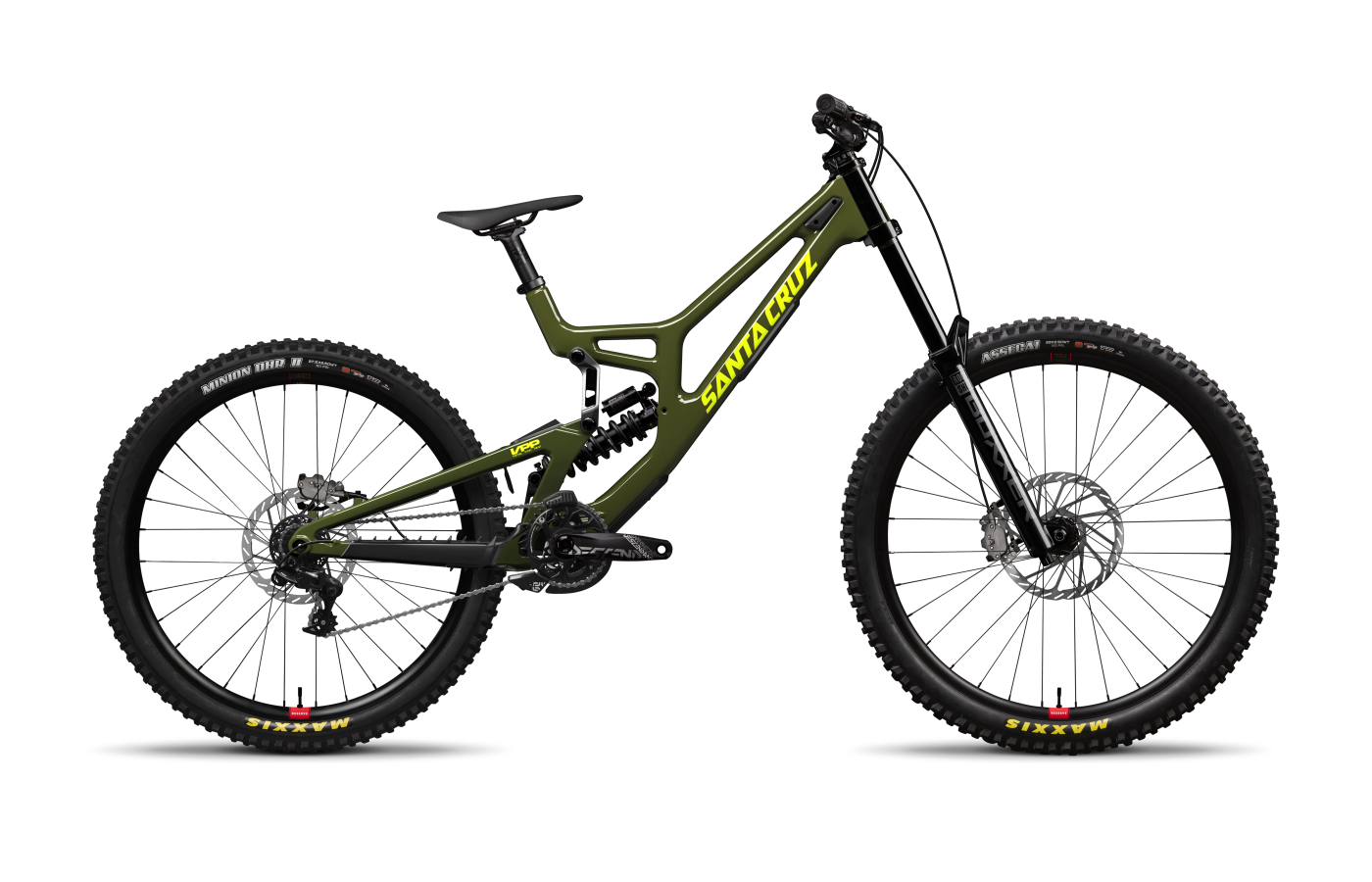
V10
The carbon Horst-link DH benchmark — refined, premium, and with arguably the deepest race pedigree in the segment. If you want carbon and Horst rather than carbon and high-pivot, this is the obvious move.
Compare →Session
Trek's high-pivot answer to the Sender, with a similar rearward axle path and the dealer network the direct-to-consumer brands don't offer. The right pick if you want the high-pivot character but value local service.
Compare →Tues
The other direct-to-consumer race rig in this price band — peppier and more poppy than the Sender, less of a freight train but more fun on jump lines. A good bridge between race bike and bike park toy.
Compare →