Cinder Cone
vsMarlin
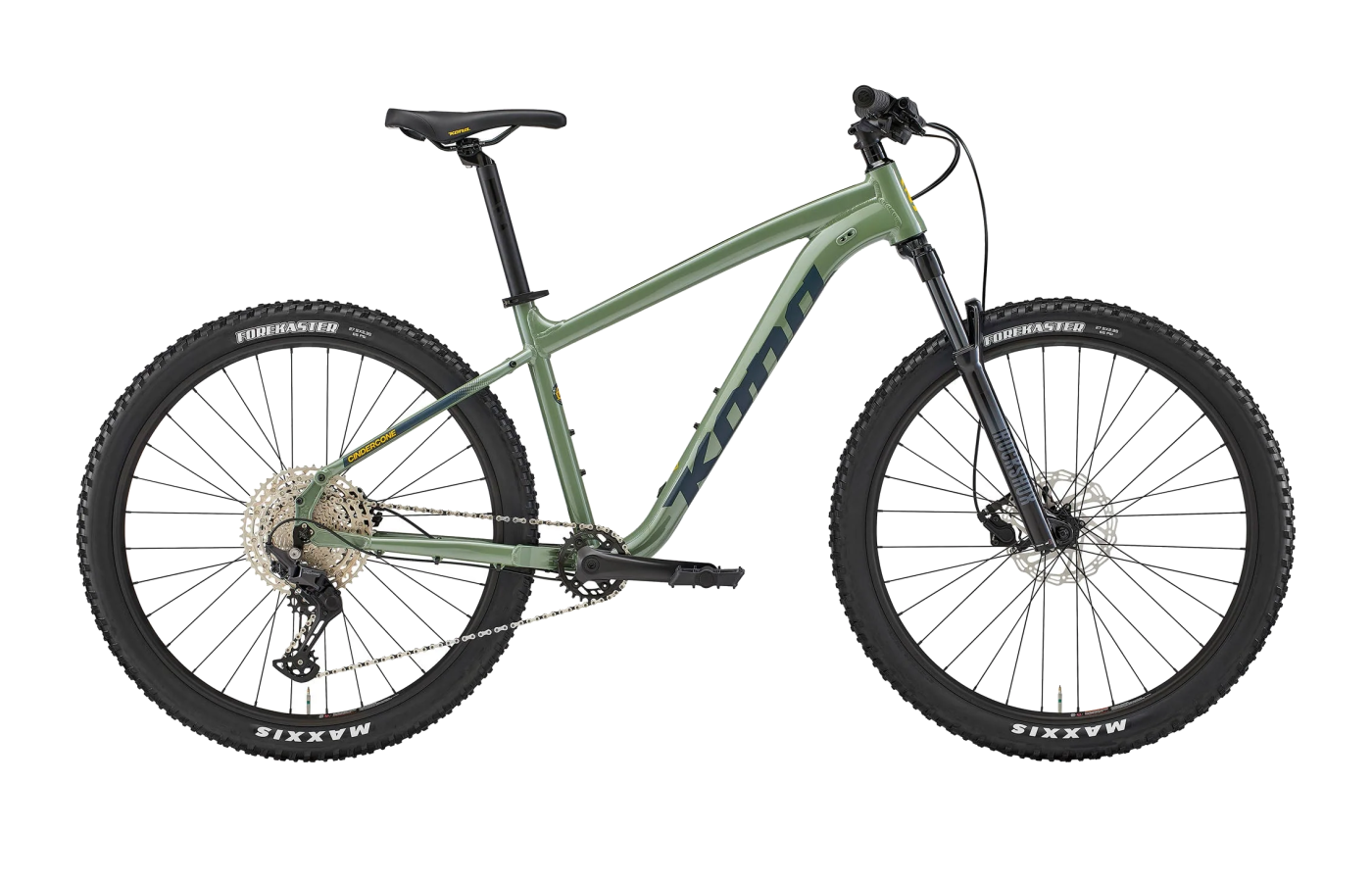
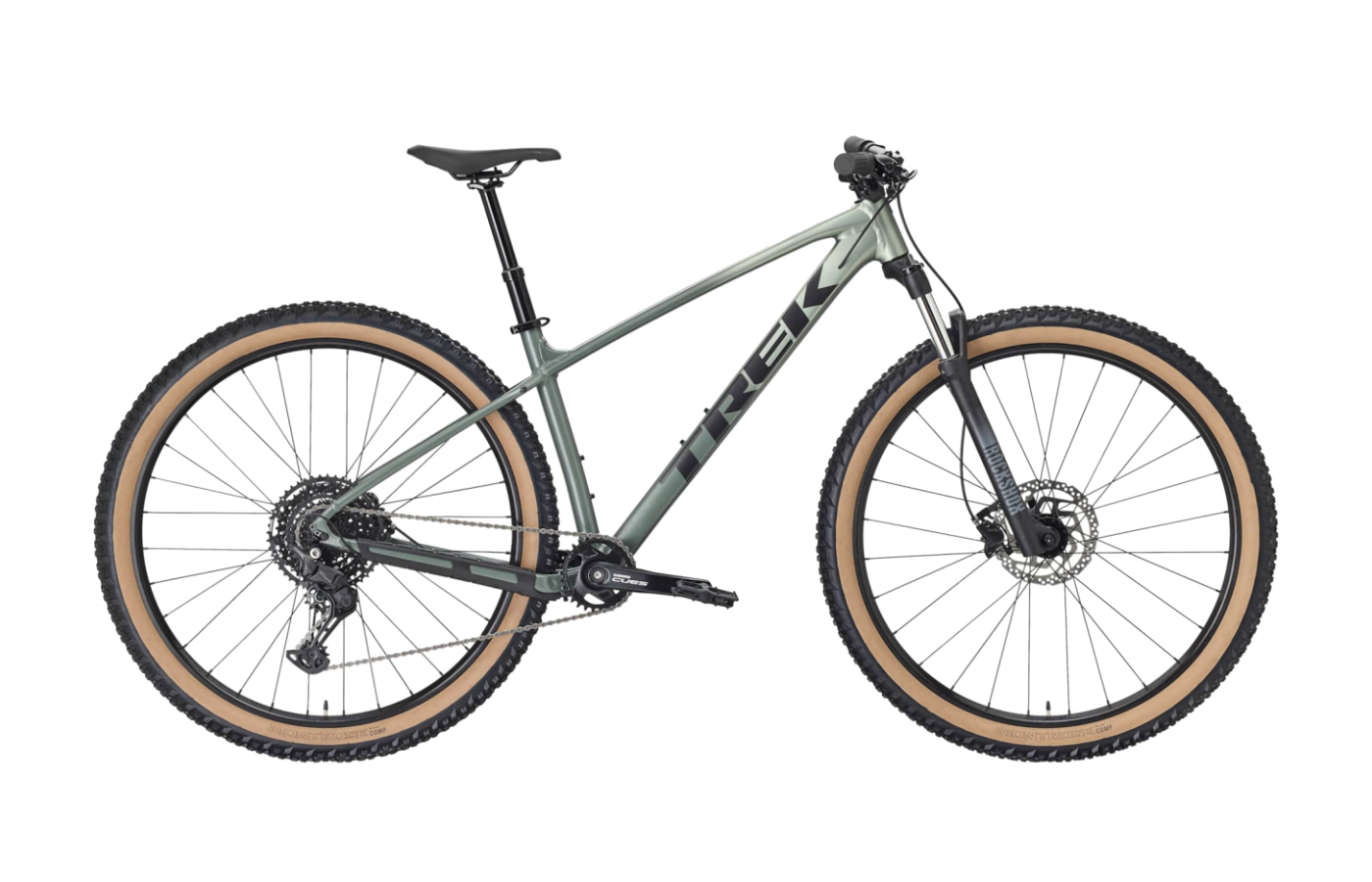
Two entry hardtails, two different jobs.
The Kona Cinder Cone is a focused trail hardtail at one price. The Trek Marlin Gen 3 is a four-build range that splits the difference between trail and commute.
Cinder Cone
- Air-sprung fork at $899 — a tuneable RockShox Judy Silver Solo Air with lockout, where most rivals at this price still ship coil.
- Single, well-judged spec — Shimano Deore 1x11 with an 11–51T cassette is, in reviewers' words, "bomb-proof fail-safe."
- Playful 27.5-inch handling — 435 mm chainstays and a 1,139 mm wheelbase (M) make it quick to flick into corners.
- Only one build — no cheaper trim to step down to if $899 is over budget.
- Quick-release rear axle limits future high-end wheel upgrades.
Marlin
- Four price points from $629 — the only one of these two that meets a sub-$700 first-bike budget.
- Slack, modern trail geometry — a 66.5° head angle and 1,163 mm wheelbase (M) are calmer and more planted on descents than the Kona.
- Built-in commuter mounts — pannier rack, fender, and kickstand bosses make dual-duty use real, not theoretical.
- Air fork only appears on the $1,399 Marlin 7 — the 4, 5, and 6 ride on coil.
- Straight 44 mm head tube and ThruSkew rear axle cap fork and wheelset upgrade options.
Editor’s analysis
On paper they're both sub-$1,000 alloy hardtails. In practice, one was built to rip singletrack and the other was built to do a little of everything.
The Kona Cinder Cone exists in exactly one configuration: a $899 Standard build with a RockShox Judy Silver TK Solo Air fork, Shimano Deore 1x11 (28T front, 11–51T cassette), and 27.5-inch Maxxis Forekaster trail tires. There's no "good", "better", "best" ladder — Kona picked one spec they thought was right at the price and committed. Reviewers agree they nailed it: an air-sprung fork and bomb-proof Deore drivetrain at $899 is the headline value play in this category.
The Trek Marlin Gen 3 is a four-step range — Marlin 4 ($629), 5 ($849), 6 ($999), 7 ($1,399) — built so the same frame can serve a $629 first-bike buyer or a $1,399 trail-curious one. The trade-off is that the air fork only shows up on the Marlin 7. The 4, 5, and 6 ride on coil forks, and the 4 and 5 use entry-level Suntour units that reviewers describe as springy and bob-prone under power.
Geometry tells the same story. The Trek Marlin Gen 3 runs a 66.5° head tube angle and 1,163 mm wheelbase in size M — slack and long for an entry hardtail, deliberately tuned to feel calm and planted on descents. The Cinder Cone's 68° head angle, 1,139 mm wheelbase, and 27.5-inch wheels are 1.5° steeper and 24 mm shorter, which gives it the playful, flickable character that reviewers consistently call out. The Marlin steepened its seat tube to 73.4°; the Kona is steeper still at 75°, putting you further over the bottom bracket on climbs.
Put another way: the Kona Cinder Cone is the bike you buy if you've already decided you want to ride trails, and you don't need a lower trim to make the budget work. The Trek Marlin Gen 3 is the bike you buy if you want one bike that commutes Monday through Friday and rides green-and-blue singletrack on Saturday — and which trim you pick depends on how much of that Saturday matters.
Where the builds differ.
Comparing our editor's-pick builds side-by-side. Winners highlighted row-by-row — lower price and weight, and the better-spec component, each mark a point.
Build variants & pricing
Kona offers one build at $899. Trek offers four, from $629 to $1,399 — picking the right Marlin trim matters more than picking between brands.
Editor's picks compare the $899 Cinder Cone Standard against the $999 Marlin 6 Gen 3 — the closest Marlin in price. Note the spec asymmetry: the Cinder Cone gets an air-sprung Judy Silver fork at this price, while the Marlin 6 ships with a coil Judy. Riders who want the Marlin with an air fork have to step up to the $1,399 Marlin 7, which then trades down to a SRAM SX Eagle drivetrain that reviewers consistently flag as the weak link.
How they fit, how they steer.
Both at size M. The Trek Marlin Gen 3 sits 10 mm taller in stack, has a 1.5° slacker head tube angle, and runs a 24 mm longer wheelbase — a calmer, more planted descender. The Kona Cinder Cone's 75° seat tube (vs 73.4°) puts you further forward on climbs.
Which size should I buy?
Size recommendations based on stack, reach, and effective top tube. The Marlin's range extends two sizes smaller (XXS and XS) than the Cinder Cone.
→These are starting points. Flexibility, riding style, and preferred position all shift the answer — if you’re between sizes, a professional fit beats a chart.
What the magazines said.
Published reviews from trusted cycling outlets. Click through for the full write-up.
Which one should you buy?
If you want a focused trail hardtail at the lowest price that still gets the right parts, get the Kona. If you need one bike that commutes and trails, or if $899 is over budget, get the Trek.
Cinder Cone
If you've decided the bike is for singletrack and skill progression — not commuting — the Cinder Cone is the better-spec'd choice at $899. The air fork, Deore 1x11, and 27.5-inch playful geometry are the right combination, and there's no cheaper trim because Kona didn't think you needed one.
Marlin
If the bike has to commute Monday and ride trails Saturday — or if you need to start under $700 — the Marlin is the better fit. The slacker geometry inspires confidence on descents, the rack and fender mounts make commuting real, and the four-trim ladder lets you match the spec to the budget.
Questions buyers actually ask.
Short answers to the things we get emailed about most often.
01Which has the better fork at the same price?
At the closest matched price points — Cinder Cone Standard ($899) vs Marlin 6 Gen 3 ($999) — the Kona wins clearly. The Cinder Cone ships with a RockShox Judy Silver TK Solo Air, an air-sprung fork with rebound adjustment and a lockout. The Marlin 6 ships with a coil-sprung RockShox Judy at the same 100 mm of travel.
Air forks are tuneable to rider weight via a shock pump, ride more progressively, and feel plusher at low speeds. The coil version is fine and reliable, but it's a fixed spring rate — heavier or lighter riders can't dial it in. To get the air fork on a Marlin you have to step up to the $1,399 Marlin 7.
02Which has the better drivetrain?
The Cinder Cone's Shimano Deore 1x11 with an 11–51T cassette is the consensus winner among reviewers — described in long-term tests as "bomb-proof fail-safe." The 28T front chainring paired with the 51T low gear gives strong climbing range.
The Marlin 6 Gen 3 runs Shimano CUES U6000 1x10, which is Shimano's newer entry-level group — reliable and cross-compatible across tiers, but one cog narrower in range. The Marlin 7 ($1,399) jumps to SRAM SX Eagle 1x12, but reviewers consistently flag SX as the weak point on that build, citing plastic derailleur components that tend to bend.
03Which is more capable on descents?
The Marlin Gen 3 has a meaningful geometry advantage on descents. Its 66.5° head tube angle is 1.5° slacker than the Cinder Cone's 68°, and its 1,163 mm wheelbase (M) is 24 mm longer than the Kona's 1,139 mm. Reviewers describe the Marlin as "stable and planted" on light trails and noticeably calmer at speed.
The Marlin 7 also ships with a dropper post stock, which is a genuine handling upgrade on descents. The Cinder Cone's frame is internally routed for a dropper, but you'd add it aftermarket.
That said, neither is a bike for black-diamond runs — both are 100 mm hardtails that reviewers describe as "easily overwhelmed" on aggressive terrain.
04Which is more fun in tight, twisty trails?
The Cinder Cone, by most accounts. Its 27.5-inch wheels, 435 mm chainstays, and 68° head angle combine into what reviewers consistently call "playful handling" — a bike you can "throw around with ease." The 75° seat tube angle also keeps you over the bottom bracket for snappy out-of-the-saddle efforts.
The Marlin Gen 3 runs 29-inch wheels on size M and up, with a slacker front end and a longer wheelbase. That trades the Kona's flickability for rollover and stability — better on flowy, faster terrain, less responsive in tight switchbacks.
05Can either work as a commuter?
Both will work, but the Marlin was designed for it. The Marlin Gen 3 ships with frame mounts for a pannier rack, fenders, and a kickstand — Trek explicitly markets it as dual-duty trail-and-commute.
The Cinder Cone has rack and mudguard bolt points too (one reviewer specifically called this out as a versatility win), but it's not as overtly commuter-tuned. The bigger issue is the tires: stock Maxxis Forekaster 27.5x2.35" knobbies are slow and noisy on pavement. You'd want a second set of wheels or smoother tires for daily commuting.
06What about future upgrades?
Both frames have upgrade limitations worth knowing about.
Cinder Cone: Quick-release rear axle. Most premium aftermarket wheelsets use bolt-through axles, so a serious wheel upgrade isn't straightforward. The frame is internally routed for a dropper post, which is the most impactful aftermarket addition.
Marlin Gen 3: Two limitations. The rear uses Trek's ThruSkew system (a quick-release that threads into a closed dropout), and the head tube is straight 44 mm rather than tapered. Reviewers note that upgrading to a fork with a tapered steerer means also replacing the headset. The frame is rated to take a 120 mm fork.
For riders who plan to upgrade aggressively, the Trek Roscoe (one tier up at Trek) avoids both issues.
07Which is heavier?
Both are in the same weight class. The Cinder Cone is reported at around 14.4 kg in long-term reviews. The Marlin 6 Gen 3 is 15.0 kg in size M (Trek's published spec), the Marlin 7 is 14.15 kg, and the Marlin 5 is 15.1 kg.
Most reviewers note the weight isn't ideal but isn't a deal-breaker for the use case — these are entry-level alloy hardtails, not race bikes. As one tester put it, lighter riders may notice the heft on long climbs more than heavier riders will.
08What warranty do they come with?
Both brands offer strong long-term frame coverage. Kona provides a 25-year frame warranty on the Cinder Cone — explicitly called out by reviewers as a standout selling point at this price. Trek provides a lifetime frame warranty on the Marlin Gen 3, which reviewers describe as a "killer argument" for choosing it over no-name budget rivals.
Similar bikes
If your priorities don’t map cleanly onto either of these, one of these adjacent bikes probably fits better.
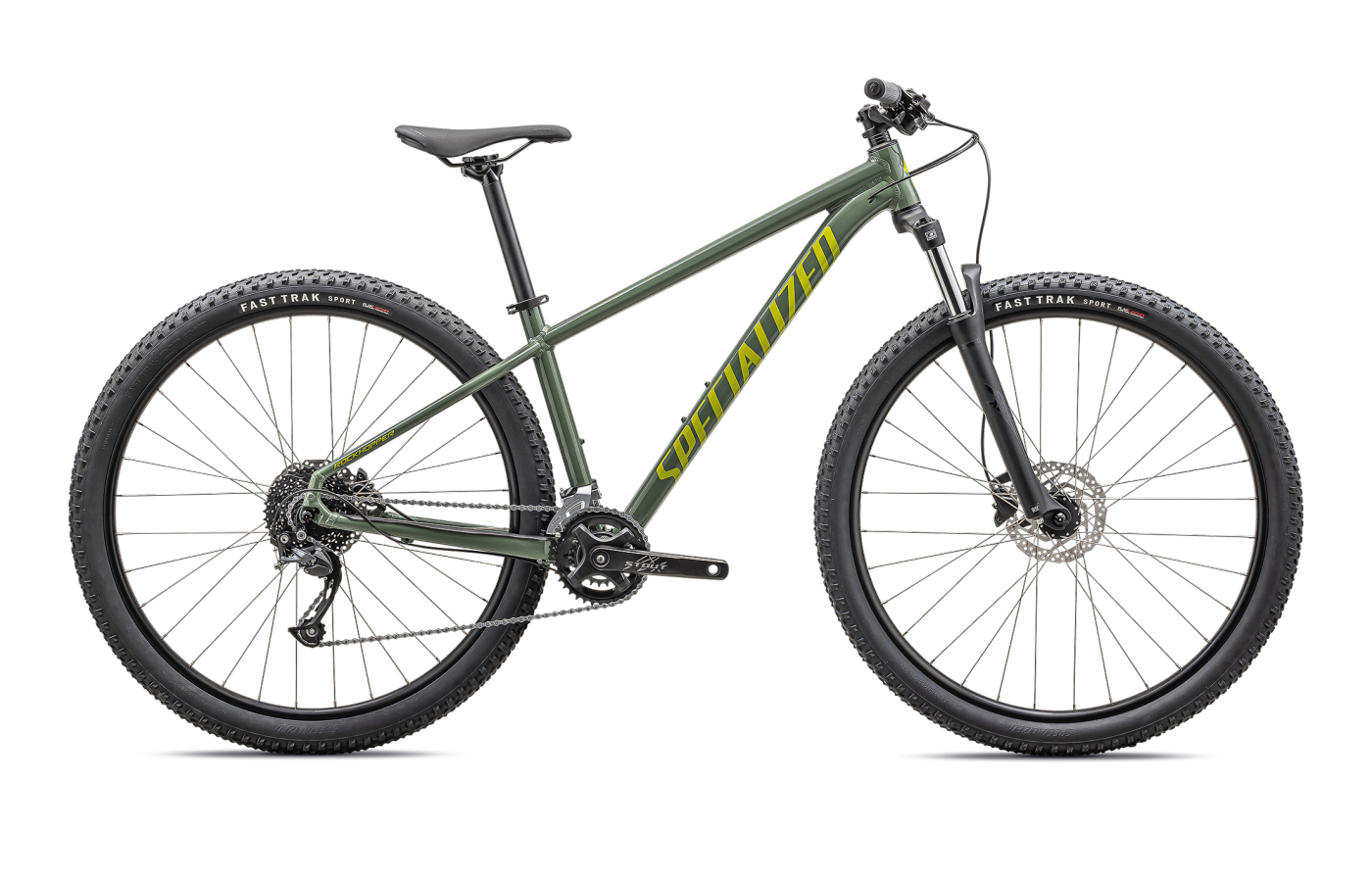
Rockhopper
Specialized's perennial entry-hardtail rival — a similarly priced alloy platform with trail-friendly geometry and one of the deepest brand dealer networks in the country if local support matters.
Compare →Roscoe
The natural step up if the Marlin geometry sounds right but you want more bike. More travel, slacker angles, and burlier components — built to ride the terrain that overwhelms a Marlin.
Compare →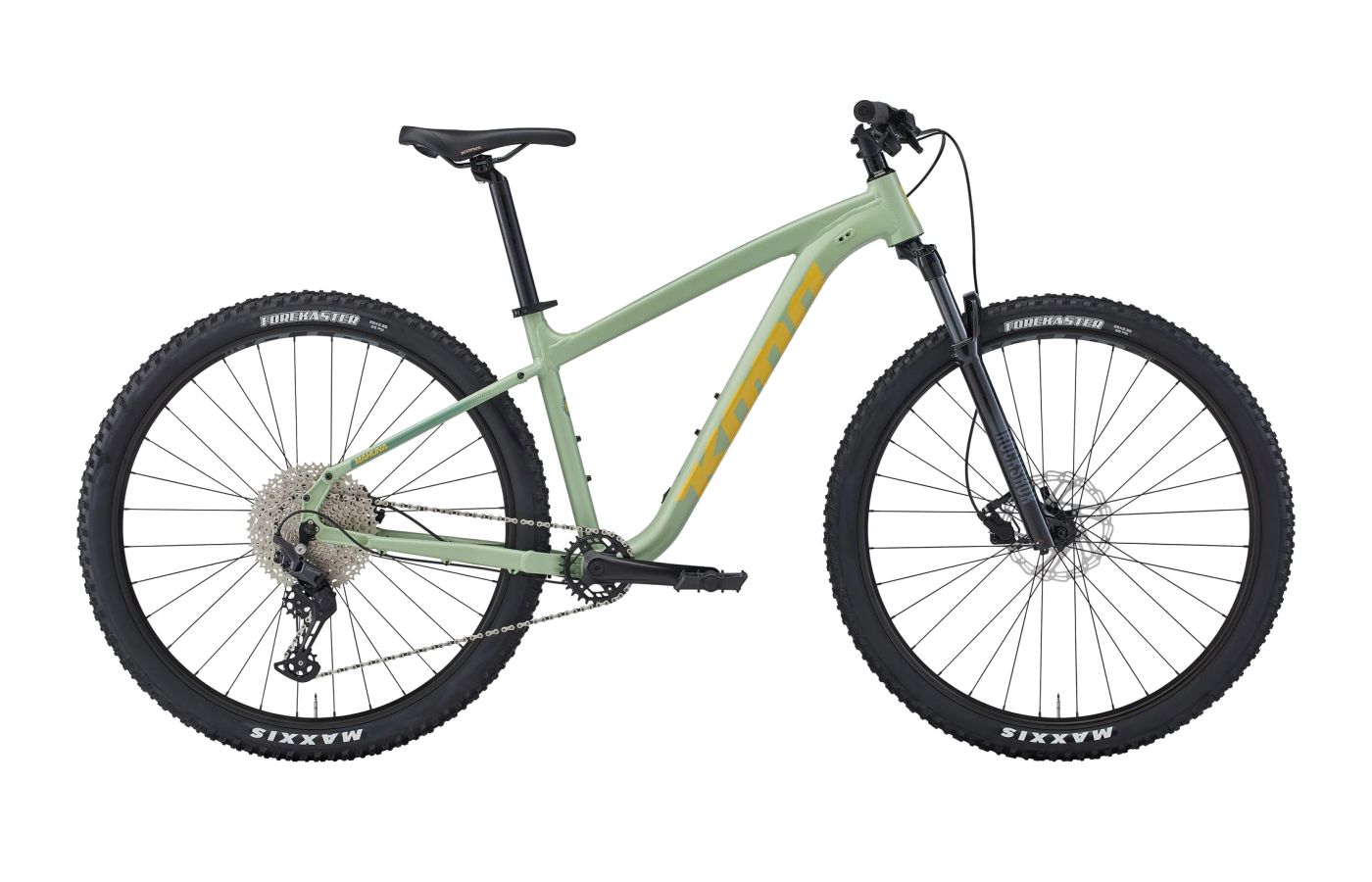
Mahuna
Kona's other entry hardtail — same Kona ride DNA as the Cinder Cone, but typically with 29-inch wheels for better rollover. Pick this if the Cinder Cone's character appeals but you want the bigger wheel.
Compare →