Sutra
vsCutthroat


Steel workhorse meets carbon bikepacking missile.
The Kona Sutra is a classic chromoly touring bike with rack mounts and a Brooks saddle. The Salsa Cutthroat is a Tour Divide race weapon — a drop-bar carbon MTB in disguise.
Sutra
- Cheapest serious tourer you can buy new — full chromoly, fenders, Tubus front rack, Brooks B17, TRP hydraulic brakes, starting at $1,599.
- Bombproof steel frame with external cable routing and mounting points everywhere — reviewers describe 4,000 km with zero structural complaints.
- Upright touring fit — 70.5 degree head angle, tall head tube, long 80 mm stock stem — stays planted under panniers and comfortable all day.
- Heavy — 32 lb for a 58 cm on the Standard build; it takes inertia to make progress.
- Stock Schwalbe Marathon Mondials are durable on pavement but get punished on aggressive, loose gravel.
Cutthroat
- Drop-bar 29er geometry — 69 degree HTA, suspension-corrected fork, 2.4 inch tire clearance. Handles real MTB trail that no touring bike would touch.
- Class 5 VRS compliance — redesigned V2 fork claims 32% more vertical compliance than the original; reviewers report floating over rocks that bogged others down.
- Purpose-built for bikepacking racing — 20+ frame mounts, direct-mount frame bag option, Tour Divide map on the down tube.
- Price floor $3,499 — more than 2x the Sutra's entry point.
- Press-fit BB92 is a known creak-prone standard, though Salsa defends the tradeoff for clearance and stiffness.
Editor’s analysis
Both bikes will carry you across a continent — they just disagree on how fast you should get there.
The Kona Sutra hasn't really changed its pitch in twenty years: chromoly steel, long chainstays, Brooks B17, external cable routing, room for fenders and a Tubus front rack out of the box. Reviewers have hauled it across the Pyrenees with panniers and loved it. Starting at $1,599, it's the single cheapest way into serious loaded touring without buying a used frame off the forums.
The Salsa Cutthroat is a different category. Salsa built it for the 4,418 km Tour Divide — a drop-bar 29er with 2.4 inch tire clearance, a 69 degree head angle, suspension-corrected fork geometry, and a carbon frame that uses Salsa's Class 5 VRS (flattened chainstays, curved seatstays) to kill vibration over long days. It costs 2–4x the Sutra and weighs around 10 pounds less in equivalent trim.
The geometry tells the story. The Cutthroat sits 1.5 degrees slacker at the head tube (69 vs 70.5) and has a 17 mm longer wheelbase at the compared sizes — that's a lot of stability for rough ground. The Sutra goes the other way: steeper, more upright, taller head tube (170 mm on the 56 vs 127 mm on the Cutthroat 56), and a touring-stable 70.5 degree head angle that stays planted on pavement with weight on board. Both run 445 mm chainstays, so cargo feels balanced on either.
The honest framing: the Sutra is the bike you buy when you want to ride to Patagonia on paved roads and well-groomed dirt. The Cutthroat is the bike you buy when you want to race the Divide — or when your idea of bikepacking includes loose rock, chunky B roads, and the option to bolt on a 100 mm suspension fork later. Same category on the shop floor. Completely different tools.
Where the builds differ.
Comparing our editor's-pick builds side-by-side. Winners highlighted row-by-row — lower price and weight, and the better-spec component, each mark a point.
Build variants & pricing
The Sutra runs $1,599 to $2,899. The Cutthroat runs $3,499 to $7,999 — there's no meaningful price overlap.
We picked the Sutra LTD (36sh) at $2,899 and the Cutthroat C GRX 610 1x at $3,699 because they're the only true apples-to-apples pairing: both are Shimano GRX 1x 12-speed mechanical builds running ~29x2.2" tires with a dropper. Prices are current US MSRP. Note that even at matched tier, the carbon Cutthroat commands a $800 premium over the steel Sutra.
How they fit, how they steer.
Sizing labels differ across conventions but refer to the best-fit frame for the same rider. The Cutthroat sits 49 mm taller in stack (619.5 vs 570) and 5 mm longer in reach (385 vs 380) — it's a meaningfully more relaxed but still planted cockpit. Head tube angle is 1.5 degrees slacker, seat tube 0.25 degrees steeper.
Which size should I buy?
Size recommendations based on stack, reach, and effective top tube. The Sutra runs 48–58 cm; the Cutthroat 52–60 cm — the Sutra extends further at the small end.
→These are starting points. Flexibility, riding style, and preferred position all shift the answer — if you’re between sizes, a professional fit beats a chart.
What the magazines said.
Published reviews from trusted cycling outlets. Click through for the full write-up.
Which one should you buy?
If you're touring paved roads and groomed gravel with panniers, get the Sutra. If you're racing (or riding) rough Divide-style singletrack with drop bars, get the Cutthroat.
Sutra
If your rides are pavement, rail trails, and well-maintained dirt — and you want fenders, a rack, and a Brooks saddle included from the factory for under two grand — the Sutra has been the answer for 20 years and still is. Steady, comfortable, repairable anywhere.
Cutthroat
If you're staring down the Tour Divide, the Colorado Trail Race, or any route where the terrain could turn into proper singletrack, the Cutthroat is the purpose-built tool. Slack, compliant, carbon, and built to carry 20+ pounds of gear at speed over rough ground.
Questions buyers actually ask.
Short answers to the things we get emailed about most often.
01Which one handles real singletrack?
The Salsa Cutthroat, easily. Its 69 degree head tube angle, 2.4 inch tire clearance, and suspension-corrected fork (designed to accept a 100 mm 29er suspension fork without changing the geometry) put it in drop-bar MTB territory. Reviewers describe popping over 8–12 inch logs and floating over fist-size rocks.
The Kona Sutra is a touring bike. Its 70.5 degree head angle and narrower tire clearance (around 29x2.1 practically, per reviewer measurements) make it fine on well-maintained gravel, but one reviewer nearly crashed on a downhill gravel corner when the front wheel lost grip on loose terrain.
02Which is better for traditional pannier touring?
The Kona Sutra, by a mile. It ships with a Tubus Tara front rack, front and rear fenders, a Brooks B17 saddle, and Brooks-matched bar tape. The chromoly frame has seven standard mounting points on the main triangle plus three-pack mounts on the fork blades.
The Cutthroat has 20+ mounts but is optimized for bikepacking bags (frame bag, fork anything-bags, top tube bolt-ons) — not rear panniers. Its carbon frame and lack of a dedicated rear rack setup mean you'd fight it to do classical loaded touring.
03How much does price actually differ?
A lot. The Sutra starts at $1,599 (Standard, Microshift) and tops out at $2,899 (LTD with Shimano GRX 1x 12-speed). The Cutthroat starts at $3,499 (GRX 810 2x) and reaches $7,999 for the Force XO AXS Transmission build with carbon wheels.
At the editor's pick pairing — Sutra LTD (36sh) at $2,899 vs Cutthroat C GRX 610 1x at $3,699 — you're paying $800 more for the carbon frame, ~10 lb weight savings, and slacker, more trail-capable geometry. That gap represents a real platform difference, not a component difference.
04Can I race the Tour Divide on either?
People have finished the Divide on both, and people have finished it on far less. But the Cutthroat was literally designed for it — the Divide route is printed on the down tube — and its long-wheelbase, slack-head-angle, high-volume tire geometry is purpose-built for the mix of loose climbs, rough descents, and endless dirt road miles.
The Sutra's steel weight and 2x10 (or Rival 1x) drivetrain are better tuned for unloaded touring pace. You could do it, but you'd be bringing a shovel to a dig crew.
05What tires do they come with, and can I fit wider?
Sutra Standard: Schwalbe Marathon Mondial 700x40c — touring tires, durable, fine on pavement and groomed gravel. The LTD (36sh) comes with Maxxis Rekon Race 29x2.25 instead — a proper gravel/XC tire. Practical clearance is around 29x2.1 on most 700c setups per review measurements.
Cutthroat: Teravail Sparwood 29x2.2 across every build. Official clearance is 29x2.4. Reviewers report the fork can fit 2.8 inches, though the rear triangle is the limiter.
06Is the Cutthroat's press-fit bottom bracket really a problem?
Mixed verdict. Press-fit BB92 has a reputation for creaking, and several reviewers (GearJunkie, Bicycling, Road.cc) flagged it as the one thing they'd change. That said, Bikepacking.com's Logan Watts logged over 1,400 miles on the V1 and more on the V2 without issue, and Salsa argues the standard is worth it for clearance, chainstay length, and pedaling stiffness.
The Sutra's threaded 68 mm BB is the low-drama classical choice — especially meaningful if you're planning to fix things in rural Patagonia or eastern Europe.
07Which climbs better loaded?
Both climb fine loaded — they just feel different doing it. The Sutra has wide-range 2x gearing on the base builds (46/30 front, 11-36 rear) and reviewers report clearing 20% ramps with panniers in New Zealand. Its 73–74.5 degree seat tube angle puts you comfortably seated for long grinds.
The Cutthroat's MTB gearing (SRAM AXS 10-52, or Shimano 10-51 on the GRX 610 1x pick) gives it even lower bailout gears, and its steeper 74.25 degree seat tube angle is more efficient for seated climbing. On very steep pitches standing, one reviewer compared it to 'piloting a long-hooded Oldsmobile Cutlass Supreme uphill' — stable but not sprightly.
08What if I want the all-rounder between these two?
Look at the Salsa Fargo — it's the Cutthroat's steel-framed cousin, touring-oriented, less race-focused. Or a Marin Four Corners, which is often cross-shopped directly with the Sutra at a similar price point but with slightly more modern touches. The Salsa Warbird goes the other direction: a faster, race-oriented gravel bike without the Cutthroat's MTB geometry.
Similar bikes
If your priorities don’t map cleanly onto either of these, one of these adjacent bikes probably fits better.

Fargo
The Cutthroat's steel-framed sibling — same bikepacking DNA, more relaxed geometry, and a chromoly frame that files down its racier edges. The move if you like Salsa's adventure philosophy but want steel comfort over carbon speed.
Compare →
Four Corners
The closest direct rival to the Sutra — steel touring frame, rack mounts everywhere, priced to compete. Worth cross-shopping if the Kona's build kit isn't hitting your spec-per-dollar bar.
Compare →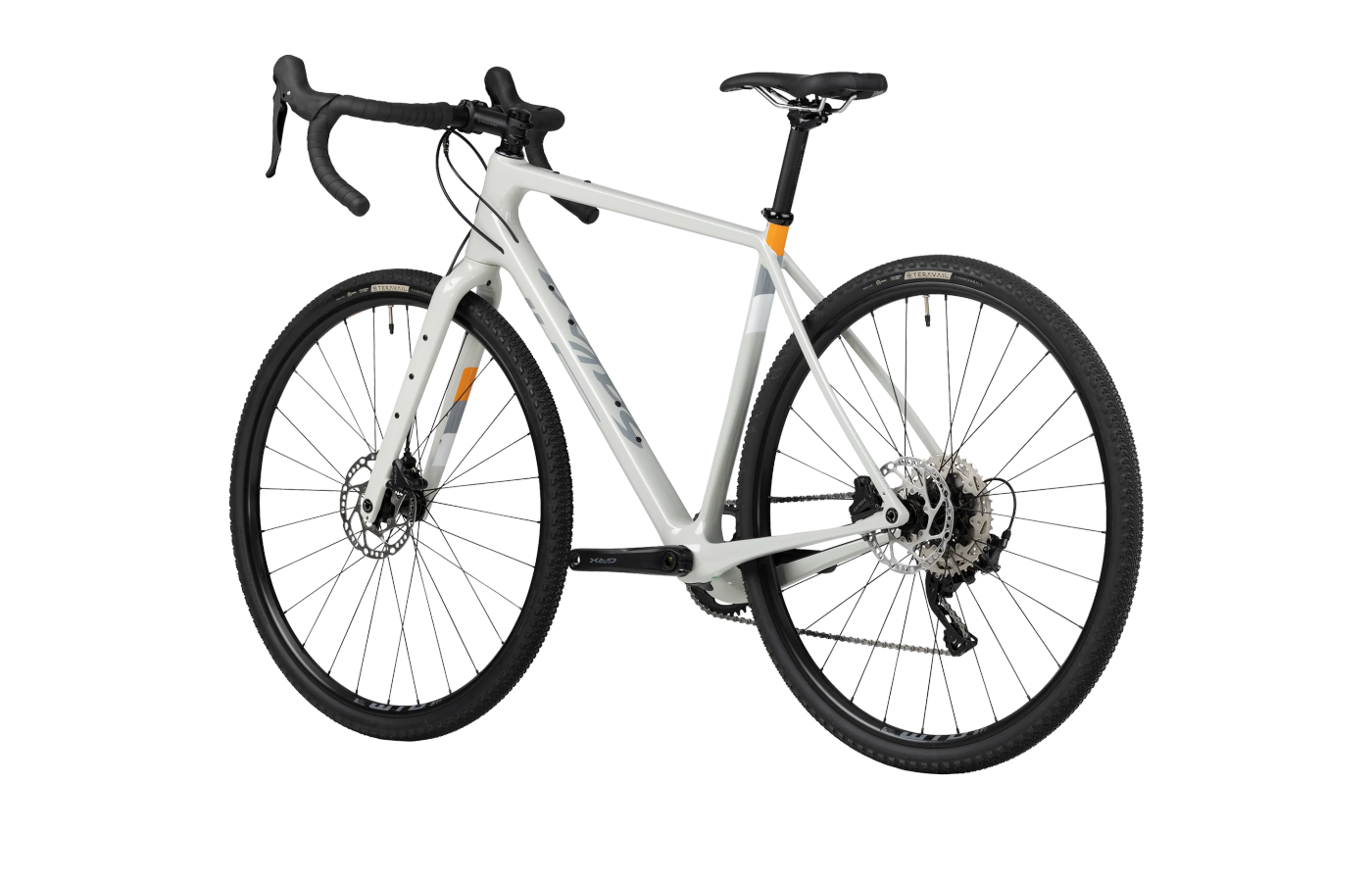
Warbird
A proper gravel race bike, not a drop-bar MTB. Faster on smoother gravel and pavement than either bike here, and the pick if your routes lean 'finish fast' over 'finish with gear.'
Compare →