Moraine
vsNotch
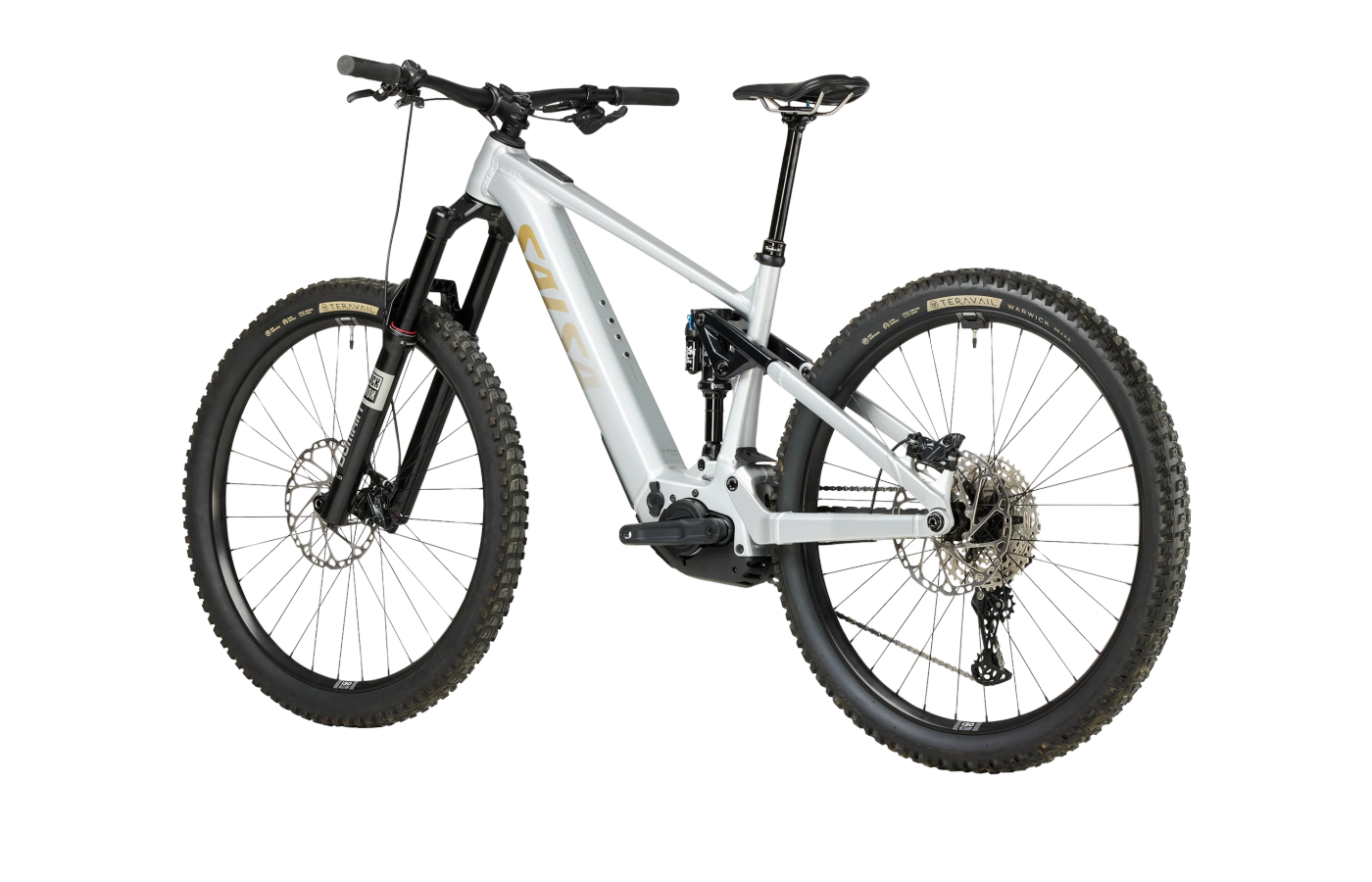
Two Salsa e-MTBs, two assist philosophies.
The Moraine is the stealth all-mountain bike that rides like an analog. The Notch is the burly enduro sled built to plow.
Moraine
- Stealth aesthetic — integrated battery and small Fazua motor mean it doesn't look like an e-bike at a glance.
- Lighter for the category at ~50 lb on the Deore 12 build, ~9 lb under the alloy Notch.
- Natural ride feel — Fazua's 'Breeze' mode is so subtle reviewers forget the assist is on.
- Only 60 Nm of torque and 430 Wh — less push and less range than the Bosch-equipped Notch.
- Runs large; size Small fits taller than typical, may not work for shorter riders.
Notch
- Bosch CX power — up to 90 Nm and a 500 Wh battery (expandable to 750 Wh) for steep, long climbs.
- Enduro-grade travel — 170-180 mm rear and up to 180 mm fork, with optional dual-crown compatibility.
- Frame and build range — $3,999 alloy CUES up to $8,699 carbon GX AXS Transmission, with a 79.9° seat tube angle for steep climbs.
- Heavy — ~59 lb on the alloy Deore 12, near the top of the e-MTB weight chart.
- Long reach (498.9 mm at size Medium) makes it stretched-out for its given size; size carefully.
Editor’s analysis
Same brand, same trail-bike DNA — but one was tuned to disappear underneath you, and the other was tuned to plow through everything in front of you.
The Salsa Moraine and Salsa Notch share a parts bin and a Wisconsin design studio, but the resemblance ends at the head badge. Both are aluminum-or-carbon, 29-inch e-MTBs aimed at all-mountain riding. Where they diverge is the entire premise of how an e-bike should feel — and that shows up in the motor, the travel, and the weight before you've even looked at geometry.
The Salsa Moraine is the lightweight-assist play. It runs Fazua's Ride 60 mid-drive — 60 Nm, 430 Wh, fully integrated into the down tube — paired with 160 mm front and 145 mm rear of Split Pivot travel. The alloy Deore 12 build comes in at a claimed 49 lb 13 oz, which for an e-MTB is on the lighter end of the segment. Reviewers consistently note it 'rides light,' that the Fazua is 'almost silent,' and that in the lowest 'Breeze' assist mode it's 'hard to even tell you're riding an e-bike.'
The Salsa Notch is the opposite swing. It's a full-power Bosch Performance Line CX (with up to 90 Nm and a 500 Wh battery, expandable to 750 Wh with a range extender) wrapped in a 170-180 mm enduro frame that can run a 200 mm dual-crown fork up front. The aluminum Deore 12 build weighs about 59 lb — roughly nine pounds heavier than the Moraine. One reviewer in a $6k e-MTB shootout called the medium-size Notch 'longer than just about every size large we have' at 499 mm of reach.
Put it this way: the Moraine wants to make your normal trail rides bigger and more frequent without changing how they feel. The Notch wants to give you a downhill bike you can pedal back to the top. Pick by what kind of rider you actually are, not by which platform sounds cooler on paper.
Where the builds differ.
Comparing our editor's-pick builds side-by-side. Winners highlighted row-by-row — lower price and weight, and the better-spec component, each mark a point.
Build variants & pricing
Two Moraine builds, four Notch builds. Both lines start with a CUES 10 entry-level alloy spec; the Notch climbs much higher with a carbon frame and AXS Transmission at the top.
Prices are current US MSRP. Both editor's-pick builds are the alloy Deore 12 trims to keep the comparison apples-to-apples — the Notch also offers carbon Deore 12 ($6,099) and carbon GX AXS Transmission ($8,699) builds that aren't on the Moraine.
How they fit, how they steer.
Both at size Small — the fit-picked size for a 5'8" rider. The Notch sits 5 mm taller in stack, runs a 24.8 mm longer reach, a 0.5° steeper head tube angle, a 2.5° steeper seat tube, and 6.4 mm longer chainstays. It's the longer, more enduro-shaped bike at every size.
Which size should I buy?
Both bikes run notoriously large for their labeled size — multiple reviewers flagged it. If you're between sizes, lean small.
→These are starting points. Flexibility, riding style, and preferred position all shift the answer — if you’re between sizes, a professional fit beats a chart.
What the magazines said.
Published reviews from trusted cycling outlets. Click through for the full write-up.
Which one should you buy?
If you want an e-bike that rides like your normal trail bike, get the Moraine. If you want a downhill bike with a motor, get the Notch.
Moraine
If your goal is to extend your existing trail rides — more laps, higher elevation, occasional bike-park days — without the bike announcing itself as an e-bike, the Moraine is the right call. The Fazua Ride 60 is quiet and natural-feeling, the 160/145 mm travel is plenty for everything short of full enduro terrain, and at ~50 lb it's manageable when the battery dies.
Notch
If your trails are steep and chunky, you spend real time at bike parks, and you want a bike that absorbs everything when pointed downhill, the Notch is built for that. The Bosch CX motor and 500 Wh battery shrug off long climbs, the 170-180 mm of travel handles serious hits, and the steep 79.9° seat tube keeps you over the cranks on steep ascents. Just don't expect it to feel light or playful.
Questions buyers actually ask.
Short answers to the things we get emailed about most often.
01What's the difference between the Moraine and the Notch?
Different motors, different missions. The Moraine uses Fazua's lightweight Ride 60 (60 Nm, 430 Wh) on a 160 mm/145 mm trail-bike chassis, weighs ~50 lb, and is designed to feel like an analog mountain bike with a tailwind. The Notch uses the full-power Bosch Performance Line CX (up to 90 Nm, 500 Wh) on a 170-180 mm enduro chassis, weighs ~59 lb in alloy trim, and is designed to be a downhill-capable bike you can pedal uphill.
The Moraine extends what a trail bike does. The Notch lets you ride terrain a trail bike shouldn't be on.
02Which has more travel?
The Notch, by 25-35 mm in the rear depending on shock setup. The Moraine runs 160 mm front / 145 mm rear as a fixed setup. The Notch runs 170-180 mm front / 170-180 mm rear and is compatible with up to a 200 mm dual-crown fork — Salsa explicitly designed it for being shredded.
For most all-mountain riding, the Moraine's travel is plenty. The Notch's extra travel only pays off if you regularly point at bike-park-grade descents.
03How much heavier is the Notch?
Quite a bit. The alloy Notch Deore 12 comes in at ~59 lb (Medium frame). The alloy Moraine Deore 12 is 49 lb 13 oz (Medium). That's roughly 9 pounds, or about 18%, on otherwise comparable builds.
If you go to the carbon Notch (C Deore 12 at 50 lb 8 oz, or C GX AXS Transmission at 49 lb 2 oz) the gap closes to almost nothing — the carbon Notch weighs about the same as the alloy Moraine, despite the extra travel and bigger battery.
04Which motor is better — Fazua Ride 60 or Bosch Performance Line CX?
Different tools. The Fazua Ride 60 (Moraine) puts out 60 Nm of torque, draws on a 430 Wh battery, and is praised by reviewers for being 'surprisingly quiet, almost silent' with 'smooth power engagement' that doesn't feel like an e-bike at low assist. It rewards higher cadences.
The Bosch Performance Line CX (Notch) is the segment standard for full-power, putting out up to 90 Nm with a 500 Wh battery (expandable to 750 Wh via a range extender). It's grunty, predictable, and shrugs off the steepest sustained climbs. Reviewers note it has so much push the Notch can pop unintended wheelies.
If you want the bike to feel like a normal mountain bike, choose Fazua. If you want maximum assist for steep, technical climbing, choose Bosch.
05Can I run mullet wheels (29/27.5) on either?
Moraine: yes, via the frame's flip chip. The flip chip adjusts BB height by 5 mm and head/seat tube angles by 0.3° to accommodate the smaller rear wheel. Multiple reviewers called this out as a thoughtful versatility feature.
Notch: yes — at least one reviewer (a Salsa employee transparent about working at QBP) reported running a 27.5 rear with the stock 29 fork on a Notch Carbon. Adjustable shock length on the Notch also lets you change rear travel from ~165 mm to 180 mm. Salsa designed both frames to be tweaked.
06What sizes do they come in, and how do they fit?
Both come in Small, Medium, Large, and X-Large, and both run large for their labeled size. Multiple reviewers — including a 5'5.5" rider on a Moraine size Small — flagged that the smallest size is bigger than other Small bikes they've ridden. The Notch is even more extreme: in one shootout, the Medium had a 499 mm reach, longer than most Larges in the test group.
For a 173 cm (5'8") rider, the fit algorithm picks size Small on both. If you're 5'5" or shorter, demo first or look elsewhere. If you're 5'10"+, the Medium and Large work as expected.
07What's the tire clearance?
Both frames clear up to 63.5 mm (2.5") rear tires, and that's what they ship with — Teravail Kessel 2.6 front and Warwick or Kessel 2.5 rear on the Moraine, Teravail Kessel 2.5 front and rear on the Notch. Both run 29-inch wheels stock, with the option to mullet to a 27.5 rear via the flip chip (Moraine) or stock-frame compatibility (Notch).
08Which has better climbing geometry?
The Notch, on paper. Its 79.9° seat tube angle is significantly steeper than the Moraine's 77.4° — a 2.5° difference that puts the rider noticeably more forward over the bottom bracket. Combined with the more powerful Bosch motor, that's a deliberate setup for steep, technical climbs.
That said, the Moraine's geometry isn't a climbing handicap — its 77.4° is still modern, just less aggressive. And reviewers praised the Moraine's overall climbing capability with the Fazua, calling sweat-managed alpine climbs '[mostly sweat-free].' Choose seat tube angle for the steepest sustained climbs; choose motor for everything else.