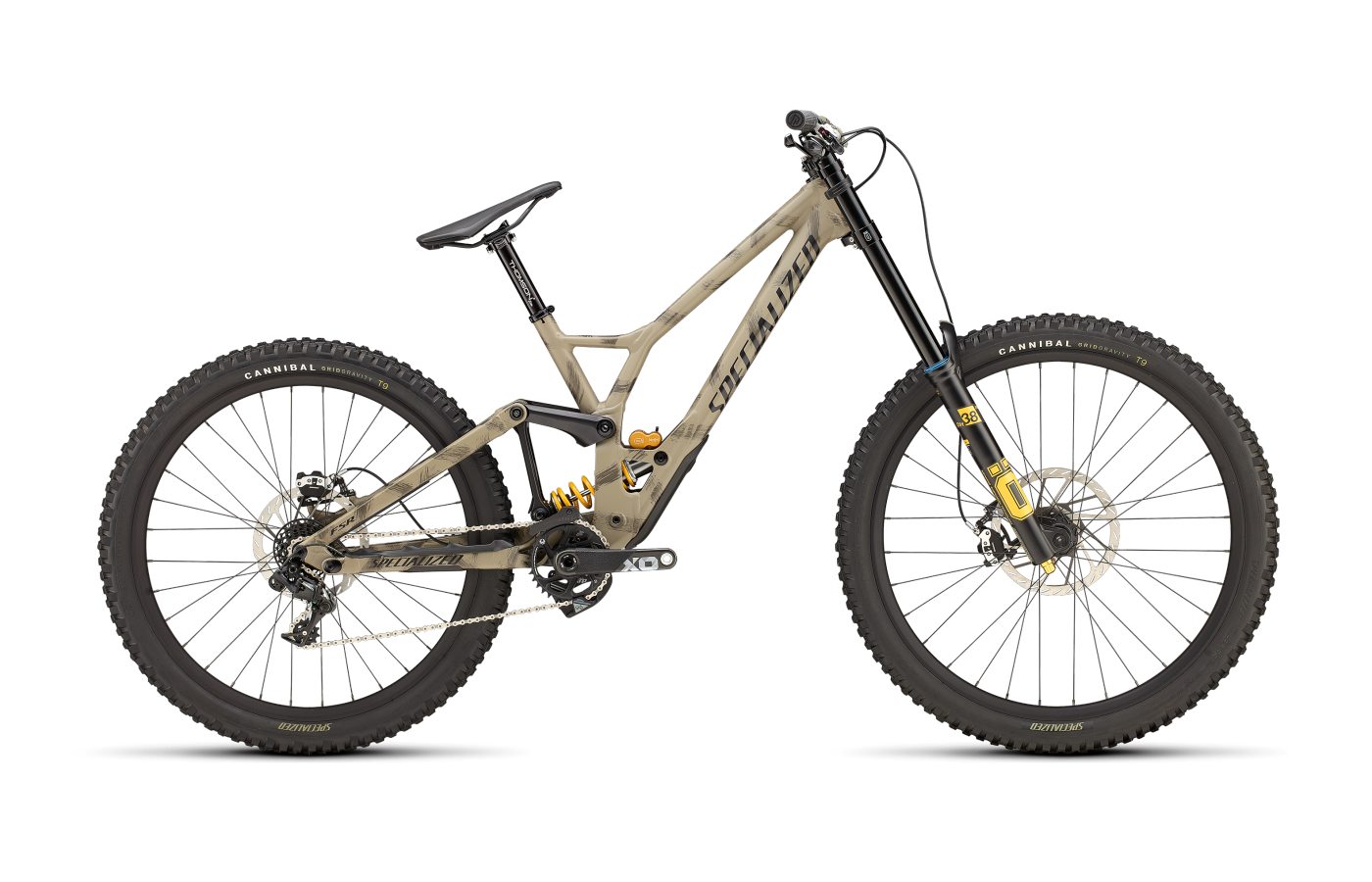
Specialized DemovsTrek Session
Picture yourself hitting the moto-style whoops at Silver Mountain at full chat. The Specialized Demo skips across the tops with its aggressive anti-squat, demanding you stay light, while the Trek Session uses its high-pivot idler to simply swallow the edges as if they weren't there.

Overview
Both Specialized and Trek took a hard look at their elite race programs and decided carbon was too stiff for the most violent tracks, moving back to aluminum for these current frames. This choice wasn't about cost-cutting; it was about chasing a "calm" feel that prevents the bike from deflecting off every rock in a chundery garden. The Specialized Demo has morphed from its old hyper-active self into a more stable momentum-carrier, though it retains an agile streak that makes it feel less like a dedicated sled and more like a very fast toy. Trek returned to a high-pivot layout for the Session, a design they last used over a decade ago, to address the square-edge hang-ups that plague traditional four-bar bikes. Specialized stuck with their FSR Horst-link but drastically revised the kinematics to create a more rearward axle path and 300% more anti-squat than the previous generation. These two bikes are chasing the same World Cup podiums but use wildly different mechanical solutions to keep the rider centered and the wheels moving forward.
Ride and handling
The Session feels like a cheat code on raw, technical tracks. Its high-pivot axle path moves the rear wheel back and up, letting it mow through square-edged hits where the Demo might feel a bit more feedback through the pedals. Trek’s idler pulley deletes almost all pedal kickback—dropping it to just 5-8 degrees—which keeps your feet remarkably quiet on flat pedals. By contrast, the Demo remains remarkably level under heavy braking thanks to a 70% increase in anti-rise, meaning you can drop your heels and hang on through steep chutes without the bike pitching you over the bars. Handling-wise, the Demo is the Jack Russell of the two, especially in its 29/27.5 mixed-wheel "Race" configuration. It snaps into corners with a level of aggression that the full-29er Session resists, making it the better tool for tight, chicane-style woods. The Trek is a straight-line plow machine that rewards high-speed commitment; the faster you go, the more the lengthening wheelbase adds stability. However, that same wheelbase growth makes the Session feel a bit ponderous in slow-speed switchbacks where the Demo stays intuitive and easy to musle around. Suspension feel is a tale of two different philosophies. The Demo’s revised FSR is deep and supportive, providing a predictable platform for heavy G-outs and massive jumps. The Session is more of an isolation chamber, muting the trail buzz so effectively that some riders might find it a bit too "dead" or lacking in feedback. If you prefer to feel the trail to find the smoothest lines, the Demo gives you that data; if you just want to let the bike do the work, the Session is the clear winner.
Specifications
If you drop seven grand on the Demo Race, you get Swedish gold in the form of an hlins DH38 fork and TTX22M.2 coil shock. Trek matches that price point with the Session 9 but uses the RockShox Boxxer Ultimate and Super Deluxe Air. One glaring weakness on the Trek is the 180mm rear rotor; on a 200mm travel bike meant for World Cup speeds, that’s a cost-saving measure that leads to heat fade and inconsistent lever feel on long runs. Specialized, however, uses a 220mm front and 200mm rear setup as standard, which is much more appropriate for the bike's intended use. Specialized opted for 148mm Boost rear spacing, which is unusual for a downhill bike but means you can borrow a spare wheel from your trail bike in a pinch. Trek sticks to the 157mm DH standard, which builds a stiffer wheel but limits your spare pool. Both bikes come with alloy rims, which is the right call for durability, but Specialized’s Butcher tires in the BLCK DMND casing are known to squirm on the 28mm Roval rims. Most aggressive riders will want to swap the Specialized rubber for something with a stiffer DH casing immediately. Component longevity is a focus for Trek, who included replaceable threads in the suspension linkage. This is a massive win for riders who plan to keep the bike for multiple seasons and don't want to scrap a frame because of a stripped pivot. Specialized counters with a very clean, sealed pivot design that uses lip seals on every bolt to keep the grease in and the pressure washers out. Both are built to be hammered, but Trek's hardware serviceability is a step ahead for the home mechanic.
| Demo | Session | |
|---|---|---|
| FRAMESET | ||
| Frame | M5 alloy, Style-Specific DH Geometry, Horst pivot flip chip for 27.5 or 29 rear wheel, BSA threaded BB, full internal cable routing with option for full external brake, 148mm rear spacing, sealed cartridge bearing pivots, replaceable derailleur hanger, 200mm travel | — |
| Fork | Öhlins DH38 M.1 29, TTX Twin Tube Damping, external low-speed rebound adjust, external high/low-speed compression adjust, 20x110mm, 58mm offset, 200mm travel | — |
| Rear shock | Öhlins TTX22M.2 Coil, external rebound adjust, external high/low-speed compression adjust, Trunnion mount, 225x75 | — |
| GROUPSET | ||
| Shift levers | SRAM X01 DH, trigger, 7-speed | — |
| Front derailleur | — | — |
| Rear derailleur | SRAM X01 DH, 7-speed | — |
| Cassette | SRAM X01 DH, 7-speed, 10-24T | — |
| Chain | SRAM PC1130 w/ Powerlink, 11-speed | — |
| Crankset | SRAM X01 DH, DUB, carbon, direct-mount ring, 165mm | — |
| Bottom bracket | SRAM DUB, 83mm | — |
| Front brake | SRAM Maven Ultimate, 4-piston hydraulic disc | — |
| Rear brake | SRAM Maven Ultimate, 4-piston hydraulic disc | — |
| WHEELSET | ||
| Front wheel | Roval Traverse Alloy, 32h, 28mm internal width (29"); DT Swiss 350, 20x110mm; Sapim D-Light | — |
| Rear wheel | Roval Traverse Alloy, 32h, 28mm internal width (27.5"); DT Swiss 350, 12x148mm; Sapim D-Light | — |
| Front tire | Specialized Cannibal, GRID GRAVITY casing, GRIPTON T9, 2Bliss Ready, 29x2.4 | — |
| Rear tire | Specialized Cannibal, GRID GRAVITY casing, GRIPTON T9, 2Bliss Ready, 27.5x2.4 | — |
| COCKPIT | ||
| Stem | Renthal Integra 35 direct-mount stem, 45mm length | — |
| Handlebars | Renthal Fatbar 35, 5° upsweep, 7° backsweep, 30mm rise, 800mm, 35.0mm clamp | — |
| Saddle | Body Geometry Henge DH, hollow titanium rails, 130mm | — |
| Seatpost | Thomson, alloy, straight, 12-degree clamp | — |
| Grips/Tape | Deity Lockjaw | — |
Geometry and fit comparison
Trek went much longer with their reach-based sizing, with the R3 reaching out to a massive 493mm. Specialized remains surprisingly conservative, with the S4 maxing out at a 466mm reach. For taller riders over 6'2", the Demo will feel cramped, forcing you into a more upright and fatiguing position compared to the roomy cockpit of the Session. The S2 size on the Demo is so short that some testers have joked it belongs in a kids' bike category, though it remains a viable option for smaller riders who find most modern DH bikes unmanageable. The Session’s wheelbase grows as it moves through its travel, which is the byproduct of the high-pivot design. This adds a level of high-speed stability that numbers on a static geometry chart can't fully capture. Specialized keeps the chainstays at 443mm for the mullet setup, which balances the bike's weight but doesn't offer the same "growing" stability as the Trek. In practice, the Demo is easier to lift the front wheel and manual, while the Trek is harder to pull out of its "plow" mode. Both bikes use 63-degree head tube angles (in their low/slack settings), but the way they arrive at that stability is different. The Demo uses a lower bottom bracket height of 350mm to drop the rider's center of gravity, while Trek uses the lengthening wheelbase to keep things steady. If you ride tracks with lots of deep ruts and rocks, the Demo’s low BB can lead to more frequent pedal strikes, though Specialized did raise it by 8mm over the previous generation to help mitigate this.
| FIT GEO | Demo | Session | |
|---|---|---|---|
| Stack | 632 | — | — |
| Reach | 426 | — | — |
| Top tube | — | — | — |
| Headtube length | 105 | — | — |
| Standover height | — | — | — |
| Seat tube length | 394 | — | — |
| HANDLING | Demo | Session | |
|---|---|---|---|
| Headtube angle | 62.8 | — | — |
| Seat tube angle | 78.2 | — | — |
| BB height | 350 | — | — |
| BB drop | 25 | — | — |
| Trail | 130 | — | — |
| Offset | 56 | — | — |
| Front center | 801 | — | — |
| Wheelbase | 1244 | — | — |
| Chainstay length | 443 | — | — |
Who each one is for
Specialized Demo
If you spend every weekend at a lift-access park and value the ability to square off a corner and sprint into a jump line, the Demo is for you. It is for the rider who wants an intuitive feel from the first lap and handles aggressive direction changes without feeling like they are wrestling a boat. You prefer a bike that provides enough trail feedback to let you pick technical lines rather than one that just erases them.
Trek Session
For the privateer racer who lives for the steepest, nastiest tracks in the PNW or the Alps. If your goal is to let go of the brakes and trust the suspension to erase square-edged rock gardens, the Session’s plow factor is unmatched. It suits the rider who finds themselves exhausted by the vibration and feedback of traditional bikes and wants a calm, quiet machine that keeps their feet planted in the rough.