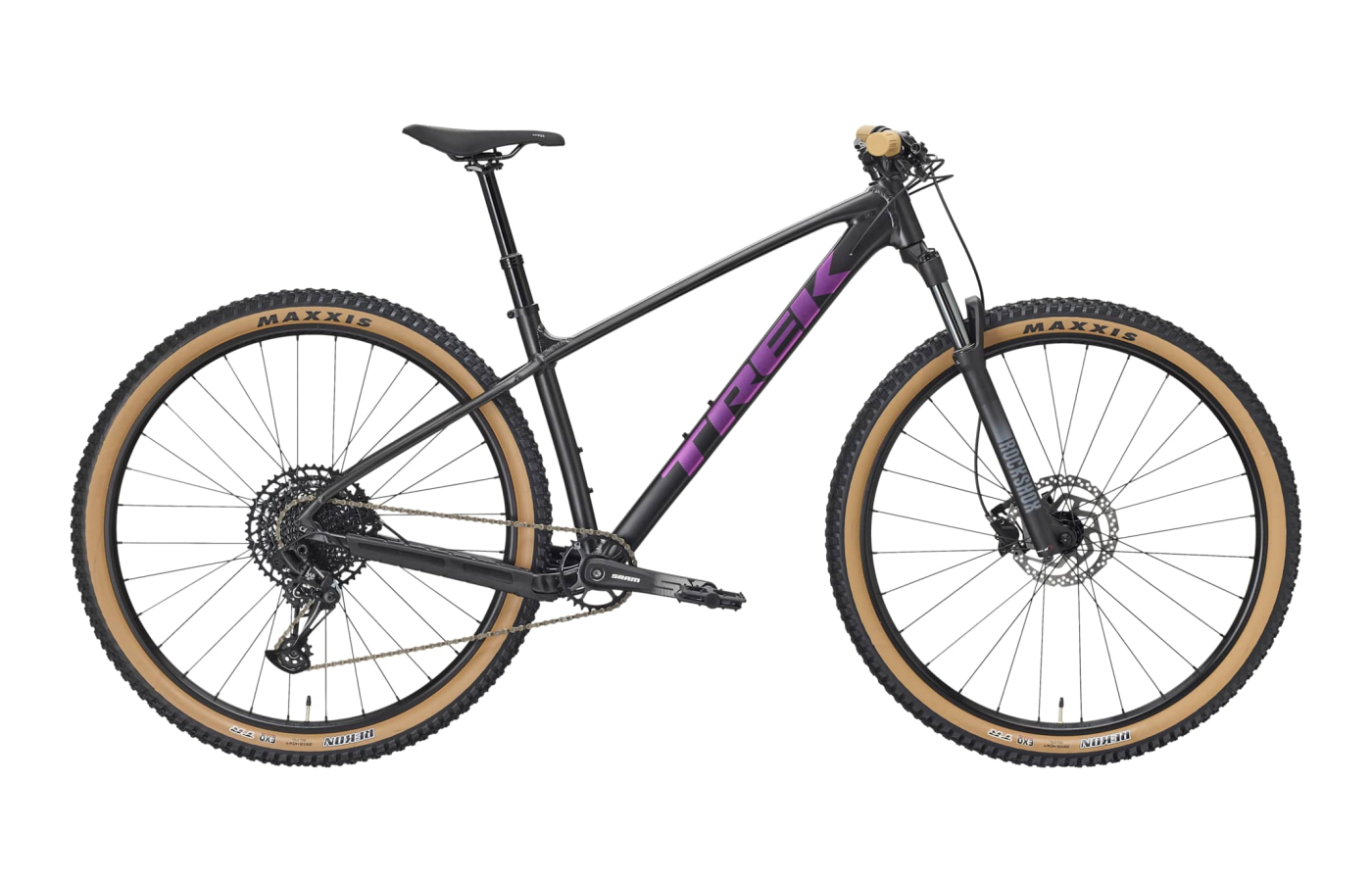
Trek MarlinvsRoscoe

The 50mm difference in fork travel and a full 1.5-degree gap in head tube angle immediately separate these two hardtails. While the Marlin Gen 3 tries to be a trail-ready cross-country bike, the Roscoe Gen 4 is built for the kind of technical terrain where most budget frames simply fall apart.

Trek Marlin
Image pending

Overview

The Marlin Gen 3 is Trek’s ubiquitous gateway bike, built on heavy Alpha Silver aluminum to hit entry-level price points while offering a 25-year warranty. It is a sturdy foundation for exploring dirt paths on Saturdays that still works for locking up at the library on Mondays. The Roscoe Gen 4 moves away from being a plus-tire experiment and becomes a legitimate hardcore hardtail using the same Alpha Platinum aluminum found on Trek's enduro-focused Slash. The price gap is substantial, with the top-tier Marlin 8 sitting near the entry point of the Roscoe range. Where the Marlin relies on skinnier 135mm rear spacing and a hybrid ThruSkew system, the Roscoe uses full 148mm Boost thru-axles and 29x2.5-inch tires. These aren't just different builds; they are built for entirely different levels of abuse, from the Marlin’s light-XC focus to the Roscoe’s willingness to tackle chunky rock gardens and steep technical descents.

Ride and handling

On the trail, the Marlin Gen 3 feels composed and stable compared to its skittish predecessors, but it has a clear ceiling. Technical reviewers found it engaging on technical singletrack, but noted the 100mm RockShox Judy can feel twangy and flexy when pushed hard. The internal cable routing is known to be rather noisy and rattly on challenging terrain, which can be a nuisance when you are trying to focus on a tricky line. It is a bike that excels on flowy green and blue trails but gets nervous when things turn steep. The Roscoe 8 is a different beast entirely, with its 150mm Fox Rhythm 36 fork providing a stiff front end that refuses to dive. Its 4-piston Shimano Deore brakes and massive 203mm front rotor provide insane stopping power, allowing you to stop on a dime even on vertical sections. While the Marlin is a safe starting point for recreational riding, the Roscoe is built to get wild, using its 200mm dropper post to get the seat completely out of the way for aggressive maneuvering. The rear end is predictably harsh on choppy stuff, but the high-volume 2.5-inch tires help take the edge off.

Specifications

Comparing the builds reveals a major quality gap in the drivetrain and wheels. The Marlin 8 typically uses SRAM's SX Eagle 12-speed kit, which many reviewers find unremarkable and cheap-feeling due to its plastic-heavy derailleur. In contrast, the Roscoe 8 features a workhorse Shimano Deore M6100 drivetrain and a Rapid Drive 108 rear hub. That hub is a massive upgrade, offering nearly instantaneous engagement that makes ratcheting through rock gardens much easier than on the slower hubs found on the Marlin. Braking is another area where the Roscoe shames the Marlin. The Marlin’s Shimano MT200 two-piston brakes are adequate for cross-country but require multiple fingers on the lever to slow down on steep stuff. The Roscoe’s 4-piston Deore setup is pro-level by comparison. Even the tires differ significantly; the Marlin’s 2.4-inch Maxxis Ardents are great all-rounders, but they can't match the pure traction of the 2.5-inch Bontrager Brevard Pro XR tires found on the Roscoe. The Marlin's use of a straight head tube also limits your future fork upgrade options compared to the Roscoe's tapered standard.

MarlinRoscoe
FRAMESET
FrameAlpha Silver Aluminum (XXS, XS: curved top tube), internal derailleur & dropper post routing, rack and kickstand mount, 135x5mm ThruSkew
ForkXXS: SR Suntour XCM 30, coil spring, preload, hydraulic lockout, 42mm offset (26"), 100mm QR, 100mm travel; XS: SR Suntour XCE 28, coil spring, preload, 42mm offset (27.5"), 100mm QR, 80mm travel; S: SR Suntour XCE 28, coil spring, preload, 42mm offset (27.5"), 100mm QR, 100mm travel; M/ML/L/XL: SR Suntour XCE 28, coil spring, preload, 46mm offset (29"), 100mm QR, 100mm travel
Rear shock
GROUPSET
Shift leversShimano M315, 8-speed
Front derailleur
Rear derailleurShimano ESSA U2000
CassetteShimano HG300, 8-speed, 11-45T
ChainKMC Z8.3, 8-speed
CranksetProWheel alloy, 30T narrow-wide steel ring — XXS/XS: 160mm; S/M/ML: 170mm; L/XL: 175mm
Bottom bracketThreaded cartridge
Front brakeHydraulic disc — XXS/XS/S: Tektro HD-M276; M/ML/L/XL: Tektro HD-M275 (also listed: Power BH-M286TF)
Rear brakeHydraulic disc — XXS/XS/S: Tektro HD-M276; M/ML/L/XL: Tektro HD-M275 (also listed: Power BH-M286TF)
WHEELSET
Front wheelBontrager Connection, double-wall, 32-hole, 20mm width, Schrader valve; Formula DC-20, alloy, 6-bolt, 100x5mm
Rear wheelBontrager Connection, double-wall, 32-hole, 20mm width, Schrader valve; Formula DC-22, alloy, 6-bolt, Shimano 8/9/10 freehub, 135x5mm
Front tireBontrager Montrose Comp, wire bead, 30 tpi — XXS: 26x2.35; XS/S: 27.5x2.4; M/ML/L/XL: 29x2.4
Rear tireBontrager Montrose Comp, wire bead, 30 tpi — XXS: 26x2.35; XS/S: 27.5x2.4; M/ML/L/XL: 29x2.4
COCKPIT
StemBontrager Comp, 31.8mm, 7° — XXS/XS/S: 35mm; M/ML/L: 50mm; XL: 60mm (M–XL Blendr compatible)
HandlebarsBontrager alloy, 31.8mm — XXS/XS: 5mm rise, 690mm; S: 15mm rise, 720mm; M/ML/L/XL: 15mm rise, 750mm
SaddleBontrager Verse Short, stainless steel rails
SeatpostBontrager alloy, 31.6mm, 12mm offset — XXS: 300mm; XS/S/M: 330mm; ML/L/XL: 400mm
Grips/TapeTrek Line Comp, nylon lock-on

Geometry and fit comparison

The Marlin’s 66.5-degree head tube angle is a huge improvement over the Gen 2, making it much calmer on descents, but it still feels like an XC bike at heart. Its 73.4-degree seat tube angle is decent, but you may still find yourself shifting weight forward to keep the front wheel down on steep climbs. With a 495mm reach on the XL, it is long enough for modern standards but lacks the aggressive stance of its sibling. The Roscoe Gen 4 pushes things further with a 65-degree head tube angle and a much steeper 76-degree seat tube angle. That steeper seat angle is a functional necessity; it keeps your weight centered so you can actually pedal the 150mm fork uphill without the front end wandering. Trek even removed the water bottle bolts from the seat tube on the Roscoe to allow for deeper dropper post insertion. This trade-off means you will need to buy a frame bag to carry tools, but in return, you get a massive 200mm dropper that lets the bike move freely underneath you.

vs
FIT GEOMarlinRoscoe
Stack618
Reach470
Top tube647
Headtube length115
Standover height771
Seat tube length450
HANDLINGMarlinRoscoe
Headtube angle66.5
Seat tube angle73.4
BB height308
BB drop60
Trail110
Offset46
Front center
Wheelbase1197
Chainstay length438

Who each one is for

Trek Marlin

The Marlin is for the newcomer who wants a versatile, reliable bike that can handle local singletrack but won't feel like a heavy chore on a ten-mile commute. It suits student riders or recreational adventurers who spend the majority of their time on gravel paths and flowy green trails but want a frame that can handle the occasional light-duty technical trail without falling apart.

Trek Roscoe

The Roscoe is for the hardcore hardtail enthusiast who specifically seeks out technical, chunky trails and doesn't want the complexity of rear suspension. It is for the rider who values a high-engagement hub and a stiff 150mm fork for aggressive descents and is willing to trade seat-tube bottle mounts for a massive 200mm dropper and pro-level braking power.

Other bikes to consider

Kona Mahuna
Kona Mahuna
Norco Torrent
Norco Torrent
Santa Cruz Chameleon