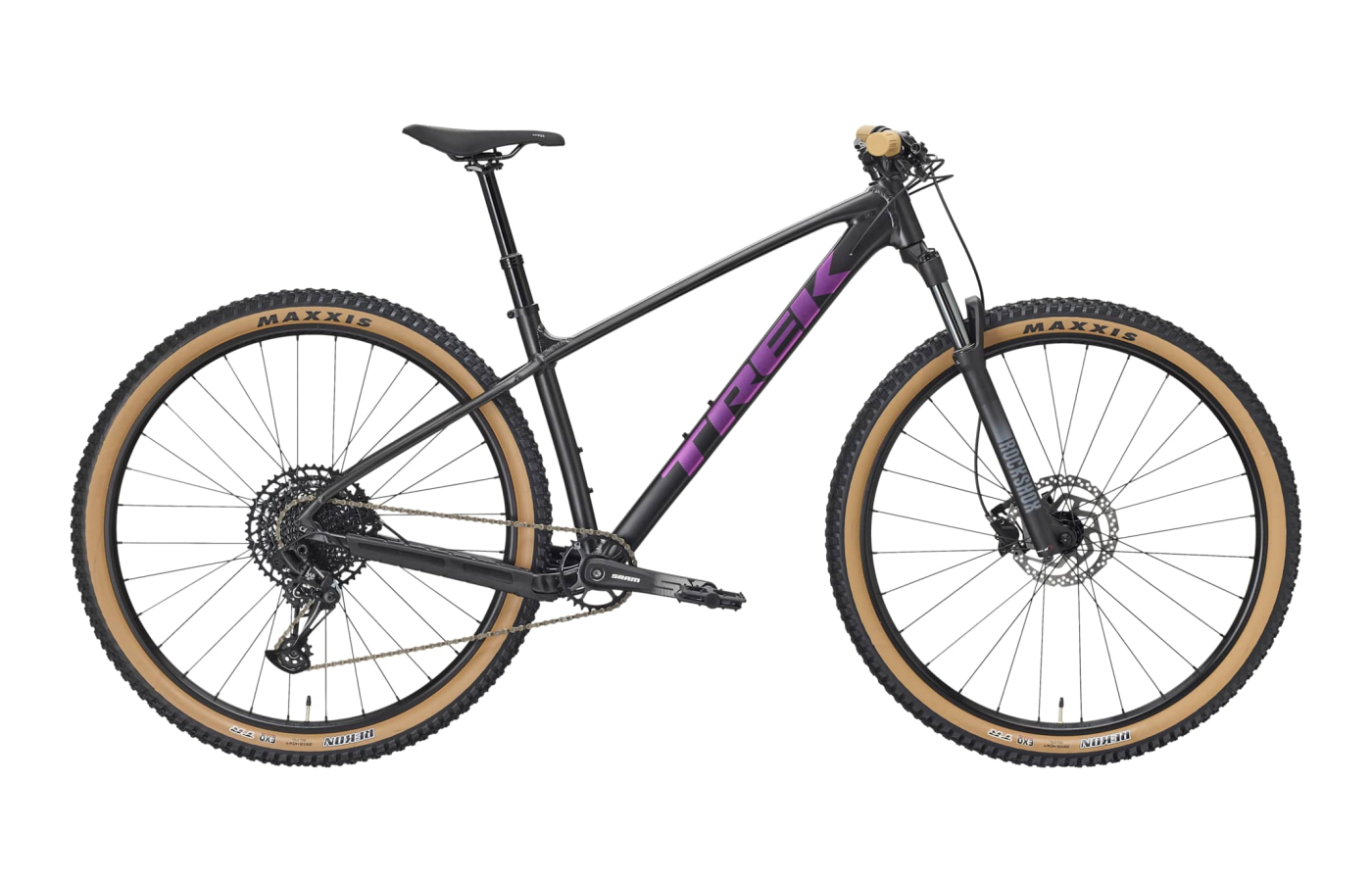
Trek MarlinvsStache
While the modern Trek Marlin Gen 3 boasts a significantly slacker head tube and longer reach than its predecessors, it's the older, discontinued Stache that still holds the crown for truly radical geometry with ultra-short chainstays designed around massive 29x3-inch tires. This stark difference in wheel and frame philosophy means these two hardtails deliver wildly divergent riding experiences. One is a versatile, confidence-inspiring entry point, the other a unique, momentum-driven play machine.

Overview
The Trek Marlin (Gen 3) is a thoroughly updated entry-level hardtail, positioned as a versatile machine equally adept at light trail riding, commuting, and fitness. Trek designers clearly aimed to modernize its geometry, making it more 'trail-ready' and stable for new mountain bikers. It’s a bike built on the principle of accessibility, offering a sensible component package across its various trims at budget-friendly prices, all backed by Trek’s lifetime frame warranty. In stark contrast, the Trek Stache (2016-2021) was a niche, experimental hardtail defined by its enormous 29+ (29x3-inch) tires and unique frame architecture. Dubbed 'Project Weird' by Trek, it was a specialized tool for riders seeking unparalleled traction, flotation, and a distinctive 'hovercraft-like' ride quality, pushing the boundaries of what a hardtail could be. While the Stache offered immense fun and capability in specific scenarios, its 'plus' sizing and bespoke frame design make it a stark departure from the Marlin's mass-market appeal.
Ride and handling
The Stache's ride quality is fundamentally dominated by its massive 29x3-inch tires, which reviewers consistently described as providing a 'hovercraft-like' or 'full suspension light' sensation. This translates to exceptional small-bump compliance and a feeling of 'positively floating' over trail chatter, roots, and rocks, effectively smoothing the terrain in a way no traditional hardtail can. Conversely, the Marlin Gen 3, while much improved over its predecessor with hydroformed frame tubes that 'soften the ride,' still relies primarily on its 100mm RockShox Judy fork and high-volume 2.4-inch tires to absorb trail irregularities, a far cry from the Stache's inherent floatation. When it comes to handling, the Stache is a bike of momentum. Its substantial rotational mass makes acceleration from a standstill feel 'sluggish' or 'burdensome,' but once rolling, it becomes an 'unstoppable steamroller' that carries speed through rough terrain with remarkable ease. Cornering on the Stache is a high-traction, 'on-rails' experience; reviewers noted its 'velcro-like grip' allows for aggressive leaning, though the bike's 'undamped bounce' from the tires can make high-speed, repetitive hits feel 'squirrely' if tire pressure isn't perfectly dialed. The Marlin, with its updated 66.5-degree head angle and longer reach, provides 'calmer handling' and inspires confidence on descents, feeling 'stable and planted' on light trails. It's more responsive to rider input at lower speeds than the Stache, but reviewers found its chassis 'easily overwhelmed' when pushed into 'black diamond' terrain. The Stache’s 'Project Weird' geometry, particularly its ultra-short 405-420mm chainstays, provides surprising agility despite the huge wheels, making it 'BMX-like' in its playfulness, ready to manual and flick around. This stands in contrast to the Marlin's 438mm chainstays, which, while modern, maintain a more conventional agility. A significant differentiator is the Stache's inherent capability on technical climbs due to its enormous contact patch, allowing it to 'crawl up steep puzzles of rocks and ruts' where others would spin out. The Marlin's 74-degree seat tube angle makes it an efficient climber, but it still requires more deliberate line choices and body English on truly loose or technical ascents, lacking the Stache's tractor-like grip.
Specifications
Looking across all builds, the Marlin Gen 3 aims for value, often featuring entry-level but functional components. Lower-end models like the Marlin 4 use SR Suntour coil forks and Tektro mechanical disc brakes, suitable for casual use but lacking performance refinement. Moving up to the Marlin 5 and 6, we see upgrades to Shimano CUES drivetrains and hydraulic disc brakes, with the Marlin 7 and 8 stepping up to RockShox Judy Silver air forks and SRAM SX Eagle 1x12 drivetrains. The inclusion of a TranzX dropper post on the Marlin 8 is a notable value-add for its price point, enhancing trail capability significantly. The Stache, as a discontinued line, was positioned at a higher price tier, and its builds reflected that with more premium components for its era. Models like the Stache 9 and 9.8 commonly featured SRAM X1 or GX 1x11 drivetrains, reliable Shimano XT brakes, and Manitou Magnum Pro forks with 110mm of travel. Its unique 29+ wheelset — featuring Sun-Ringlé Mulefüt 50SL rims and Bontrager Chupacabra 3.0-inch tires — was a hallmark, though reviewers noted the tires were prone to sidewall damage in rocky terrain. The Stache 9.8 even offered a carbon frame and carbon wheels, pushing its price to nearly $5000, a level far above any Marlin. A key spec divergence is the axle standards. Marlin Gen 3 models use a combination of quick-release (QR) front axles and Trek's 'ThruSkew' 135x5mm rear system. While ThruSkew improves on traditional QR by ensuring square alignment, reviewers universally noted the lack of true thru-axles limits the Marlin's stiffness and upgrade potential, creating a 'twangy' feel under load. The Stache, by contrast, came with Boost 110 front and Boost 148 rear thru-axles, which, despite the Manitou HexLock axle being 'fiddly,' provided a much stiffer and more precise wheel interface, essential for managing its large wheels and aggressive handling. Additionally, many Stache builds came with dropper posts from the factory, an amenity only found on the highest-tier Marlin 8.
| Marlin | Stache | |
|---|---|---|
| FRAMESET | ||
| Frame | Alpha Silver Aluminum (XXS, XS: curved top tube), internal derailleur & dropper post routing, rack and kickstand mount, 135x5mm ThruSkew | — |
| Fork | XXS: SR Suntour XCM 30, coil spring, preload, hydraulic lockout, 42mm offset (26"), 100mm QR, 100mm travel; XS: SR Suntour XCE 28, coil spring, preload, 42mm offset (27.5"), 100mm QR, 80mm travel; S: SR Suntour XCE 28, coil spring, preload, 42mm offset (27.5"), 100mm QR, 100mm travel; M/ML/L/XL: SR Suntour XCE 28, coil spring, preload, 46mm offset (29"), 100mm QR, 100mm travel | — |
| Rear shock | — | — |
| GROUPSET | ||
| Shift levers | Shimano M315, 8-speed | — |
| Front derailleur | — | — |
| Rear derailleur | Shimano ESSA U2000 | — |
| Cassette | Shimano HG300, 8-speed, 11-45T | — |
| Chain | KMC Z8.3, 8-speed | — |
| Crankset | ProWheel alloy, 30T narrow-wide steel ring — XXS/XS: 160mm; S/M/ML: 170mm; L/XL: 175mm | — |
| Bottom bracket | Threaded cartridge | — |
| Front brake | Hydraulic disc — XXS/XS/S: Tektro HD-M276; M/ML/L/XL: Tektro HD-M275 (also listed: Power BH-M286TF) | — |
| Rear brake | Hydraulic disc — XXS/XS/S: Tektro HD-M276; M/ML/L/XL: Tektro HD-M275 (also listed: Power BH-M286TF) | — |
| WHEELSET | ||
| Front wheel | Bontrager Connection, double-wall, 32-hole, 20mm width, Schrader valve; Formula DC-20, alloy, 6-bolt, 100x5mm | — |
| Rear wheel | Bontrager Connection, double-wall, 32-hole, 20mm width, Schrader valve; Formula DC-22, alloy, 6-bolt, Shimano 8/9/10 freehub, 135x5mm | — |
| Front tire | Bontrager Montrose Comp, wire bead, 30 tpi — XXS: 26x2.35; XS/S: 27.5x2.4; M/ML/L/XL: 29x2.4 | — |
| Rear tire | Bontrager Montrose Comp, wire bead, 30 tpi — XXS: 26x2.35; XS/S: 27.5x2.4; M/ML/L/XL: 29x2.4 | — |
| COCKPIT | ||
| Stem | Bontrager Comp, 31.8mm, 7° — XXS/XS/S: 35mm; M/ML/L: 50mm; XL: 60mm (M–XL Blendr compatible) | — |
| Handlebars | Bontrager alloy, 31.8mm — XXS/XS: 5mm rise, 690mm; S: 15mm rise, 720mm; M/ML/L/XL: 15mm rise, 750mm | — |
| Saddle | Bontrager Verse Short, stainless steel rails | — |
| Seatpost | Bontrager alloy, 31.6mm, 12mm offset — XXS: 300mm; XS/S/M: 330mm; ML/L/XL: 400mm | — |
| Grips/Tape | Trek Line Comp, nylon lock-on | — |
Geometry and fit comparison
The Trek Marlin Gen 3 geometry marks a substantial update from its predecessors, moving towards a more trail-oriented stance, but remains fundamentally different from the Stache's unique proportions. For the XL Marlin 7, the head tube angle sits at 66.5 degrees, significantly slacker than previous Marlins and providing enhanced stability on descents. Its effective seat tube angle is 73.4 degrees, steepened to promote an efficient pedaling position, and the reach measures a generous 495mm. These numbers, along with a 1230mm wheelbase and 438mm chainstays, create a balanced platform that reviewers found inspires confidence for new riders. The Stache, however, was in a league of its own. For a size 19.5-inch Stache 9, the head tube angle was a less slack 68.4 degrees (which was considered progressive for its time), but its real standout was the ultra-short 410-418mm adjustable chainstays. This compact rear end, combined with the massive 29x3-inch tires, was the result of 'Project Weird' engineering that allowed for surprising agility. The Stache’s wheelbase, even with its colossal wheels, was often shorter than comparable 29ers, around 1124-1132mm for the 19.5-inch, making it feel remarkably nimble in tight corners despite its large footprint. The bottom bracket height on the Stache was also notably higher at 319mm compared to the Marlin's 308mm-313mm, giving more clearance over obstacles. Comparing the two, the Marlin's geometry is a modern interpretation of a versatile cross-country and light trail hardtail. Its longer reach and slacker head angle provide a stable platform without feeling cumbersome, making it an excellent choice for a wide range of riders. The Stache, on the other hand, was an extreme experiment; its geometry was meticulously crafted around the 29+ tire size to maximize traction and playfulness. The combination of a relatively steeper head tube angle with extremely short chainstays and massive tires created a distinct, momentum-driven ride that defied conventional handling expectations for big-wheeled bikes. Riders experienced an upright position on the Stache, with an effective seat tube angle around 69.5 degrees, less steep than the Marlin's, which contributed to its 'monster truck' feel. The ergonomic implications are clear: the Marlin offers a comfortable, sporty seated position suitable for longer rides and varied terrain, though some taller riders might want a 'roomier seated position.' The Stache’s geometry, while offering an upright climbing position, also frequently drew comments about heel and calf rub on the wide seatstays due to its tight rear end. While the Marlin is designed to be a 'balanced customer' for the masses, the Stache was a specialized tool for those willing to embrace its unique ride characteristics and optimize tire pressure to unlock its full potential.
| FIT GEO | Marlin | Stache | |
|---|---|---|---|
| Stack | 618 | — | — |
| Reach | 470 | — | — |
| Top tube | 647 | — | — |
| Headtube length | 115 | — | — |
| Standover height | 771 | — | — |
| Seat tube length | 450 | — | — |
| HANDLING | Marlin | Stache | |
|---|---|---|---|
| Headtube angle | 66.5 | — | — |
| Seat tube angle | 73.4 | — | — |
| BB height | 308 | — | — |
| BB drop | 60 | — | — |
| Trail | 110 | — | — |
| Offset | 46 | — | — |
| Front center | — | — | — |
| Wheelbase | 1197 | — | — |
| Chainstay length | 438 | — | — |
Who each one is for
Trek Marlin
The Trek Marlin Gen 3 is an excellent option for the new mountain biker eager to explore local green and blue trails, or for the student who needs a durable, go-anywhere bike for daily commuting and weekend adventures. If you’re looking for a capable hardtail for fitness rides, light singletrack, or gravel paths, and appreciate modern geometry that inspires confidence without breaking the bank, the Marlin 7 Gen 3, with its dropper post and air fork, is particularly compelling. It’s also a solid choice for those contemplating bikepacking on mellower routes, thanks to its rack and fender mounts, providing a reliable companion for practical and recreational use.
Trek Stache
The Stache is for the rider who values an incredibly unique, traction-rich, and playful hardtail experience above all else. If you spend your weekends seeking out 'rollercoasters of momentum' on flowy, moderately bumpy trails, relishing the ability to 'monster-truck' over obstacles and manual with ease, the Stache is your bike. It’s also surprisingly adept for bikepacking, offering a comfortable, stable platform for long adventures over varied terrain, where its massive tires smooth out washboards and loose surfaces. This bike shines for those who want a hardtail with a 'full suspension light' feel, are meticulous about tire pressure, and enjoy the 'tail-out hooliganism' that its immense grip and short chainstays encourage.