Specialissima
vsTarmac
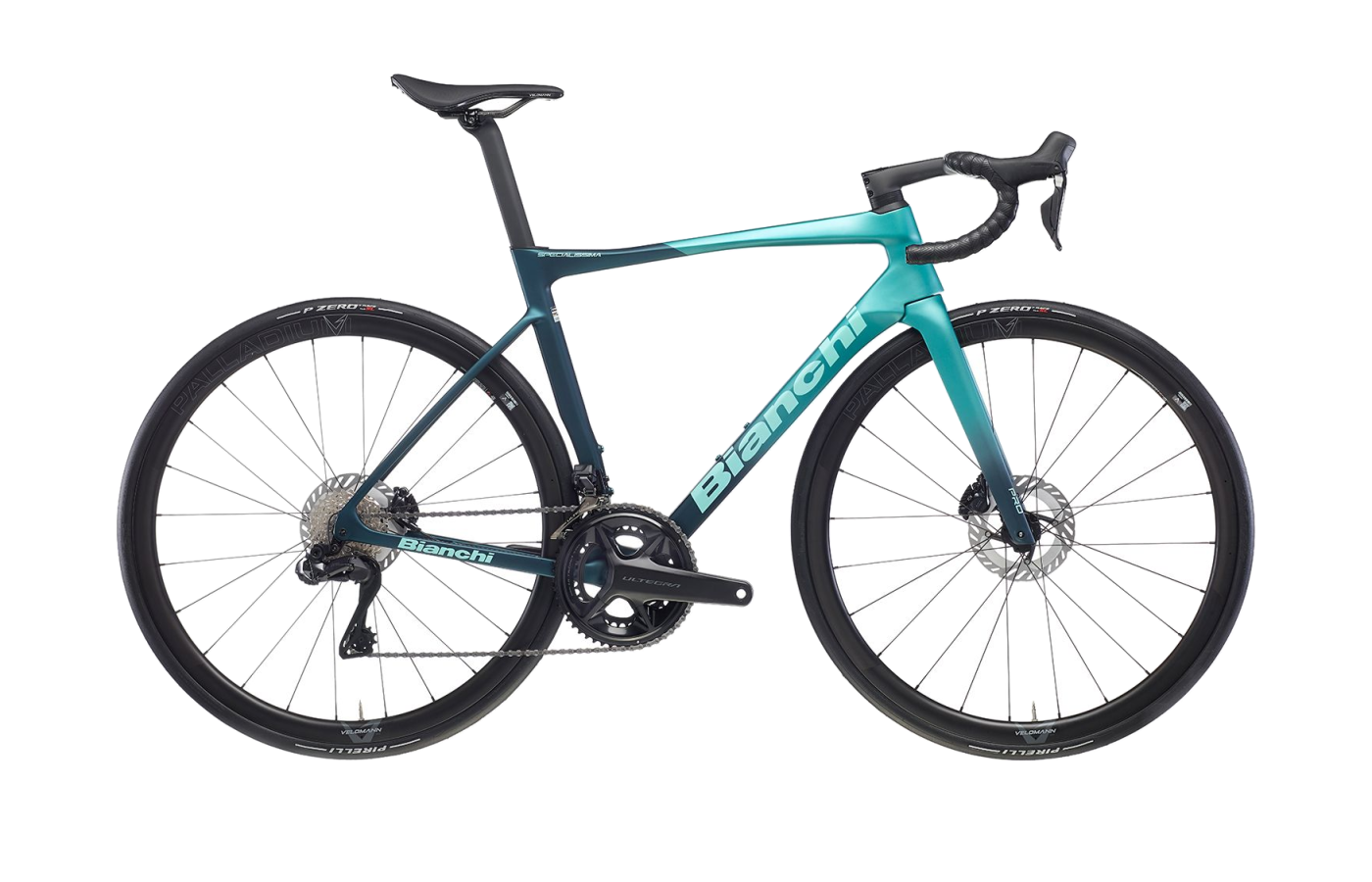
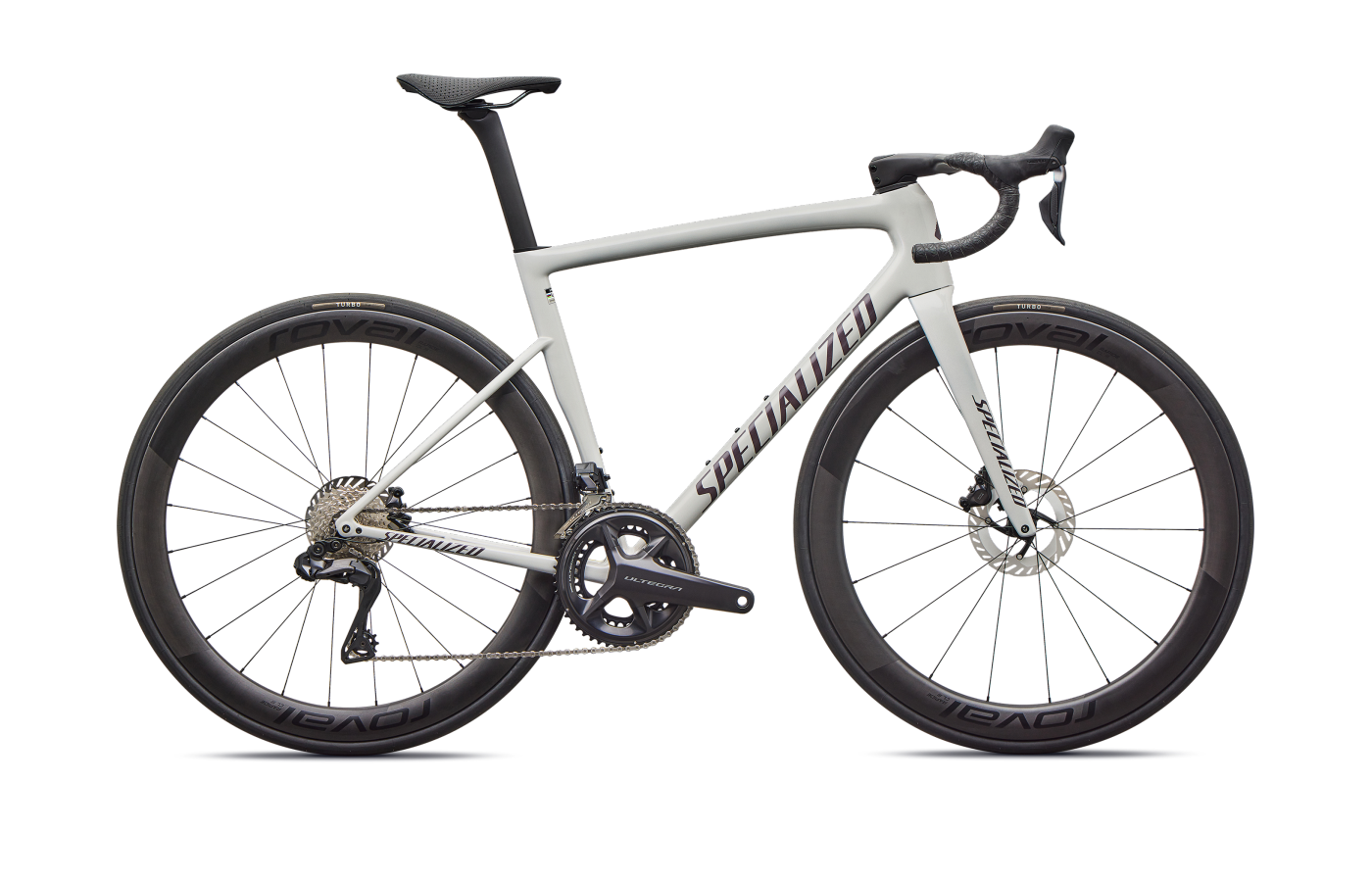
Italian climber meets Silicon Valley all-rounder.
The Specialissima is a long-and-low climbing weapon that grudgingly nodded to aero. The Tarmac is the do-everything race bike that quietly killed the Venge.
Specialissima
- Lighter at the top — the RC frame hits 6.56 kg measured (Cycling News), undercutting the S-Works Tarmac.
- Countervail damping on the Pro turns road resonance into thuds without softening the stiff chassis.
- Long-and-low race posture — 8 mm lower stack and 7 mm longer reach than the Tarmac at a fit-equivalent size.
- Stock 26 mm Pirelli TT tires are universally panned — plan to swap to 28–32 mm immediately.
- Small US presence; Velo flagged a months-long wait on a replacement seatpost gasket.
Tarmac
- Sharper, more forgiving handling — 73° HTA and 58 mm trail, with a neutrality reviewers call telepathic.
- Power meter standard across the lineup — 4iiii on Shimano builds, Quarq on SRAM. Few rivals match this.
- Threaded BSA bottom bracket — easier service, less creak risk than the Bianchi's Press Fit 86.5x41.
- Roval one-piece cockpit on Pro and S-Works locks you into pre-spec'd bar/stem combos — changing it is expensive.
- Stock 26 mm S-Works Turbo tires need an immediate upgrade for grip and comfort.
Editor’s analysis
Both bikes have a Tour stage in their bloodline — but they get there from very different directions.
On the spec sheet these two look like the same bike: pro-level all-rounders, ~32 mm tire clearance, threaded-or-pressfit BB nitpicks aside, electronic-only routing, integrated cockpits, claimed weights in the 6.6–7.3 kg range. Then you ride them and the philosophies pull apart. The Specialized Tarmac is the engineered consensus answer — Aethos rear, Venge front, the integrated cockpit that reviewers call telepathic. It's the bike that wins the local crit, the Sunday century, and the WorldTour mountain stage with the same chassis. The Specialissima is the Italian counterpoint: lighter, lower, longer in reach, and unapologetically built for going up.
The Bianchi Specialissima RC undercuts the Tarmac SL8 on weight at the top end (6.56 kg measured by Cycling News vs 6.67 kg for the S-Works) and runs an even more aggressive geometry. At a fit-comparable size, the Bianchi sits 8 mm lower and stretches 7 mm longer in reach — a properly long-and-low race posture that demands a flexible rider. The headline frame, the RC, has a high-modulus carbon layup so light Cyclonline calls it 'UCI-illegal at 6.56 kg.' The Pro variant we picked here adds Bianchi's Countervail vibration-damping insert, which Velo describes as turning road buzz into thuds — the same stiffness, less of the resonance.
The Specialized Tarmac is the all-rounder benchmark for a reason. Its 73° head tube and 58 mm trail make it the sharper steerer of the two — Cyclingnews calls the handling 'telepathic immediacy,' and Bicycling describes it carving lines that feel 'explosive when called upon but serene' otherwise. Specialized claims a 33% improvement in stiffness-to-weight over the SL7 and 16.6 seconds saved over 40 km at 45 km/h vs the predecessor. It's not a dedicated aero bike, but it's within a handful of watts of one (cited around 209 W at 45 km/h vs 205 W for the Cervélo S5). The trade is character: the Tarmac is engineered to be invisible under you. The Specialissima isn't trying to disappear.
Put another way: the Tarmac is the bike WorldTour mechanics hand a rider with a shrug — it works on every parcours. The Specialissima is the bike a Pantani-style climber picks because it makes the gradient feel optional. If you live on rolling roads and want one bike that does everything to a high standard, the Tarmac is the easier yes. If you ride mountains, value the Italian heritage, and want something that responds to every watt going uphill, the Specialissima earns its premium.
Where the builds differ.
Comparing our editor's-pick builds side-by-side. Winners highlighted row-by-row — lower price and weight, and the better-spec component, each mark a point.
Build variants & pricing
Both span roughly $4.7k to $13.5k+, with the Tarmac starting cheaper and the Specialissima reaching higher with a $25k Founder Edition halo build.
Prices are current US MSRP. The Bianchi has a smaller US dealer network than Specialized — verify availability and demo options locally before committing. Tier-matched picks here put both at Ultegra Di2 ($8,499 Tarmac SL8 Pro vs $8,699 Bianchi Pro), which is where most serious buyers actually land.
How they fit, how they steer.
Sized fairly: the Bianchi 550 sits 8 mm lower in stack and 7 mm longer in reach than the Tarmac 54 — a more aggressive, attack-ready posture. Trail is 10 mm longer on the Bianchi (68 vs 58) and the wheelbase 10 mm longer, so it tracks straighter while the Tarmac steers quicker.
Which size should I buy?
Size recommendations based on stack, reach, and effective top tube. Both ranges overlap closely in the middle; the Tarmac extends further at the small end (44 cm) for shorter riders.
→These are starting points. Flexibility, riding style, and preferred position all shift the answer — if you’re between sizes, a professional fit beats a chart.
What the magazines said.
Published reviews from trusted cycling outlets. Click through for the full write-up.
Which one should you buy?
If you want one race bike that vanishes under you on every road, get the Tarmac. If you ride mountains and want a bike with a soul, get the Specialissima.
Specialissima
If your idea of a good ride starts with a 30-minute climb and you want a bike that responds to every watt, the Specialissima earns its keep. The aggressive long-and-low posture and Countervail damping suit a flexible, powerful rider who values the Reparto Corse heritage as much as the watts.
Tarmac
If you want one bike that handles crits, weekend climbs, century rides, and the occasional gravel detour without compromise, the Tarmac is still the benchmark. Sharper steering, easier-to-live-with threaded BB, power meter standard, and the wider dealer network for service.
Questions buyers actually ask.
Short answers to the things we get emailed about most often.
01Which is lighter?
The Bianchi Specialissima RC, by a small margin at the top end. Cycling News measured the Dura-Ace RC at 6.56 kg in size 55 (without pedals or cages), and Granfondo reported 6.6 kg. Specialized's S-Works SL8 has a measured weight around 6.67 kg in size 56.
At the mid-tier we picked for editor's pick, the gap closes: the Bianchi Pro Ultegra Di2 runs ~7.27 kg (Velo, size 55), the Tarmac SL8 Pro sits around 7.25 kg. Effectively a wash.
02Which climbs better?
Both climb well, but the Specialissima is the more single-mindedly built climber. Its lower frame weight and aggressive long-and-low geometry reward riders who attack out of the saddle — Bikeitbellagio's reviewer described it as feeling 'like wings' on gradients.
The Tarmac SL8 is no slouch — Specialized claims a 33% stiffness-to-weight improvement over the SL7, and reviewers describe it as 'dancing uphill with urgency.' But it gives up some grams to the RC and trades a touch of climbing focus for all-around capability.
03Which is faster on flat roads?
The Specialized Tarmac SL8, marginally. External wind tunnel testing cited by reviewers puts the SL8 at ~209 W at 45 km/h — within a few watts of the dedicated Cervélo S5 (205 W). Specialized claims 16.6 seconds saved over 40 km at 45 km/h vs the SL7.
The Specialissima is also aero-optimized — Bianchi claims 31.19 seconds saved over 10 km at 200 W vs the previous Specialissima — but it's the climber-first bike of the two. Above 35 km/h with deep wheels, the Tarmac edges ahead.
04What's the maximum tire clearance?
Specialissima: 32 mm officially. Reviewers running 30 mm with room to spare confirm the spec.
Tarmac SL8: 32 mm officially. Specialized rates it at 32 mm, and most riders run a true 30 mm comfortably.
Both ship with 26 mm tires from the factory that nearly every reviewer recommends swapping immediately for 28–32 mm tubeless. The frames have the clearance — the stock rubber doesn't use it.
05How aggressive is the fit, really?
The Bianchi is the lower and longer of the two. At the fit-picked sizes (Bianchi 550, Tarmac 54), the Specialissima sits 8 mm lower in stack (536 vs 544) and stretches 7 mm longer in reach (391 vs 384). That's a meaningfully more aggressive position — flexible riders will love it; less-flexible riders will end up with a stack of spacers under the stem.
The Tarmac is no upright endurance bike either, but it's the more accessible posture of the two. If you're between an endurance bike and a race bike philosophically, the Tarmac is the easier transition.
06What's the difference between the Bianchi RC, Pro, and Comp frames?
Three carbon tiers. The RC is high-modulus carbon with the lightest layup — the frame Cycling News measured at sub-UCI-legal weight. No Countervail.
The Pro uses high-modulus carbon plus Bianchi's Countervail (CV) vibration-damping insert — about 40 g heavier than the RC frame, but Velo recommends it as 'the one you should buy' for the comfort/aesthetics combination.
The Comp is a standard carbon layup at the entry-level price ($6,500 with Ultegra Di2). Same geometry as the others, no Countervail, slightly heavier frame.
07Are both compatible with mechanical shifting?
No. Both frames are wireless/electronic-only — the routing and cable stops for mechanical derailleurs simply aren't there. If you want Shimano 105 mechanical or Campagnolo cable-shift, neither of these bikes will work.
The entry point for both is electronic: SRAM Rival AXS or Shimano 105 Di2 territory.
08How serviceable are the integrated cockpits?
Both bikes use one-piece integrated bar/stem units with internal routing. Adjusting bar width or stem length means buying a new unit, which Cyclingnews has called 'insanely expensive' for the Roval cockpit on the Tarmac.
The Tarmac Expert ($6,999) is the exception in the Tarmac lineup — it ships with a two-piece bar and stem (alloy bar, integrated stem), which is significantly easier to refit. The Specialissima uses the integrated Reparto Corse cockpit on every build in the lineup.
Similar bikes
If your priorities don’t map cleanly onto either of these, one of these adjacent bikes probably fits better.
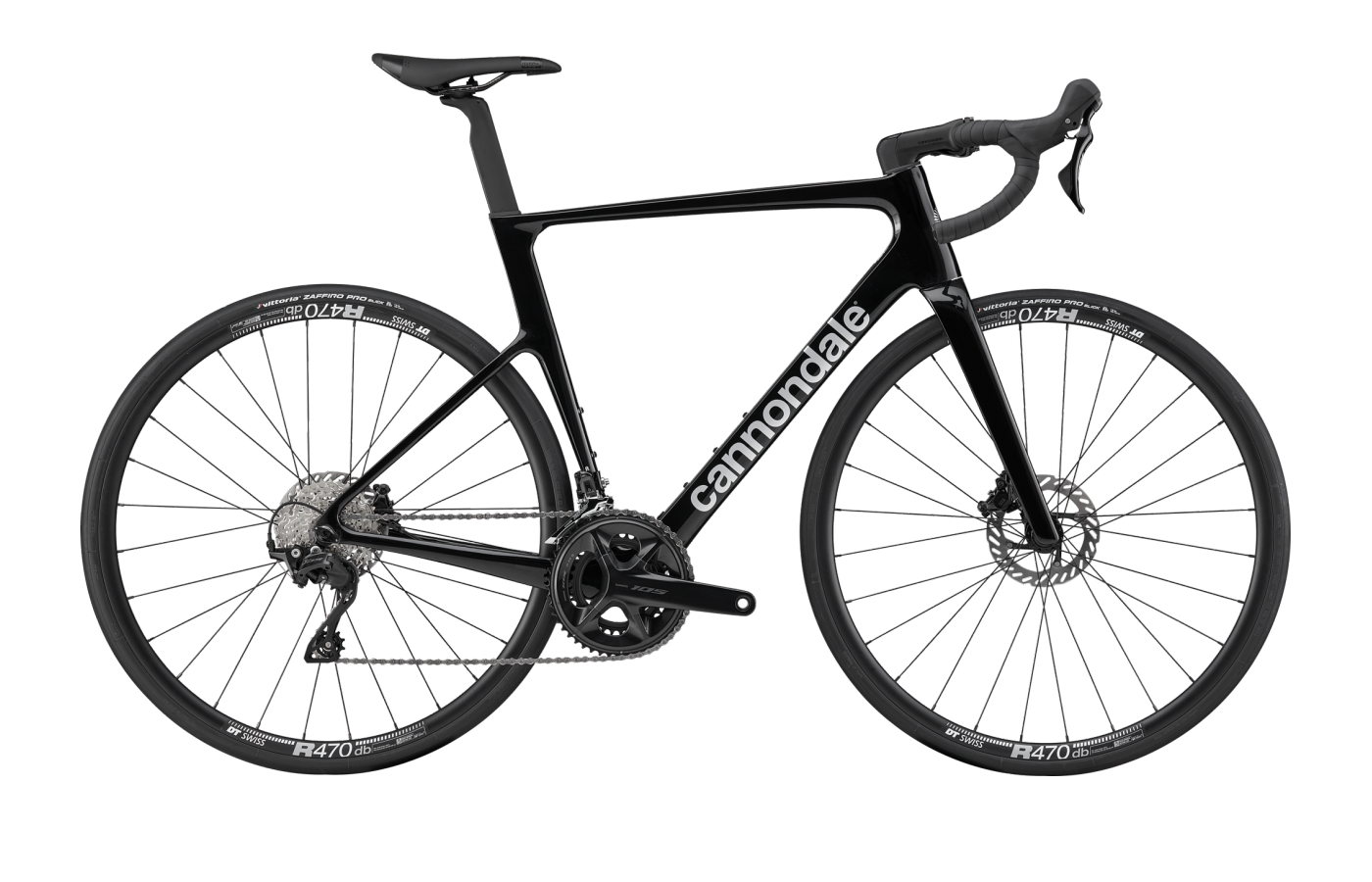
SuperSix EVO
The Tarmac's most direct rival — even stiffer through the bottom bracket and just as light. If you like the Tarmac's all-rounder thesis but want something less ubiquitous on the group ride, the SuperSix EVO is the obvious cross-shop.
Compare →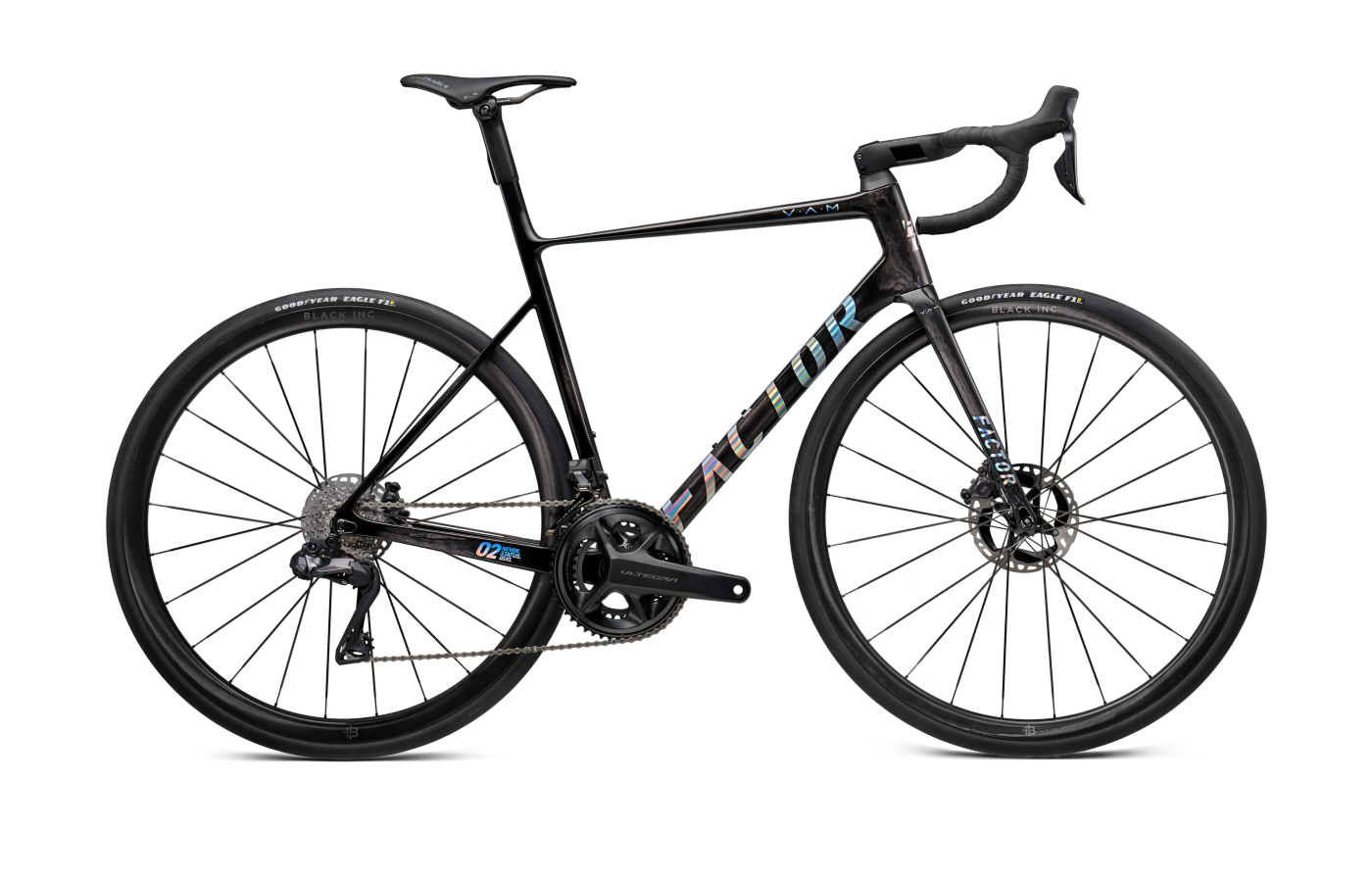
O2 VAM
The pure climbing specialist that makes even the Specialissima feel heavy — sub-6.5 kg builds are routine. If you want the Bianchi's climbing focus taken to its logical extreme and don't care about aero, this is the answer.
Compare →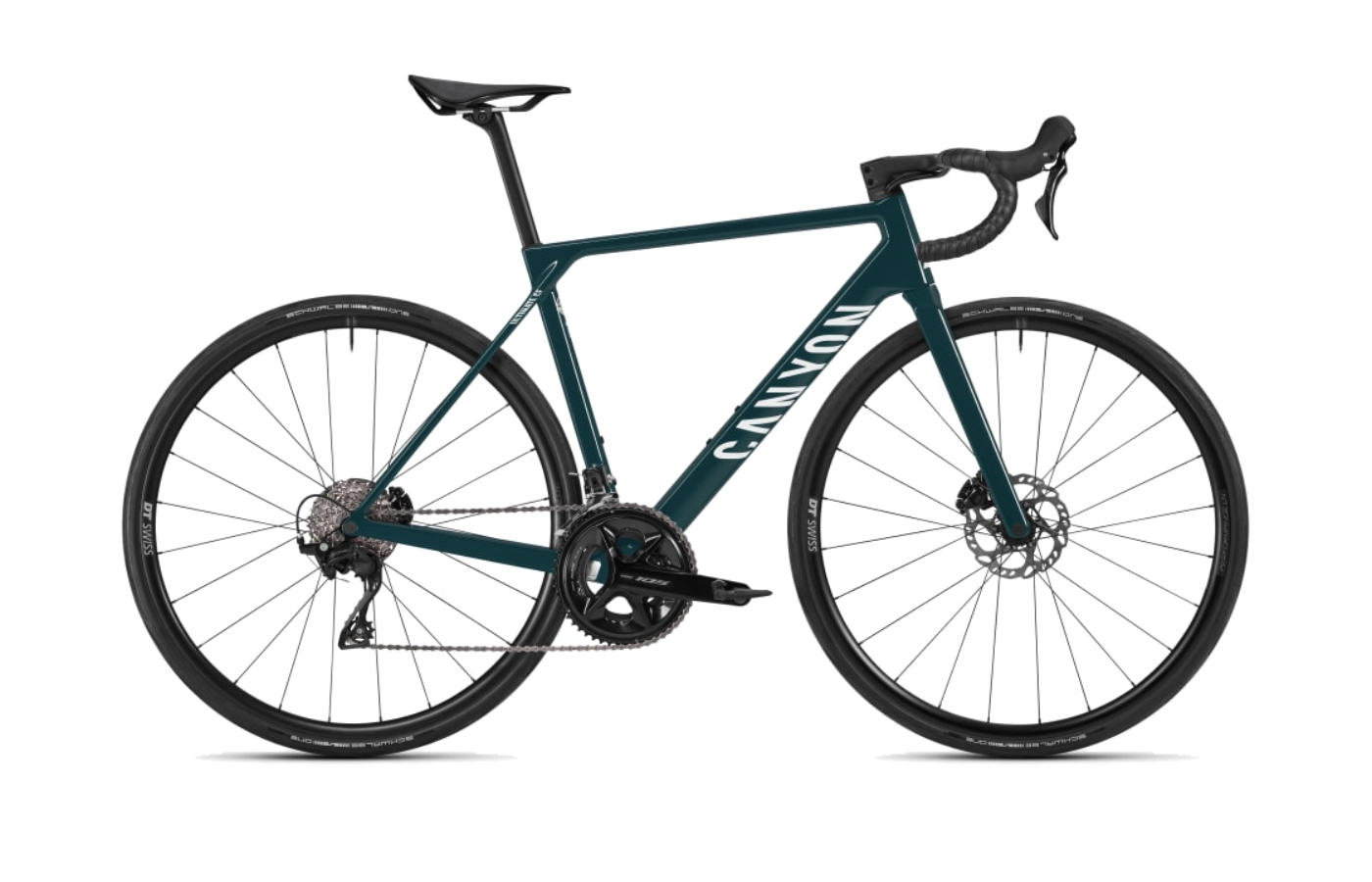
Ultimate
Lightweight all-rounder at direct-to-consumer pricing — roughly 25–30% less than the Specialized for comparable performance. The catch is no local dealer and no demos; best if you already know your fit.
Compare →