Grizl
vsTerrel
Two takes on drop-bar adventure.
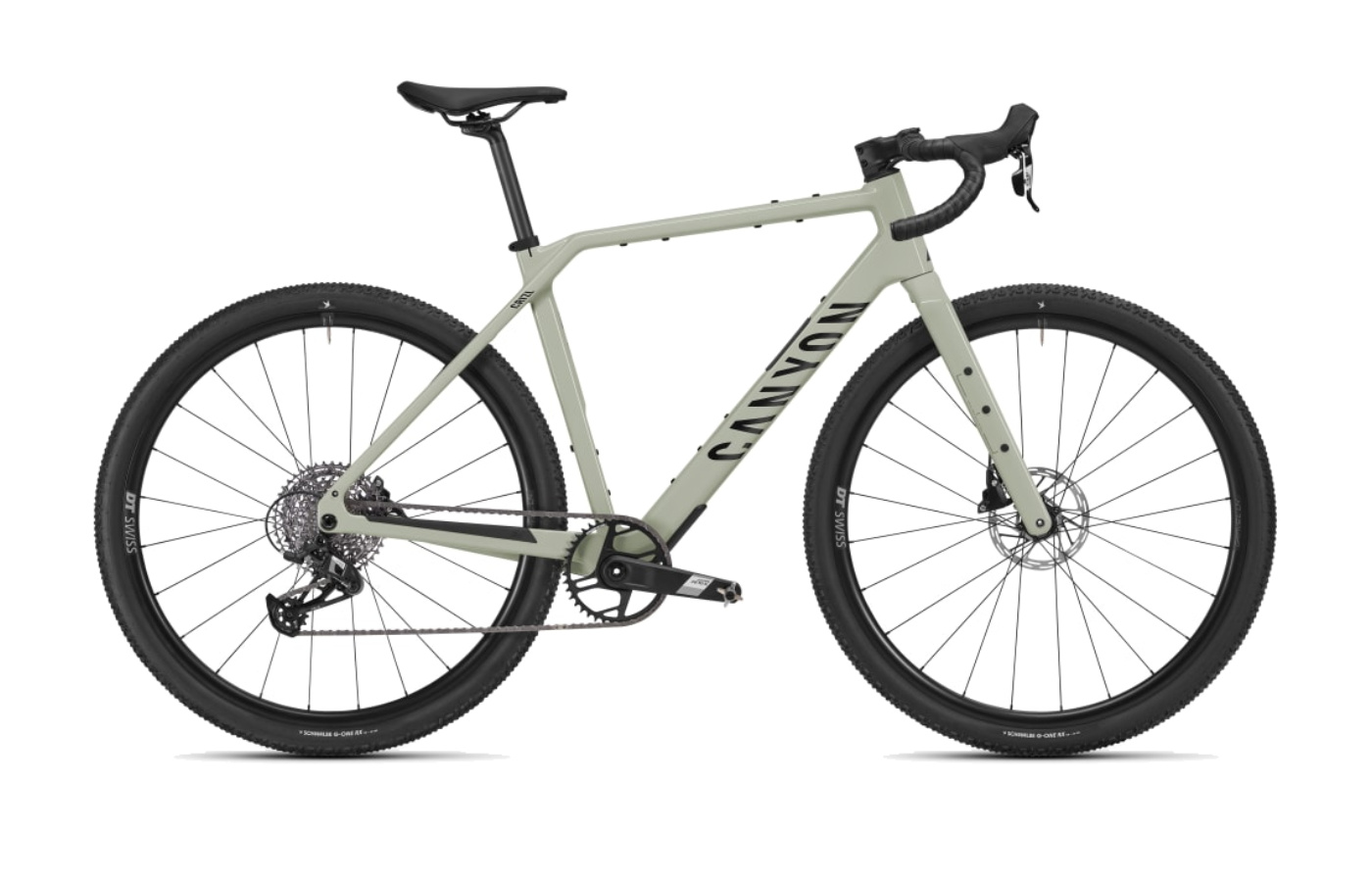
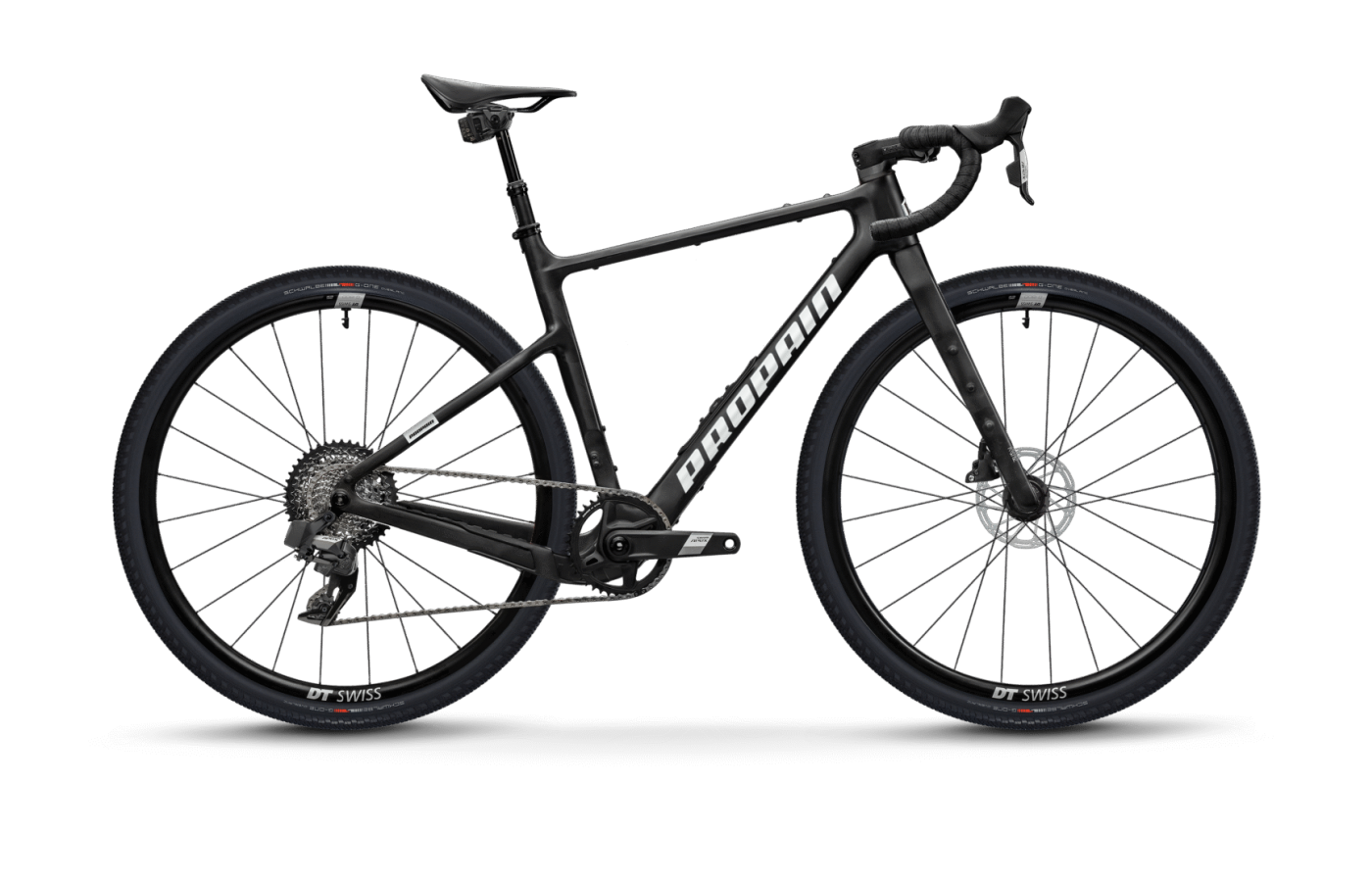
The Canyon Grizl is a planted long-haul mile-muncher with clever bikepacking integration. The Propain Terrel is a mountain biker's attempt at a drop bar — slack, suspension-corrected, and ready to evolve.
Grizl
- Widest tire clearance in class — the CF frame swallows 54 mm rubber, more than the Terrel's 50 mm and most gravel rivals.
- VCLS 2.0 seatpost — 20 mm of leaf-spring compliance that reviewers universally praise for damping chatter without killing pedal efficiency.
- ECLIPS option — the $4,699 CF 8 Escape integrates a SON dynamo, 3,500 mAh battery, and Lupine lights for under-the-hood self-sufficiency.
- Press-fit BB86 bottom bracket where the Terrel uses a threaded T47.
- Calmer, less playful handling — reviewers call it boat-like compared to earlier Grizls.
Terrel
- Suspension-corrected geometry — the rigid carbon fork is built to be swapped for a 40 mm gravel suspension fork without wrecking the handling.
- T47 threaded bottom bracket — easier home-mechanic maintenance than the Grizl's press-fit.
- Configurator flexibility — Propain's "Make it yours" lets you spec dropper, suspension fork, wheels, and bars from the order page.
- Only two stock builds, both SRAM Apex — no Shimano GRX option off the shelf.
- 50 mm tire clearance trails the Grizl's 54 mm for the truly wide-rubber crowd.
Editor’s analysis
Both are direct-to-consumer adventure gravel rigs — but one wants to carry four bags across a country, the other wants to get rowdy on singletrack.
The Canyon Grizl leans hard into the bikepacking-first identity. The 2025/2026 redesign slackened the head angle to 71 degrees on most sizes, stretched chainstays to 440 mm, and pushed tire clearance up to 54 mm on the CF frame. Reviewers at The Radavist, Granfondo, and Flow Mountain Bike consistently describe it as calm, composed, and boat-like — a bike that rewards mile-munching and loaded touring over flickable singletrack.
The Propain Terrel comes at the same target from the mountain-bike side. Slack 70 degree head angle in size M, 435 mm chainstays across the board, 50 mm tire clearance, and — critically — a suspension-corrected carbon fork that's ready to accept a 40 mm gravel suspension fork without throwing off the geometry. Just Ride Bikes and Granfondo both describe it as feeling like a rigid hardtail with drop bars: stable on descents, happy on technical trails, less urgent on tarmac.
Pricing tells the rest. Canyon Grizl spans $1,799 (alloy GRX 10-speed) to $4,699 (CF 8 ESC with the ECLIPS dynamo/lighting system). Propain Terrel lands in a narrower $2,899–$3,999 carbon-only window. At the sub-$3k end, the matchup is close — both sell a SRAM Apex 1x mechanical carbon bike for around $2,600 to $2,900. Higher up, the bikes diverge: Canyon spends its money on integration (ECLIPS dynamo, GRX Di2), Propain on electronic mullet drivetrains and configurator flexibility.
The tidy summary: the Canyon Grizl is a bike Canyon built. The Propain Terrel is a bike you build — via the online configurator, with or without a suspension fork, dropper post, carbon wheels, or aero bars. If you know what you want, the Terrel gets you there. If you want a turnkey long-haul adventure rig, the Grizl is the easier answer.
Where the builds differ.
Comparing our editor's-pick builds side-by-side. Winners highlighted row-by-row — lower price and weight, and the better-spec component, each mark a point.
Build variants & pricing
Canyon spans from a $1,799 alloy to a $4,699 ECLIPS-integrated carbon flagship. Propain stays carbon-only in a tighter $2,899–$3,999 window, with electronic mullet at the top.
Prices are current US MSRP and can shift with regional availability. Propain's configurator can push the Terrel well past its base price with carbon wheels, a suspension fork, or a dropper post added on.
How they fit, how they steer.
Propain's XS slots against Canyon's S for a 173 cm rider — the Terrel runs a slacker 69.5 degree head angle and a steeper 74.3 degree seat angle than the Grizl's S (70.25 / 73.5), with a 17 mm shorter wheelbase but the same 435 mm chainstays.
Which size should I buy?
Sizing is recommended from stack, reach, and effective top tube. The Grizl covers 3XS to 2XL — unusually broad — while the Terrel runs XS to XL.
→These are starting points. Flexibility, riding style, and preferred position all shift the answer — if you’re between sizes, a professional fit beats a chart.
What the magazines said.
Published reviews from trusted cycling outlets. Click through for the full write-up.
Which one should you buy?
If you want a turnkey long-haul bikepacking rig, get the Grizl. If you want a drop-bar bike that rides like a hardtail and can grow with you, get the Terrel.
Grizl
If your riding trends toward multi-day trips, heavy bags, and mile-after-mile of mixed terrain, the Grizl is built around that use case. The ECLIPS builds in particular replace a whole shopping list of dynamo, battery, and light gear — at a price that's hard to beat once you add it all up.
Terrel
If you already think in mountain-bike terms and want a drop-bar that can handle real singletrack, the Terrel's slack geometry and suspension-corrected fork give you a clear upgrade path. The T47 BB and conventional component standards keep it easy to live with long-term.
Questions buyers actually ask.
Short answers to the things we get emailed about most often.
01Which has wider tire clearance?
The Canyon Grizl CF at 54 mm, versus 50 mm on the Propain Terrel. Canyon's CF frames boosted clearance with the 2025 redesign specifically to unlock 2.1-inch mountain-bike tires for rough singletrack.
Both bikes come specced with 45–50 mm tires stock. If your terrain pushes past that, the Grizl has more headroom; at 50 mm and under, the gap disappears.
02Can I put a suspension fork on these?
Propain Terrel: explicitly yes. Propain designed the Terrel with suspension-corrected geometry — the rigid carbon fork is the same axle-to-crown length as a 40 mm gravel suspension fork, so swapping in something like a Fox 32 TC or RockShox Rudy won't drop the front end or steepen the angles. Propain's configurator even lets you order it pre-built that way.
Canyon Grizl: Canyon sells the "Rift" variant with a DT Swiss F132 One 40 mm fork from the factory, so yes — though aftermarket swaps on a non-Rift Grizl aren't officially supported.
03What bottom bracket does each use?
The Canyon Grizl runs a press-fit BB86. Canyon defends the choice on stiffness and packaging grounds, and reviewers at Bikepacking.com and Just Ride Bikes report no creaking issues, but press-fit systems require specialty tools for service.
The Propain Terrel uses a T47 threaded bottom bracket. It's easier to service at home and less prone to the creaking issues press-fit designs have historically had.
04Which is better for a loaded bikepacking trip?
The Canyon Grizl — especially the Escape builds with ECLIPS. Reviewers consistently describe it as more planted and composed with a load, and the ECLIPS system (SON dynamo hub, 3,500 mAh Lupine battery, integrated lighting, USB-C charging port) replaces a pile of aftermarket gear with one integrated package that Bikepacking.com estimates would cost over $1,200 to assemble yourself.
The Terrel will carry bags fine — it has frame, fork, and top-tube mounts — but it's more of a day-ride and trail-ride bike that happens to accept luggage, not a purpose-built long-haul platform.
05Is the Canyon Grizl's cockpit really that integrated?
On the carbon CF 7 and CF 8 builds, yes — they ship with the one-piece Canyon CP0050 carbon cockpit that routes hoses internally. Changing stem length or bar width means buying a new unit.
The alloy RAW builds (and the CF 6 Apex) keep a conventional two-piece alloy stem and flared bar, which is far friendlier to aftermarket swaps. The Propain Terrel stays conventional across its lineup.
06Does the Terrel come in a Shimano build?
No — as of the 2024–present generation, the stock Propain Terrel is SRAM Apex only: mechanical on the Signature Spec 1 ($2,899) and Apex/GX T-Type AXS electronic mullet on the Signature Spec 2 ($3,999). If you want Shimano GRX off the shelf, the Grizl is the one to look at — it offers GRX RX400, RX610, RX820, and GRX Di2 across its range.
07Which handles better on technical singletrack?
The Propain Terrel. Its 69.5-degree head angle in XS (70.5 in M) is closer to a cross-country hardtail than a gravel race bike, and the suspension-corrected fork gives you an easy upgrade path to 40 mm of travel. Reviewers consistently call out its confidence on rocky, rooted, aggressive terrain.
The Grizl is capable on singletrack — Flow Mountain Bike called it "remarkably composed" — but it's tuned for stability with a load rather than trail playfulness. If your gravel rides routinely spill into mountain-bike territory, the Terrel is the sharper tool.
08How do the ride positions compare for a 5'8" rider?
The fit-picked frames are Grizl S (stack 556, reach 397) and Terrel XS (stack 554, reach 382). Stack is nearly identical, but the Terrel's reach is 15 mm shorter — paired with its typical short stem, that's a more upright, mountain-bike-ish cockpit.
Both have the same 435 mm chainstays at these sizes. The Terrel's wheelbase is 25 mm shorter (1,012 mm vs 1,044 mm), so it turns more quickly at low speed.
Similar bikes
If your priorities don’t map cleanly onto either of these, one of these adjacent bikes probably fits better.
Szepter
YT's drop-bar mountain-bike crossover, with deep MTB roots and a stock suspension fork. If the Terrel's trail bias appeals but you want the fork included instead of configured in, this is the play.
Compare →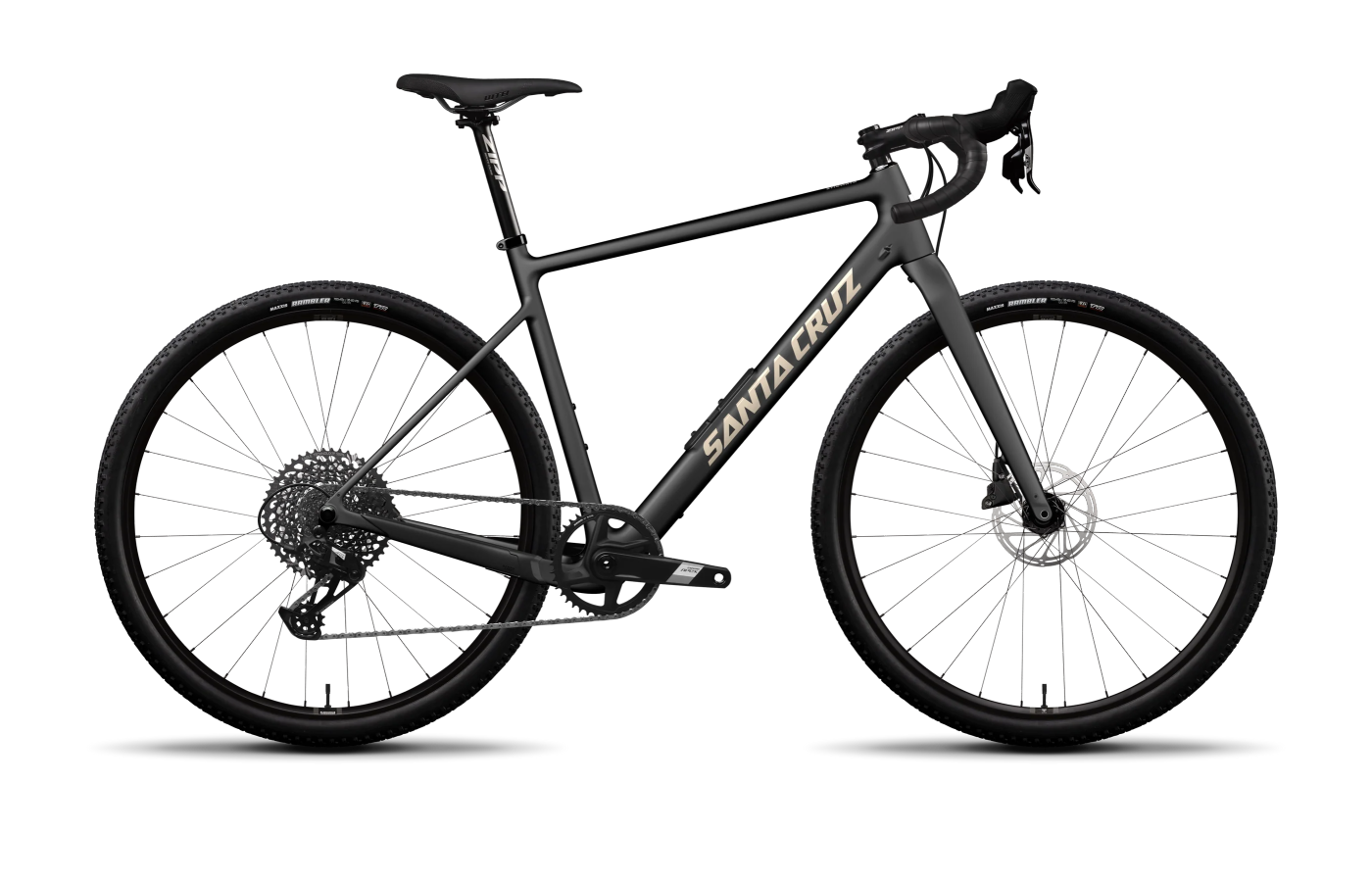
Stigmata
Santa Cruz's take on an adventure-gravel all-rounder — big tire clearance, threaded BB, and a marginally racier handling feel than either of the bikes in this comparison. The premium-brand tax is real, but so is the ride feel.
Compare →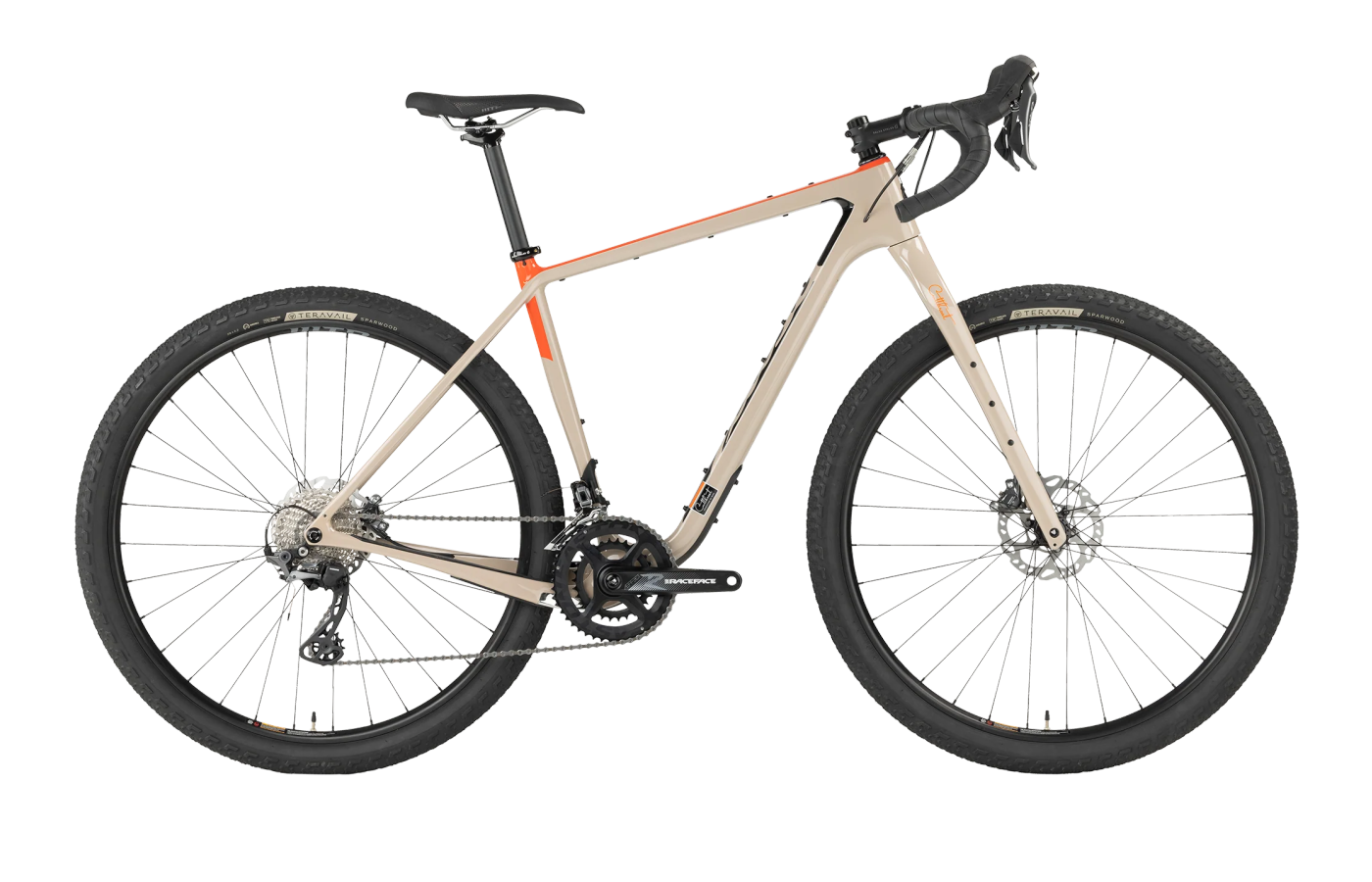
Cutthroat
The original drop-bar MTB for ultra-endurance bikepacking racing. If the Grizl's adventure-first brief resonates but you want even more tire volume and a more race-loaded posture, the Cutthroat is where you end up.
Compare →