Salsa RangefindervsTrek Roscoe

Unlike many hardtails that straddle the line between XC and light trail, the Trek Roscoe Gen 4 arrives with a burly Fox Rhythm 36 fork boasting 150mm of travel and powerful 4-piston Shimano Deore brakes, complete with a massive 203mm front rotor. In stark contrast, the Salsa Rangefinder, while a capable trail hardtail, typically sports 120mm forks and more modest 2-piston Shimano MT200 brakes with 160mm rotors. This immediate spec difference signals two very different approaches to the trail.

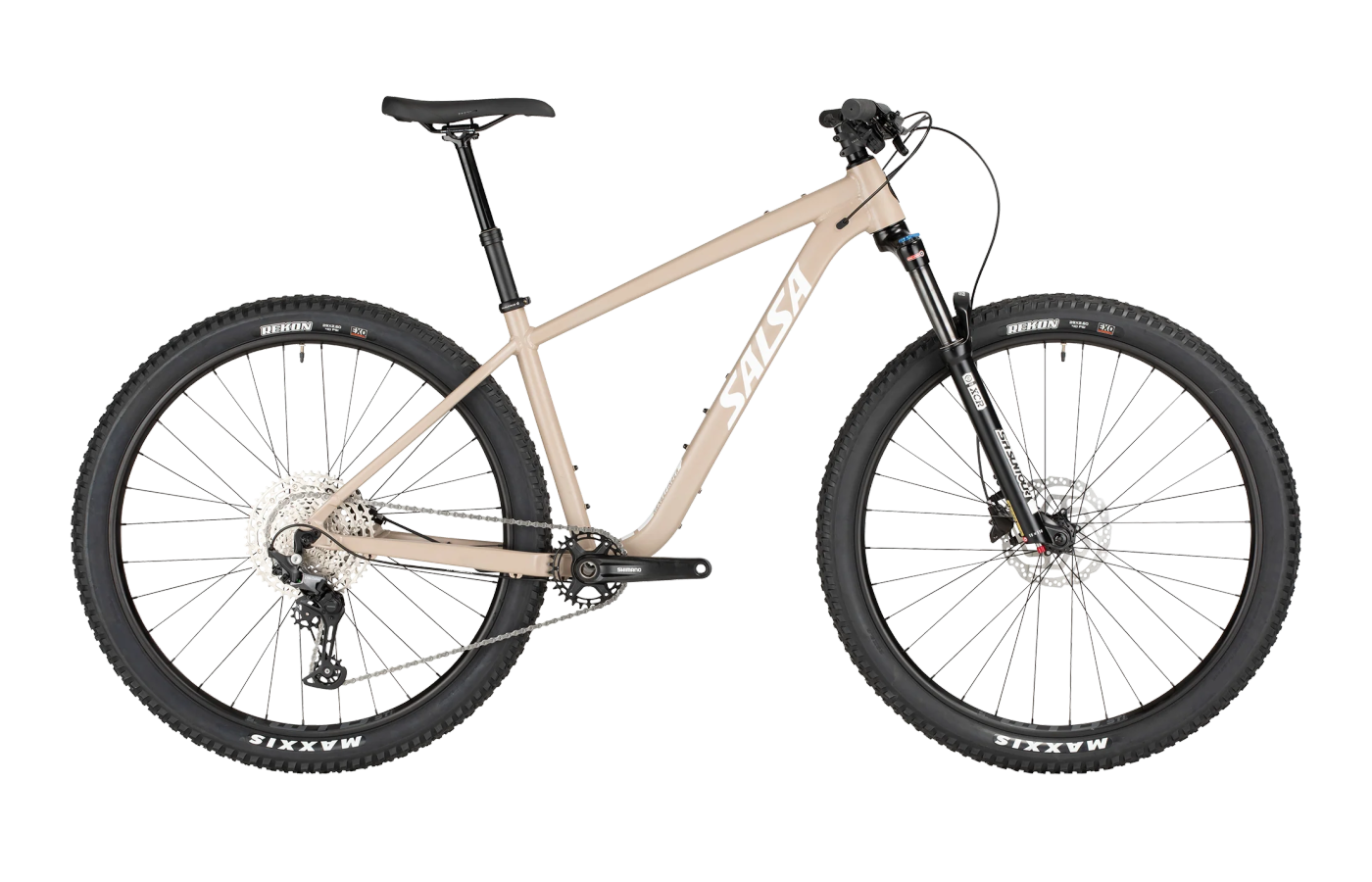
Salsa Rangefinder
Image pending

Overview

The Salsa Rangefinder, launched in 2020, carved out its niche as a highly accessible and adventure-ready hardtail for the entry-level to recreational mountain biker. Priced keenly from around $650 to $1,600, it offers exceptional versatility, serving equally well as a rugged commuter, a bikepacking rig thanks to its numerous mounts, or a first proper trail bike. It’s a confidence-building machine designed to let riders progress their skills on local singletrack without an intimidating price tag, available in both 27.5+ and 29er wheel options. Conversely, the Trek Roscoe Gen 4, particularly in its higher-end Roscoe 8 guise, has shed any pretense of being an entry-level bike. Positioned as a hardcore hardtail, it aims squarely at aggressive trail riding, leveraging Trek's Alpha Platinum Aluminum frame—the same premium alloy found on their full-suspension platforms. At a price point around $2,400 for the Roscoe 8, it delivers high-performance suspension, powerful brakes, and modern, slack geometry to tackle challenging terrain, setting it apart as a formidable singletrack shredder designed to push limits.

Ride and handling

Riders consistently describe the Salsa Rangefinder as a stable and predictable bike, perfectly suited for building confidence on moderate trails. Its 120mm travel, whether from a basic SR Suntour XCM32 coil or a more adjustable XCR air fork, smooths out smaller bumps adequately for general trail use. The wide Maxxis Rekon tires (2.6" for 29ers, 2.8" for 27.5+) are praised for their "prodigious grip" and contribute significantly to comfort and stability over varied surfaces, even handling snow. While competent, reviewers suggest that on "steep descents" or "rough, technical trails," riders might desire a slacker head tube and more suspension travel, indicating its limits when pushing aggressive speeds. In contrast, the Trek Roscoe Gen 4 is built to "get wild." The massive 150mm Fox Rhythm 36 fork with its stiff 36mm stanchions provides a level of front-end composure typically found on full-suspension bikes, absorbing bigger hits and resisting flex through chunky terrain. This allows the Roscoe to maintain composure and precise line holding where the Rangefinder would start to feel overwhelmed. Initial impressions highlight the Roscoe as "fast" and "playful" despite its burly appearance, managing to feel agile rather than sluggish. The inclusion of a 200mm dropper post further enhances its descending prowess, allowing the saddle to disappear completely and giving riders immense freedom of movement to maneuver the bike underneath them. When it comes to handling and responsiveness, the Rangefinder offers "excellent maneuverability" with its short stem and long top tube, making it feel "pretty rowdy" on less demanding trails. The choice between 27.5+ wheels for a "more nimble handling" and 29ers for speed and rollover capability allows riders to tailor the feel. However, the Roscoe's dramatically slacker head angle and high-engagement Bontrager Rapid Drive hub (108 points) translate to more confident high-speed stability and immediate power transfer in technical sections. The Roscoe's powerful Shimano Deore 4-piston brakes, with their 203mm front rotor, provide "insane stopping power," allowing riders to carry more speed and stop on a dime, a critical advantage on aggressive terrain where the Rangefinder's brakes would require more finesse and planning.

Specifications

Looking at the Salsa Rangefinder's builds, the lineup offers a broad spectrum of value, ranging from entry-level Advent X 10-speed options to more capable Deore 12-speed setups. A significant value proposition is the inclusion of a dropper post across all models, a feature often absent on hardtails in its lower price bracket. While the lower-cost builds feature basic SR Suntour XCM32 coil forks, functional but heavy, higher-tier builds upgrade to more adjustable SR Suntour XCR air forks. Shimano MT200 hydraulic disc brakes are standard, providing reliable stopping power, though the 160mm rotors are typical for cross-country or light trail use. However, a consistent criticism is the use of wire-bead Maxxis Rekon tires that are not tubeless compatible, requiring an immediate upgrade for improved ride quality and puncture resistance. Some models also use a less robust 9x141mm quick-release rear hub. The Trek Roscoe 8 Gen 4, at its higher price point, focuses on performance where it counts. Its Shimano Deore M6100 1x12 drivetrain is a proven workhorse, offering a wide gear range and reliable shifting. The standout component is undoubtedly the Fox Rhythm 36 150mm fork, providing superior damping and stiffness over any fork found on the Rangefinder. Braking is also vastly superior, with Shimano Deore 4-piston calipers and large 203mm front and 180mm rear rotors, delivering confident, powerful stops. The Bontrager Rapid Drive 108 hub is another premium inclusion, offering near-instantaneous engagement crucial for technical riding. However, Trek makes some surprising compromises in the cockpit, with reviewers noting the stem and handlebars are components also found on the much cheaper Trek Marlin series, a definite quality gap for a $2,400 bike. Essentially, the Roscoe Gen 4 invests heavily in the core performance components—frame, fork, brakes, and rear hub—offering a truly aggressive trail ride. The Rangefinder spreads its value across a wider range of builds, providing a very capable and versatile package at more accessible price points, though with compromises in high-performance components. The Rangefinder's adventure-ready mounts and included dropper post on all builds are key differentiators for its value proposition, while the Roscoe relies on its brute strength and high-end suspension.

RangefinderRoscoe
FRAMESET
FrameRangefinder Aluminum
ForkSR Suntour XCM32 Boost, coil, NLO, DS, 120mm
Rear shock
GROUPSET
Shift leversmicroSHIFT Advent X M9605
Front derailleur
Rear derailleurmicroSHIFT Advent X M6205
CassettemicroSHIFT Advent X H104, 10-speed, 11-48T
ChainShimano HG54
CranksetFSA Alpha Drive, 30T
Bottom bracketFSA 124.5mm bottom bracket
Front brakeShimano MT200 OR Tektro M520 hydraulic disc
Rear brakeShimano MT200 OR Tektro M520 hydraulic disc
WHEELSET
Front wheelShimano MT400 Center Lock hub, 15x110mm TA / WTB ST i40 32h 27.5" rim
Rear wheelShimano MT200 Center Lock hub, 10x141mm QR / WTB ST i40 32h 27.5" rim
Front tireMaxxis Rekon 27.5 x 2.8", EXO, wire bead (not tubeless compatible)
Rear tireMaxxis Rekon 27.5 x 2.8", EXO, wire bead (not tubeless compatible)
COCKPIT
StemSalsa Guide 31.8, 60mm, 6°
HandlebarsSalsa Salt Flat 31.8, 750mm (XS-SM) / Salsa Rustler 31.8, 800mm (M-XL)
SaddleWTB Volt Medium, steel rails, 142 x 265mm
SeatpostSalsa Guide 30.9, 0 offset
Grips/TapeSalsa File Tread

Geometry and fit comparison

Comparing the Salsa Rangefinder (Medium) with its 68.6-degree head tube angle and 74.6-degree seat tube angle, to the Trek Roscoe Gen 4 (which for a size Large features a 65-degree head tube angle and a 76-degree seat tube angle), reveals a fundamental difference in design philosophy. The Rangefinder's geometry is more traditional trail-oriented, offering a balanced feel that is stable but still responsive enough for less aggressive terrain. Its 444.4mm reach and 611.0mm stack on a Medium provide a comfortable, upright-leaning posture suitable for varied riding, from leisurely explorations to moderate singletrack. The 439mm chainstays contribute to predictable handling without feeling overly long or short. The Roscoe Gen 4, on the other hand, embraces decidedly modern and aggressive geometry. Its 65-degree head tube angle is significantly slacker than the Rangefinder's, making it inherently more stable at high speeds and over steep, technical descents. The steeper 76-degree seat tube angle positions the rider more effectively over the bottom bracket for efficient climbing, even with its long-travel fork. While we don't have direct medium-to-medium comparison, the Roscoe's longer reach (470mm on a size Large) paired with its slack head angle creates a longer front-center, boosting confidence in steep terrain and allowing for more controlled weight shifts. This combination of slack head angle, steep seat angle, and generous reach indicates a bike built to charge. For riders prioritizing a comfortable, upright position and predictable handling on varied, non-extreme terrain, the Rangefinder's geometry is a forgiving and approachable fit. It suits those who might be new to mountain biking or who prefer longer, steadier rides where twitchy handling is not desired. Conversely, the Roscoe's aggressive numbers cater to riders who regularly tackle steeper trails, faster descents, and more technical features. Its geometry encourages a commanding riding position for aggressive trail attacks, favoring dynamic rider input and high-speed stability over casual comfort, especially for riders with a more aggressive stance.

vs
FIT GEORangefinderRoscoe
Stack620.1
Reach470.4
Top tube641.9
Headtube length115
Standover height779.1
Seat tube length470
HANDLINGRangefinderRoscoe
Headtube angle68.5
Seat tube angle74.5
BB height
BB drop61.8
Trail
Offset
Front center
Wheelbase1179.4
Chainstay length439

Who each one is for

Salsa Rangefinder

The Salsa Rangefinder is an excellent choice for the budding mountain biker eager to dip their toes into trail riding, or the seasoned recreational rider seeking a versatile, dependable, and budget-friendly hardtail. If your weekend rides involve exploring local singletrack, fire roads, or even light bikepacking trips, and you value a bike with ample mounting points for gear, this is your machine. It's also ideal for someone looking for a rugged, capable commuter that can handle less-than-perfect urban terrain. If you want a bike that provides a confidence boost without breaking the bank and leaves room for future upgrades as your skills progress, the Rangefinder delivers.

Trek Roscoe

The Trek Roscoe Gen 4 is built for the rider who lives for aggressive trail riding and wants a hardtail capable of challenging full-suspension bikes on descents. If you thrive on steep, technical trails, launching off drops, and rail through berms, and you appreciate the directness of a hardtail but demand top-tier suspension and braking performance, this bike is for you. It suits riders who want to push their limits, value a huge dropper post for maximum body movement, and don't mind a premium price for a hardcore, bombproof aluminum frame and high-end components where it matters most for shredding.

Other bikes to consider

Marin San Quentin
Marin San Quentin
Rocky Mountain Growler
Kona Big Honzo