V10
vsDemo
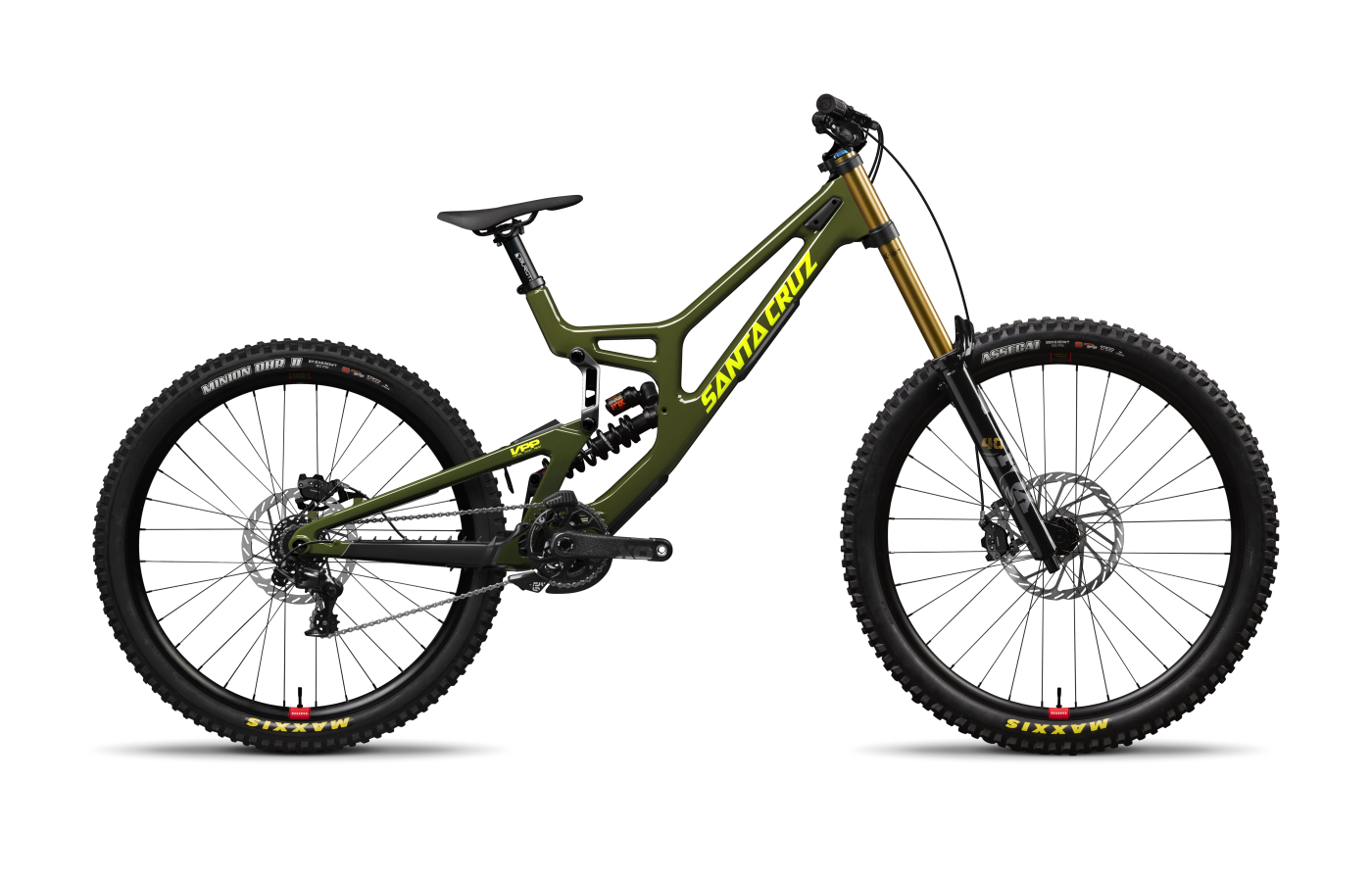
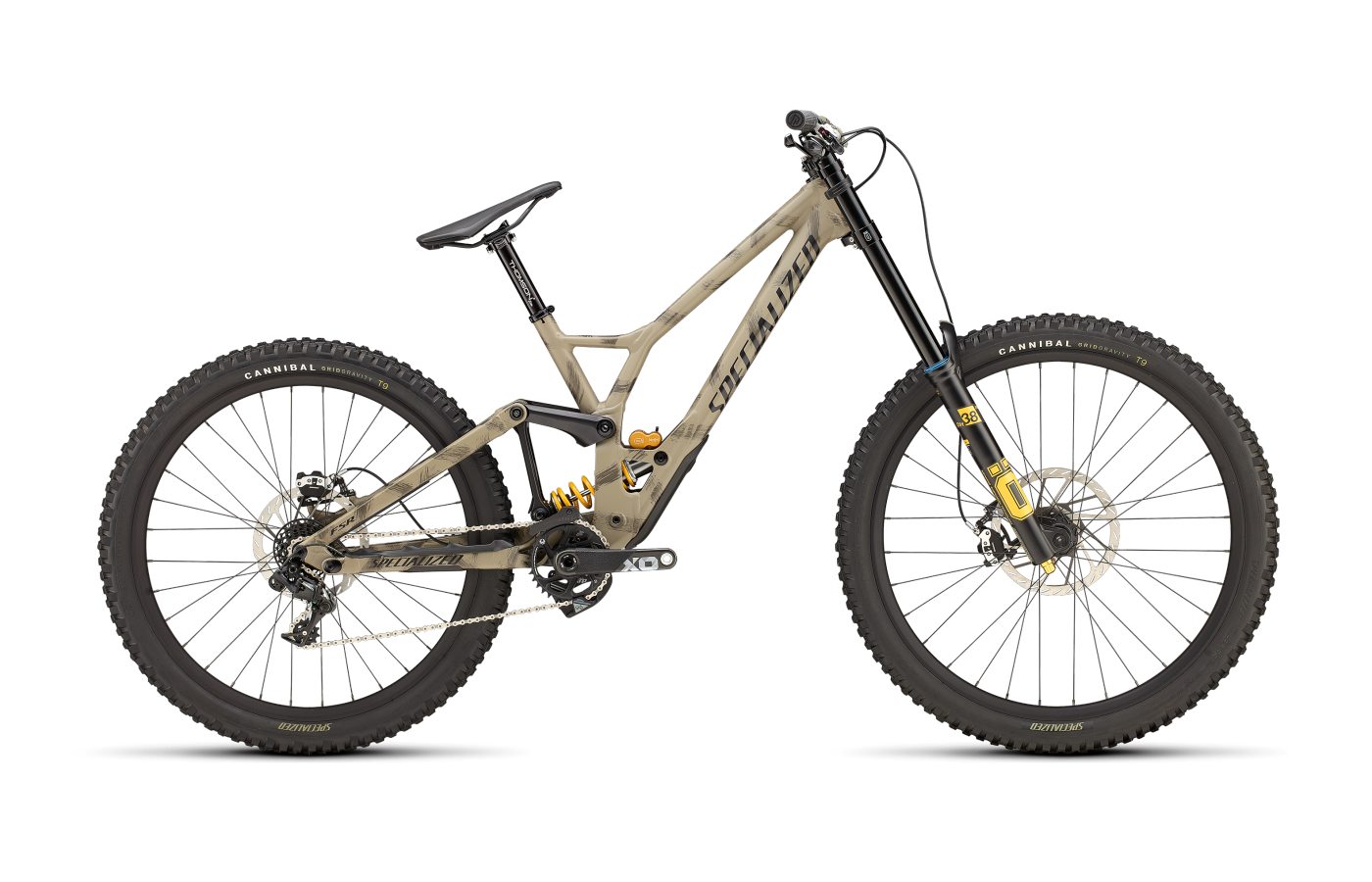
Two World Cup weapons, two material religions.
The V10 is a carbon-only luxury race tool with more adjustability than most riders will ever use. The Demo is an alloy plow built to survive a season on a privateer's budget.
V10
- Massive geometry adjustability — +/- 8 mm reach, +/- 5 mm chainstays, BB/HTA flip chip, all hardware in the box.
- Lighter chassis — 16.15 kg on the DH X01 build vs 17.62 kg on the Demo Race, a ~1.5 kg swing.
- 208 mm of refined VPP travel — supple small-bump sensitivity with firm mid-stroke, no VPP wallow.
- Price floor starts at $7,049 — no alloy or entry-level build exists.
- Headset cups can creak in dusty conditions without regular re-greasing.
Demo
- Alloy durability at a flagship price — $7,099 buys Öhlins DH38 and TTX22M.2 coil on a forge-heavy M5 chassis.
- Start-gate efficiency — 300 percent increase in anti-squat makes this the sprintiest 200 mm bike in the segment.
- Race-ready serviceability — lip-sealed pivots, dual-routed rear brake, threaded BB, simple S-sizing.
- Only one build in the lineup — no cheaper Expert-tier option currently offered.
- Reach tops out at 466 mm on the S4; riders over 6'2" may feel cramped.
Editor’s analysis
This isn't carbon-vs-alloy as an abstract debate. It's a question of how you want to win — with a surgical, tune-it-forever scalpel, or a momentum-hoarding sledgehammer you can crash and keep racing.
On paper, the Santa Cruz V10 and Specialized Demo sit in the same narrow bracket: 200 mm-class downhill bikes with World Cup pedigrees, SRAM X01 DH seven-speed drivetrains, and 63-degree-ish head angles. Both are mullet-capable, both run alloy Reserve/Roval rims, both are ridden to the top of the sport by pros. But the platforms diverge hard on everything else — material, suspension layout, adjustability, price floor.
The V10.8 is carbon-only — Santa Cruz's top-tier CC layup is the only way you buy this frame. It gets 208 mm of VPP rear travel, three-way reach adjustment via drop-in headset cups (+/- 8 mm), +/- 5 mm chainstay chips, and a flip-chip for BB height and head angle. Reviewers call it the Ferrari of mountain bikes and mean it both ways — sublime ride quality, eye-watering sticker. The DH X01 we've picked lands at $8,899, about $1,800 above the only Demo in the range.
The Specialized Demo stayed with M5 alloy, and Specialized owns it. The Demo Race is $7,099, one build, done. The revised Horst-link gets 200 mm of rear travel, a 300 percent bump in anti-squat for start-gate sprints, and a 70 percent bump in anti-rise to keep the rear end planted under heavy braking. The frame is heavily forged, lip-sealed at every pivot, dual-routed for the rear brake so a broken line swaps in minutes without re-bleeding. It's a race mechanic's dream, and about 1.5 kg heavier than the V10 build.
Put another way: the Santa Cruz V10 is what you buy when a DH bike is the nicest bike you own and you'll keep it for five years. The Specialized Demo is what you buy when you crash hard three times a season and need the frame to still be there in October.
Where the builds differ.
Comparing our editor's-pick builds side-by-side. Winners highlighted row-by-row — lower price and weight, and the better-spec component, each mark a point.
Build variants & pricing
The Demo comes in exactly one build. The V10 offers a $1,850 span between its two trims — both on the same CC carbon frame.
The editor's pick here pairs the V10 DH X01 ($8,899) with the Demo Race ($7,099) because both run SRAM X01 DH 7-speed — the only apples-to-apples drivetrain match. The ~$1,800 gap is a real platform difference: Santa Cruz builds only in CC carbon, Specialized only in M5 alloy. If frame material matters more than components, look at the V10 DH S at $7,049 — same carbon frame, SRAM GX DH instead.
How they fit, how they steer.
Size M V10 and S3 Demo land within a millimeter on reach (447 vs 446 mm) and stack (633 vs 632 mm). The V10 runs 11 mm of extra wheelbase (1275 vs 1264 mm) and a 0.2-degree steeper head angle (63 vs 62.8 deg). Chainstays are nearly identical at 445 vs 443 mm.
Which size should I buy?
V10 uses S/M/L/XL labels; Demo uses Specialized S-Sizing (S2/S3/S4). Reach ranges overlap tightly in the middle — 426–492 mm on V10, 426–466 mm on Demo — but the V10 extends further at both ends and offers +/- 8 mm of headset-cup reach tuning on top.
→These are starting points. Flexibility, riding style, and preferred position all shift the answer — if you’re between sizes, a professional fit beats a chart.
What the magazines said.
Published reviews from trusted cycling outlets. Click through for the full write-up.
Which one should you buy?
If you want the lightest, most adjustable carbon DH frame on the market and will pay for it, get the V10. If you want a battle-ready alloy race bike with a simpler parts bill, get the Demo.
V10
If you want to dial reach, chainstay length, BB height, and head angle to each track — and have the budget for a carbon-only frame that Syndicate rides in stock trim — the V10 is the benchmark. Lighter, quieter, endlessly adjustable.
Demo
If you race a full season on your own dime, crash hard, and need a frame that keeps taking it — the alloy Demo is purpose-built. Forge-heavy, lip-sealed, mechanic-friendly, and $1,800 under the V10 X01.
Questions buyers actually ask.
Short answers to the things we get emailed about most often.
01Carbon or aluminum — does it matter at this level?
For weight, yes. The Santa Cruz V10 DH X01 weighs 16.15 kg; the Specialized Demo Race weighs 17.62 kg. That's roughly 1.5 kg — about 3.3 lb — of extra frame and suspension mass on the Demo, most of it from the M5 alloy chassis.
For durability, the alloy chassis is more tolerant of rock strikes and casing impacts that would crack carbon. For a privateer racing a full season, that matters more than three pounds. For a rider buying once and keeping the bike years, Santa Cruz's lifetime carbon warranty and free lifetime pivot bearings close the gap.
02Which is faster in a World Cup race?
Both have won at the top level — Santa Cruz Syndicate on V10s, and Loic Bruni and Finn Iles on the Demo platform. The answer is rider-dependent.
The V10 rewards a tuned, detail-oriented rider who uses the adjustable reach and chainstay length to match each track. The Demo rewards a rider who wants to jump on and go — reviewers consistently highlight how intuitive it feels from the first lap, with a 300% anti-squat increase that makes the start gate sprint feel like a hardtail.
03How do the suspension platforms compare?
Santa Cruz V10.8: VPP (Virtual Pivot Point), 208 mm rear travel, paired with 200–203 mm forks. Reviewers describe the revised kinematics as more mid-stroke supportive than prior VPP generations — supple off the top, firm through the middle, resistant to wallow.
Specialized Demo Race: Horst-link, 200 mm rear travel, paired with a 200 mm Öhlins DH38. Specialized rebuilt the kinematics for this generation: 300% more anti-squat for pedaling, 70% more anti-rise for braking stability, and a more rearward axle path so the rear wheel doesn't hang up on square-edge hits.
04How adjustable are these bikes out of the box?
The V10 is in a different league here. Three-way reach adjustment via drop-in (not press-fit) headset cups gives +/- 8 mm. Swap-in chainstay inserts give +/- 5 mm of CS length. A lower shock flip-chip adjusts BB height and head angle. All the required hardware ships with the bike — nothing extra to buy.
The Demo has a Horst-pivot flip chip that lets you run full 29-inch or mixed-wheel (29/27.5) setups and adjusts BB height. Reach is fixed at each S-size. It's a much simpler system — intentional, given the target rider.
05What wheel sizes do they run?
Both ship mullet on the sizes most riders buy. The V10 runs 29-inch front and 27.5-inch rear on sizes S, M, and L; the XL is the only full 29er. The Demo Race uses a Horst-pivot flip chip to swap between full 29er and mixed-wheel setups on any S-size — rider's choice.
There's no mullet-vs-29er right answer. 29/27.5 corners sharper; full 29 holds speed better in straight-line chatter.
06Which holds up better to a season of hard riding?
Santa Cruz backs the V10 frame with a lifetime warranty and free replacement pivot bearings for life. That's one of the strongest support packages in the industry — a meaningful part of the price premium.
Specialized's M5 alloy frame is simply more crash-tolerant for the average rider. Reviewers consistently praised the lip-sealed pivots, the sealed bolt-head hardware, and the dual-routed rear brake (internal or external — racers can swap a damaged line in minutes without re-bleeding). Both bikes have known quirks: the V10's drop-in headset cups can creak in dry dust, and the Demo has a documented internal cable rattle that most owners damp with foam or tape.
07What about build options and price ceilings?
V10: two builds. DH S at $7,049 (SRAM GX DH, RockShox BoXXer Base, Vivid Select+). DH X01 at $8,899 (SRAM X01 DH, Fox 40 Factory, Fox DHX2 Factory). Both on the same CC carbon frame.
Demo: one build currently — the Race at $7,099 (SRAM X01 DH, Öhlins DH38 M.1, Öhlins TTX22M.2 coil). Specialized has historically offered an Expert trim at a lower price on prior model years, but the current lineup is Race-only.
Practically: if you want alloy-frame durability at $7k, the Demo is the only option. If you want carbon at $7k, the V10 DH S is the only option. Tier-for-tier on components, the Demo Race and V10 DH X01 is the apples-to-apples match, and the $1,800 gap is what carbon costs on this platform.
08Is either of these usable at lift-served bike parks, not just races?
Both. The V10 is explicitly praised as versatile — reviewers describe it as shifting between "thoroughbred race bike" and "bike park shredder" via the geometry adjustments. Set the chainstays short, the BB low, and the reach neutral, and it's a playful park bike that you can still pin on a race track.
The Demo is less of a chameleon — geometry is fixed at each size — but the 200 mm travel, the mullet-ready rear end, and the highly damped Öhlins suspension make it right at home on park laps. The durability angle is bigger here: alloy takes chairlift scuffs and tailgate dings better than carbon.
Similar bikes
If your priorities don’t map cleanly onto either of these, one of these adjacent bikes probably fits better.
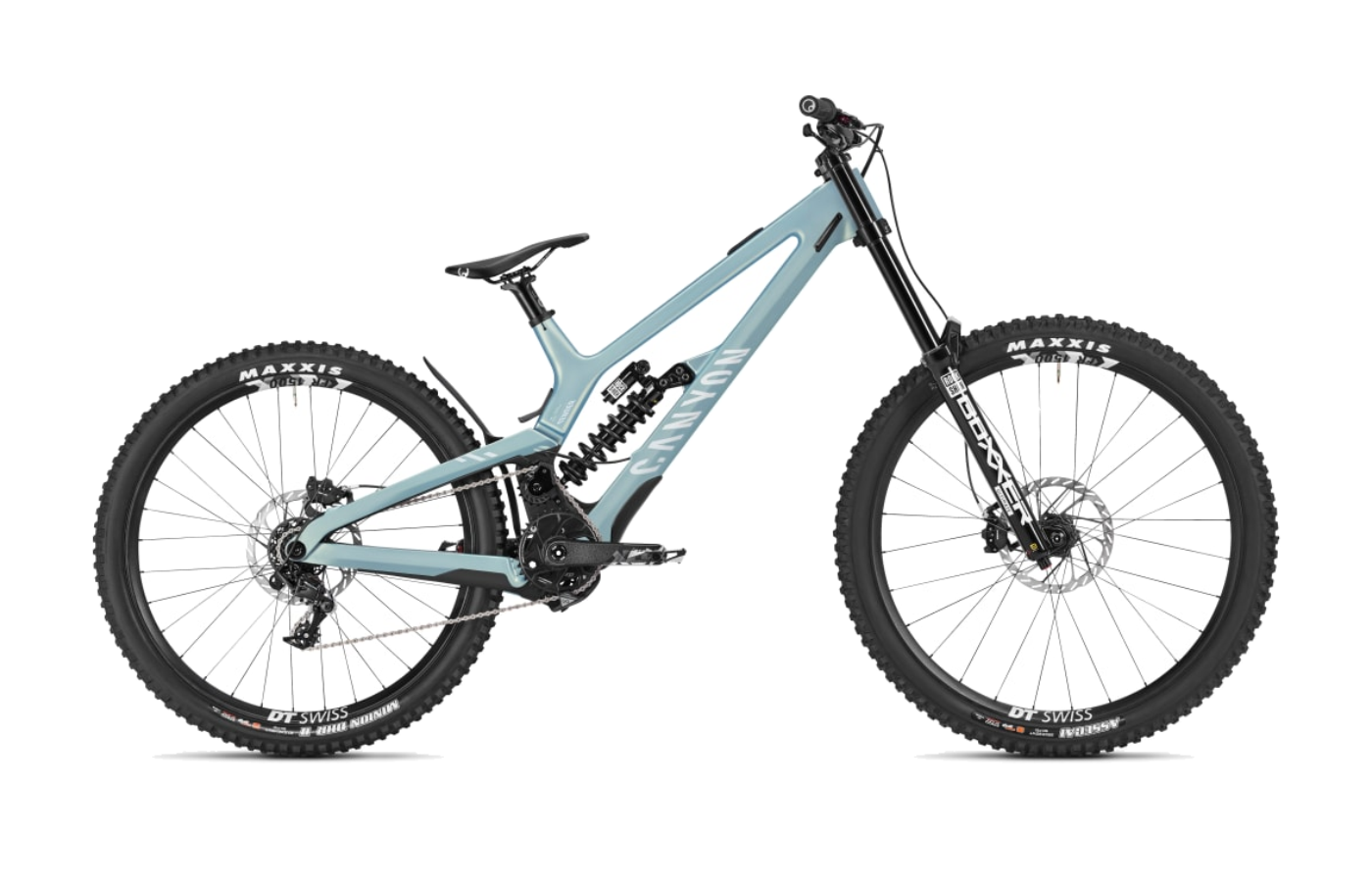
Sender
Canyon's World Cup race weapon on a carbon four-bar layout closer in philosophy to the Demo than the V10. Direct-to-consumer pricing and a dialed build spec — the value play if you want a carbon DH frame without Santa Cruz money.
Compare →Session
Trek's answer for riders who want the rearward-axle-path advantage taken further — a true high-pivot with an idler, which swallows square edges in a way neither of these bikes tries to. Chain drag is the price.
Compare →Tues
The consumer-direct value king in DH. You give up dealer support and demo rides, but the Tues gets you a highly progressive race frame and a full race-spec build well under either of these bikes. Best if you know your fit.
Compare →