Enduro
vsStatus 170
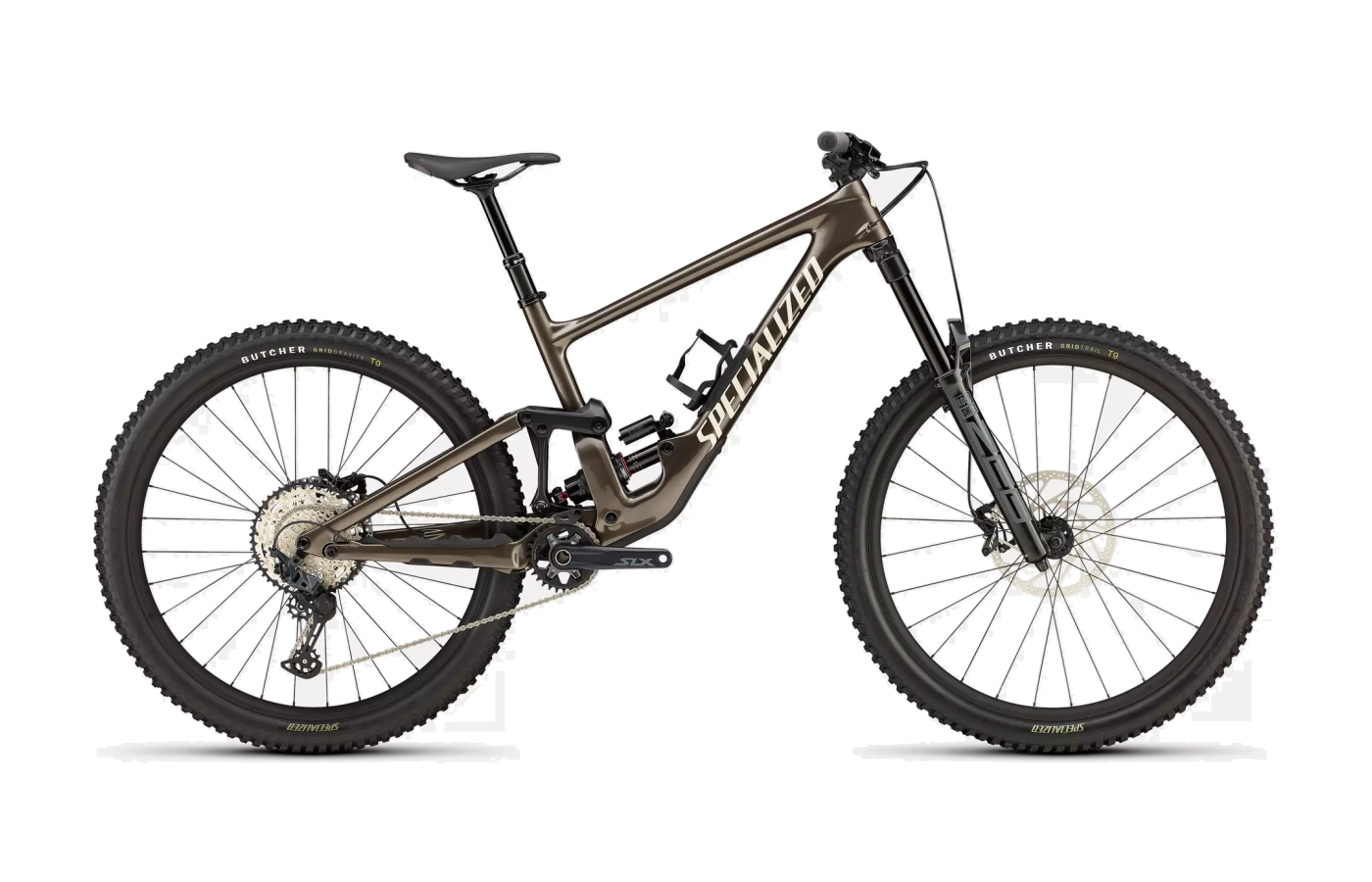
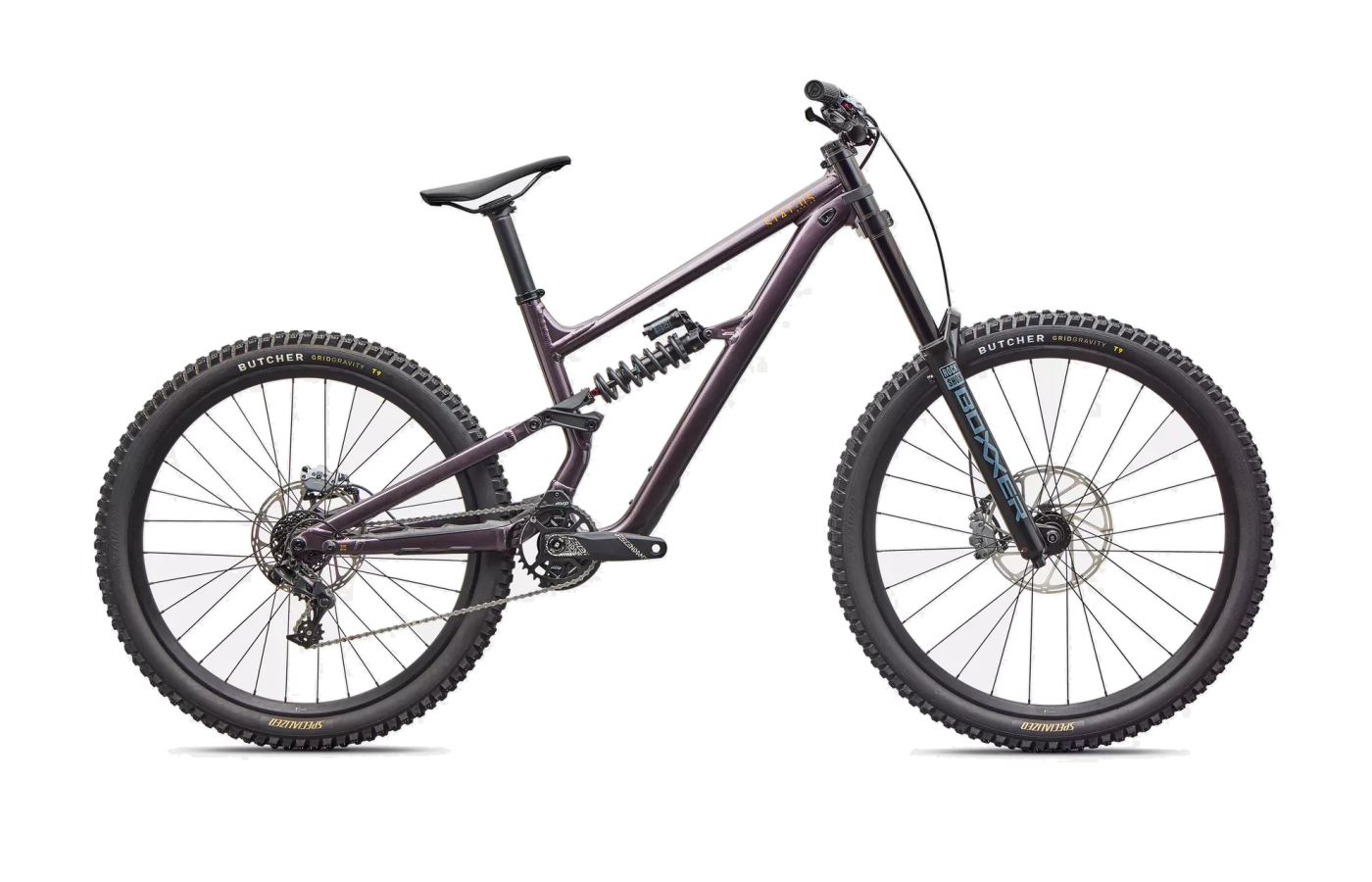
Two takes on 170 mm — race tool vs. park hammer.
Same travel number, opposite missions. The Enduro is a carbon race weapon for backcountry descents. The Status is an alloy freeride bike built to live on a chairlift.
Enduro
- Pedals up real climbs — 40% more anti-squat than the prior gen, and reviewers were repeatedly "blown away" by how well a 170 mm bike ascends.
- Carbon frame, SWAT storage — FACT 11m chassis across the lineup, plus Specialized's downtube tool/snack box.
- High-speed magic-carpet feel — Demo-derived rear linkage with rearward axle path, repeatedly described as "it was like cheating."
- Premium Specialized pricing — $4,999 just to get in the door, no alloy option.
- Wants steep, fast trails to come alive; can feel "boring" or "sluggish" on mellow flow.
Status 170
- Half the price of entry — $2,499 for the standard 170, $4,499 for the DH build, with a 25-year frame warranty.
- Bombproof alloy chassis — M5 frame, oversized pivot bearings, threaded BB, UDH, and the option for fully external rear-brake routing.
- Mullet-wheel agility — 27.5" rear and short 432 mm chainstays make direction changes effortless on jump lines.
- Heavy (17+ kg) and "sluggish" on flat ground — not built for pedaling traverses.
- Entry-level BoXXer and Super Deluxe damping is the consensus weak link on rough, fast tracks.
Editor’s analysis
Both bikes claim 170 mm of travel and the Specialized badge — but the moment you look past the spec sheet, the agreement ends.
The Specialized Enduro is a carbon-framed enduro race bike with a Demo-derived rear linkage, a 64.3-degree head angle, and a stated mission of carrying "ridiculous speed" through square-edge hits. Reviewers consistently call it a "mini downhill bike" — Bike Magazine flat-out said it felt "like cheating" on familiar trails. It will pedal back up a 3,000-foot climb, and Specialized increased anti-squat 40% over the prior generation specifically so it could.
The Specialized Status 170 starts from a different premise. It's an M5 alloy chassis, mullet-wheeled, with the priciest builds shipping a dual-crown RockShox BoXXer and a 7-speed SRAM GX DH drivetrain. MBR called it "the perfect holiday bike for Alpine tourists or bike park weekends" — fast and composed, but with a 63.5-degree head angle and a 17 kg+ build weight that makes it sluggish on flat ground. It is not designed to climb. The DH variant is functionally not designed to pedal at all.
On geometry, the Status is actually slacker at the front (63.5 vs. 64.3 degrees) and steeper at the seat tube (77 vs. 76 degrees), with shorter chainstays (432 vs. 442 mm) — a more compact, gravity-biased posture. The Enduro is the longer, more stretched-out shape. Specialized's S-Sizing means both come in S2-S5 with reach-driven sizing rather than seat-tube-driven, but the underlying intent diverges sharply: the Enduro wants a long wheelbase for high-speed composure, the Status wants a tucked-in rear end for direction changes in a bike park berm.
The price gap reflects what's inside. The Enduro starts at $4,999 (Comp) and tops out at $8,499 (Pro) for a carbon FACT 11m frame, X0 Eagle Transmission, and Roval Traverse HD carbon wheels. The Status spans $2,499 to $4,499, all alloy, with the priciest builds running a dual-crown fork and DH-only drivetrain. Reviewers across the board called the Status's value "huge" — Enduro MTB noted it was "by far the most affordable" bike in its bike-park group test while still holding its own.
Where the builds differ.
Comparing our editor's-pick builds side-by-side. Winners highlighted row-by-row — lower price and weight, and the better-spec component, each mark a point.
Build variants & pricing
The Enduro lineup is just two carbon builds ($4,999 Comp and $8,499 Pro). The Status has four alloy builds spanning $2,499 to $4,499 — including two DH variants with dual-crown forks.
Editor's picks compare the Enduro Comp ($4,999) against the Status 2 170 DH ($4,499) — the closest price match between the two platforms. Note the platforms diverge at the frame: the Enduro is carbon-only, the Status is alloy-only. Prices are current US MSRP.
How they fit, how they steer.
Both at size S2. The Status sits 9 mm taller in stack with 8 mm more reach, runs a slacker 63.5-degree head angle (vs. 64.3), and has shorter 432 mm chainstays — a more compact, gravity-biased posture than the Enduro's longer race shape.
Which size should I buy?
Both bikes use Specialized's S-Sizing (S2-S5), which decouples reach from seat-tube length so you can choose by ride feel rather than inseam.
→These are starting points. Flexibility, riding style, and preferred position all shift the answer — if you’re between sizes, a professional fit beats a chart.
What the magazines said.
Published reviews from trusted cycling outlets. Click through for the full write-up.
Which one should you buy?
If you ride backcountry enduro stages and need to pedal back up, get the Enduro. If most of your saddle time is on a chairlift, get the Status.
Enduro
If you race the local enduro series, link 3,000-foot backcountry descents, and need a bike that can actually pedal home — this is the carbon race tool. The Demo-derived linkage swallows square-edge hits, and the 40% anti-squat bump means it climbs better than any 170 mm bike has a right to.
Status 170
If your weekends are uplift days and your priorities are durability, jib-friendly handling, and not crying when you scrape a downtube on a rock, this is the better tool. Mullet wheels and a dual-crown fork on the DH build give you DH composure for $4,499 — and a 25-year warranty on the frame.
Questions buyers actually ask.
Short answers to the things we get emailed about most often.
01Which one can actually pedal uphill?
The Enduro, comfortably. Specialized increased anti-squat by 40% on this generation, and reviewers from Bike Magazine to Enduro MTB were repeatedly "blown away" by how well it climbs for a 170 mm bike. The 76-degree seat tube angle puts the rider over the pedals, and you can ride uphill with the shock open without the suspension wallowing.
The Status 170 in its standard 12-speed form will pedal — it has a Shimano Deore 12-speed and a 32T ring — but the 17 kg+ weight and aggressive Butcher Grid Gravity tires mean it feels "sluggish" on flat ground and "slow" on mellow trails. The Status DH build uses a 7-speed SRAM GX DH drivetrain that is explicitly not designed for pedaling uphill — MBR was blunt that riders who plan to climb should stick to the standard 12-speed Status.
02Why is the Status so much cheaper?
Three reasons. Frame: the Enduro is FACT 11m carbon across every build; the Status is M5 alloy across every build. Components: the Status uses entry-level RockShox BoXXer Base/Select damping and budget brake rotors where the Enduro runs Zeb Select or Zeb Ultimate. Wheels: Roval alloy DH on the Status vs. Roval Traverse HD carbon on the Enduro Pro.
What the Status doesn't compromise on is the chassis itself. Reviewers called the M5 alloy frame "bombproof," with oversized pivot bearings, a threaded BB, UDH compatibility, and a 25-year warranty — exceptionally long for a bike at this price.
03What does the dual-crown fork on the Status DH actually change?
Stiffness and steering precision. The RockShox BoXXer is a downhill fork with two crowns clamping the steerer above and below the head tube. MBR specifically credited it for the "solidity and precision of the steering response" — beyond what even the beefiest single-crown forks (Zeb, Fox 38) can match.
The trade-offs: it's heavier, you can't ride seated for very long because of the high front end, and the entry-level Charger 3 RC damper on the Base version is the consensus "weak link" — reviewers noted it can blow through travel or stiffen up under repeated high-speed hits. The standard Status 170 (non-DH) ships a single-crown Fox 38 Rhythm instead, which makes a lot more sense if you ever pedal.
04How serious is the Enduro headset cracking issue?
Real, but specific to early frames. Reviewers and PinkBike commenters confirmed an "infamous headset cracking issue" on 2020-2021 Enduros. Specialized claims to have fixed it on 2022 and later frames, and warranty support was reportedly fast — one reviewer who experienced a crack got a frame replacement in under a week.
If you're shopping a current new build, you're getting the revised frame. If you're shopping used, ask the seller for the frame's production date and confirm a healthy headset before buying.
05What about wheel size?
Enduro: full 29" front and rear across every build.
Status 170: mullet — 29" front, 27.5" rear — on every build except the small-rider ZERO build, which runs 27.5"/26". The mullet setup is part of why reviewers described the Status as a "nimble hare" on jump lines: the smaller rear wheel allows for "effortless direction changes," while the 29" front loads early for cornering traction. The Enduro's matched 29ers prioritize high-speed composure over toss-ability.
06Is the Status's stock parts kit good enough out of the box?
Mostly yes, with two known weak points. The brakes (SRAM Maven Bronze on the DH builds) drew universal praise — Enduro MTB said they "stop like a dog outside a butcher's store." The frame and chassis are bombproof.
The fork damping (BoXXer Base / Charger 3 RC on the DH, Fox 38 Rhythm on the standard) is the consensus weak link on chunky terrain. And the stock Centerline rotors are thinner than ideal for sustained downhill use — multiple reviewers recommended an upgrade to SRAM HS2 rotors. Tires (Butcher Grid Gravity) are durable but the side knobs can fold under hard cornering on hard-pack.
07Can either bike take a coil shock?
Both can. The Enduro frame's leverage curve is progressive enough that reviewers — including PinkBike and Singletracks — repeatedly noted it was a great coil candidate, even though the stock builds ship with air shocks (Vivid Ultimate on the Pro, Vivid Select Plus on the Comp).
The Status 170 DH builds already ship with coil (RockShox Vivid Coil or Super Deluxe Select Coil) as standard. Reviewers praised the coil-sprung Horst Link feel — "much deeper than 170 mm suggests" — though noted the suspension is on the firmer/progressive side, so it rewards active pumping rather than a passive plush ride.
08Which holds up better long-term?
Different failure modes. The Enduro's carbon frame is tough but not crash-proof, and the linkage runs 14 bearings — long-term replacement bills won't be small. The early headset crack issue is fixed on current frames. SWAT storage and the threaded BB are home-mechanic friendly.
The Status's M5 alloy frame is built to be thrashed and put away dirty — Specialized backs it with a 25-year warranty, which is exceptional for the category. Reviewers explicitly framed it as "the second bike to thrash" so your high-end rig doesn't take the bike-park beating. Stock rotors and tires are likely the first things to need attention.
Similar bikes
If your priorities don’t map cleanly onto either of these, one of these adjacent bikes probably fits better.
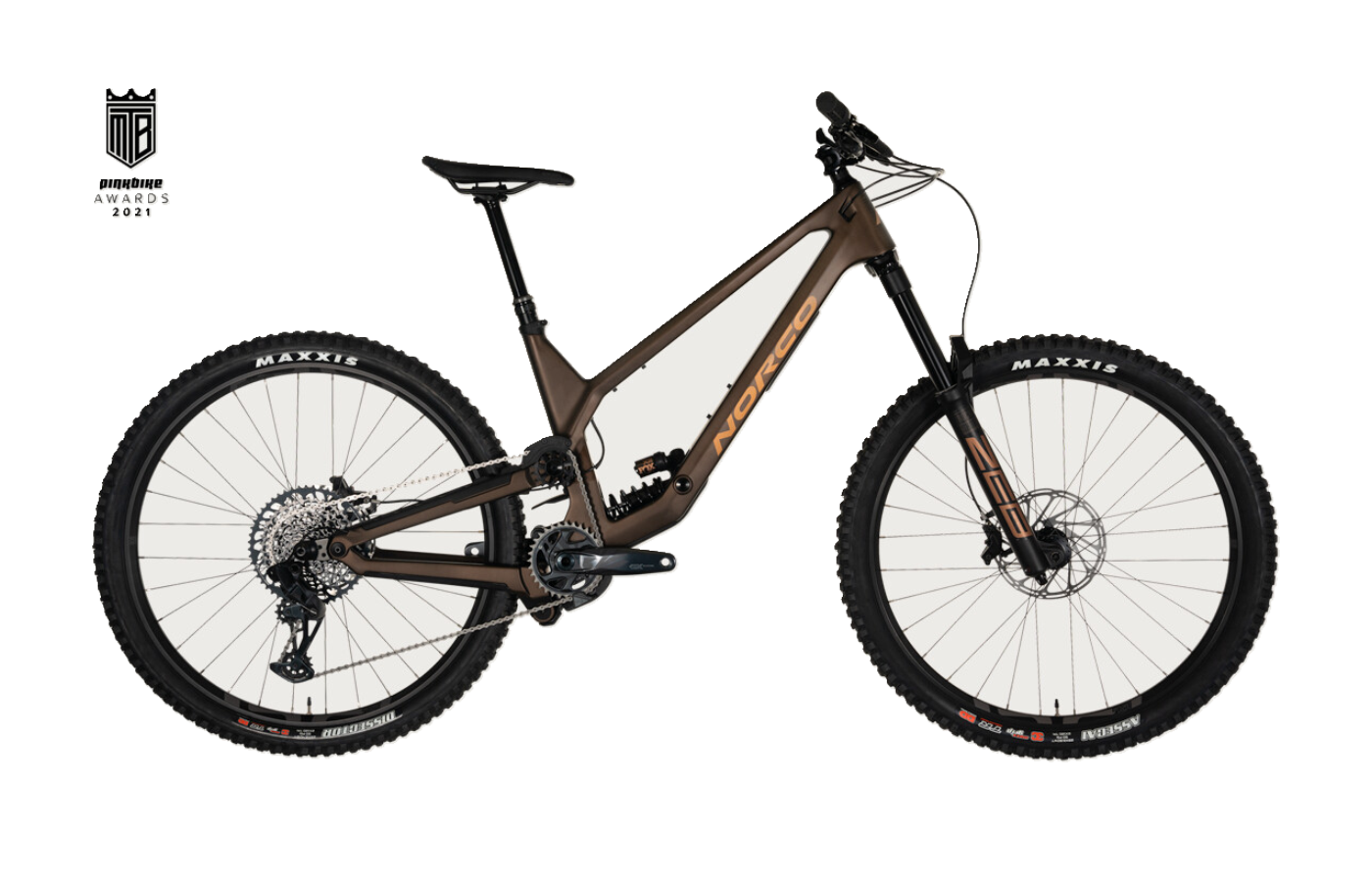
Range
The high-pivot answer to the Enduro — even more glued to the ground in steep, technical chunder, but a noticeably harder pedal back up to the trailhead.
Compare →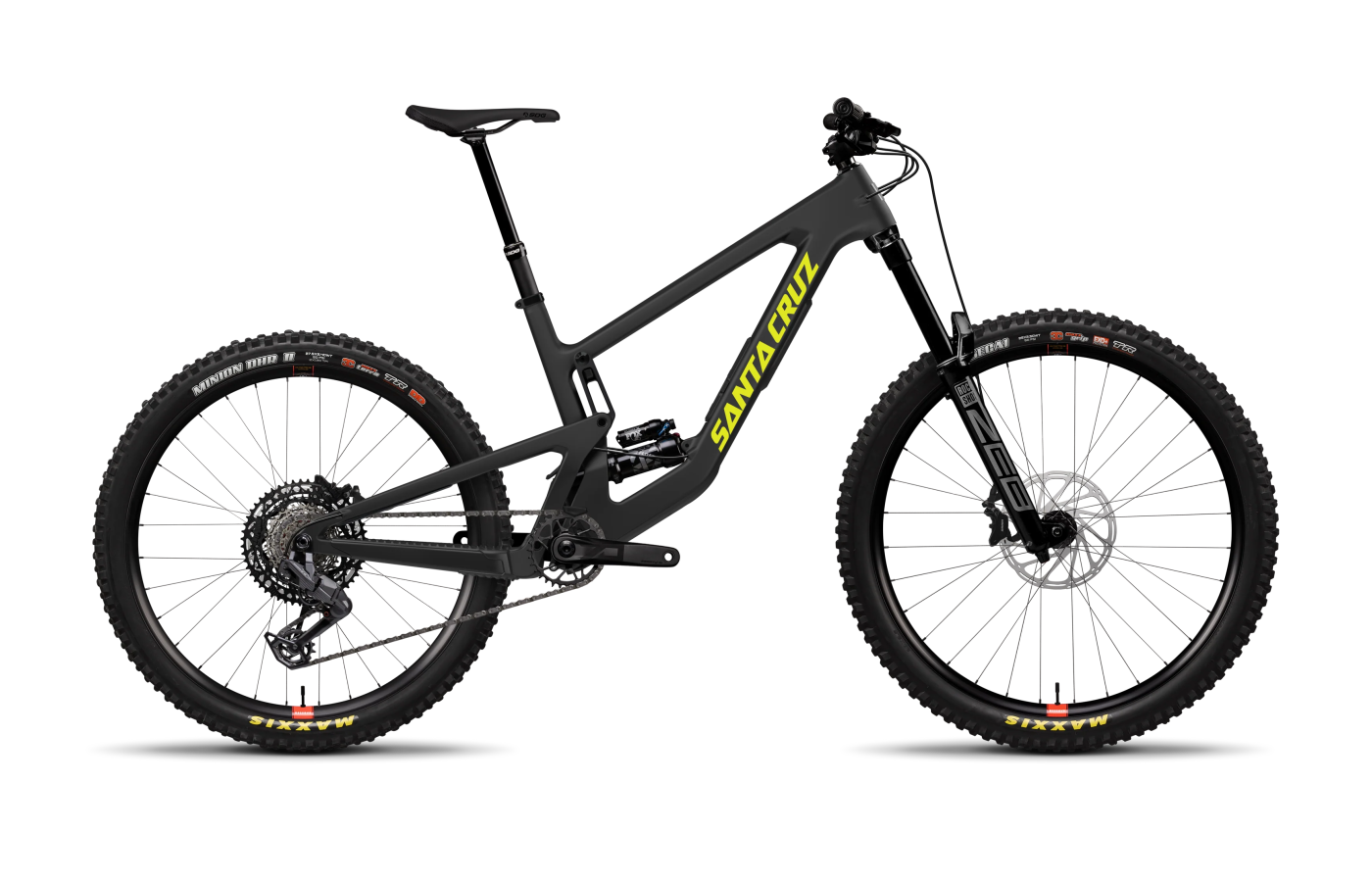
Nomad
If the Status's mullet-wheel, 170 mm-travel formula appeals but you want a premium carbon frame and higher-end suspension out of the box, the Nomad is the upmarket answer.
Compare →Spire
An alloy 170 mm 29er that splits the difference between the two — more capable on a real climb than the Status, more affordable than the Enduro carbon.
Compare →