Trek FarleyvsRoscoe

Is it better to have a bike that floats over everything or one that carves through it? These two Trek hardtails force a choice between the all-season float of 4.5-inch tires and the precision of a modern 29er trail machine.

Trek Farley
Image pending

Overview

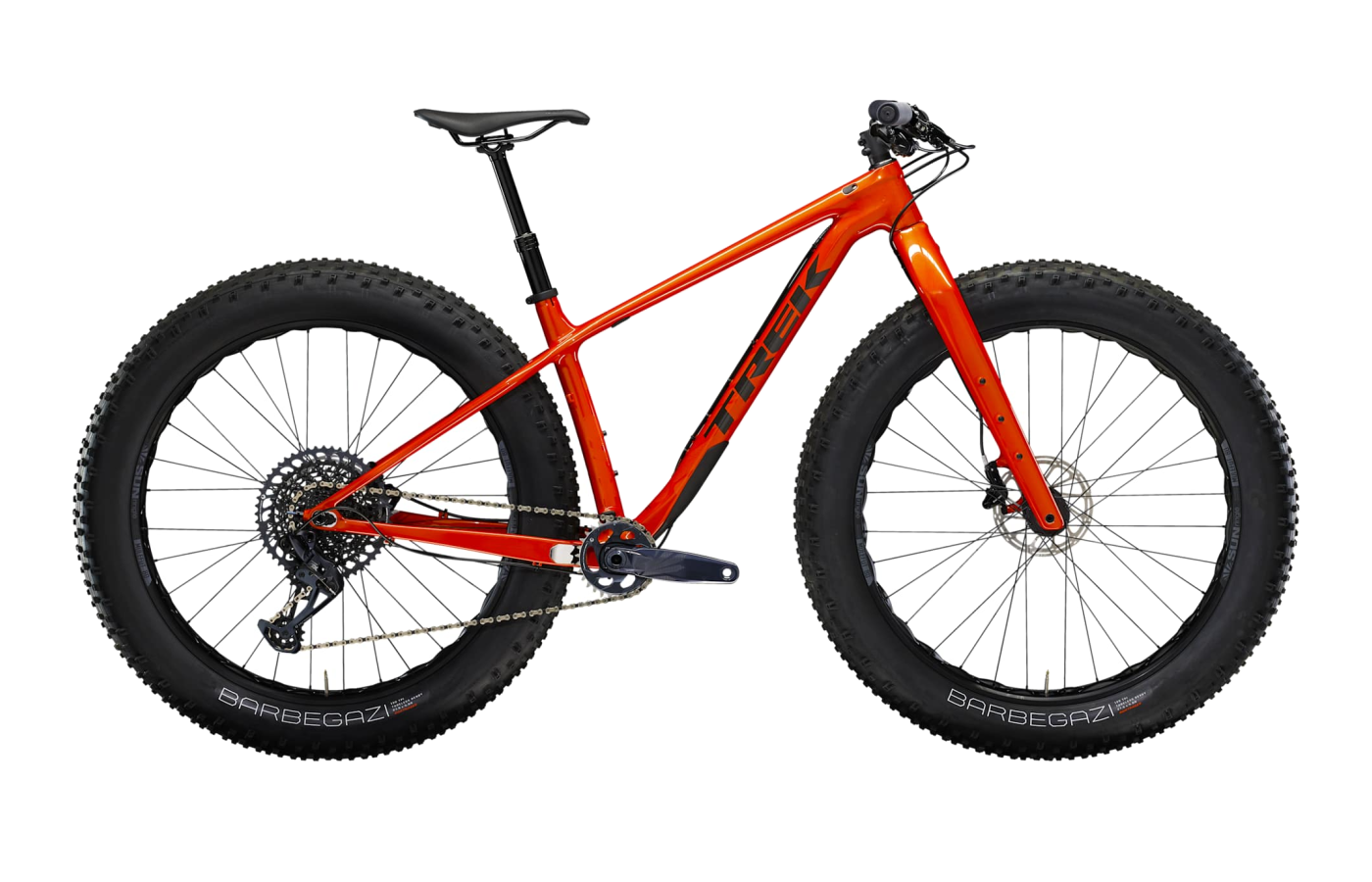
Trek frames the Farley as a trail bike first and a fat bike second, trying to escape the lumbering, tank-like reputation typical of the category. It targets the person who sees a frozen singletrack or a sandy wash and wants to keep the heart rate up without the bike feeling like a boat. In contrast, the Gen 4 Roscoe has shed its plus-bike roots to become a genuine hardcore hardtail. It uses the same Alpha Platinum Aluminum as Trek’s enduro-focused Slash, signifying it is ready for significantly higher stresses than previous iterations. The Farley 9.6 build brings OCLV Mountain Carbon into the mix, which helps the bike climb with a pep that the 40-pound alloy builds simply cannot match. Meanwhile, the Roscoe leans into the value of aluminum while packing in heavy-hitting components like 4-piston brakes and a 150mm Fox 36 fork. One bike is about floatation and all-season grip, while the other aims for raw descending speed and maximizing vertical drop on dirt.

Ride and handling

Riding the Farley is a lesson in momentum. Those massive 27.5 x 4.5-inch Gnarwhal tires allow for pressures as low as 7 PSI, turning frozen ruts into a muted hum. The cornering is described as heroic; the bike reacts well to a dip of the shoulder and dives into turns with surprising ease. It does not feel like a sluggish boat—it feels like an athletic trail bike that just happens to have huge shoes. While the Farley 7 uses a Manitou Mastodon to take the edge off rough sections, the rigid carbon fork on the 9.6 keeps the front end light and precise for technical snow maneuvers. The Roscoe is a different animal. With its 65-degree head tube angle and 150mm fork, it is designed to be hammered into rock gardens. It stops on a dime thanks to a massive 203mm front rotor and Shimano Deore 4-piston calipers, giving you the confidence to carry speed that would make the Farley feel skittish. While the Farley uses tire volume for vibration damping, the Roscoe relies on raw fork travel and a 200mm dropper post to let you move the bike freely. One reviewer noted they were barely having to pedal on the Roscoe to keep it zooming, whereas the Farley can feel lethargic and loud on hardpacked dirt due to the massive tread blocks.

Specifications

Both bikes share Trek's Rapid Drive 108 rear hub, providing nearly instant power transfer which is critical when navigating technical snow or ratcheting through rock gardens. The Farley 9.6 uses a SRAM GX Eagle 12-speed drivetrain that remains crisp and reliable even in sub-zero conditions. It is a purposeful build that prioritizes function, though the PressFit 121mm bottom bracket on the carbon frame might annoy those who prefer the threaded 100mm BB found on the alloy Farley and Roscoe models. The Roscoe 8 counters with a Shimano Deore M6100 1x12 groupset—a workhorse that might lack the cachet of GX but offers an identical range. Where the Roscoe really pulls ahead in spec is the dropper post. While the Farley caps out at 150mm on the XL, the Roscoe Gen 4 frame is designed without water bottle bolts on the seat tube to allow for massive insertion depths. This lets the Roscoe ship with a 200mm dropper, letting the saddle disappear when things get steep. The Farley 9.6 uses a rigid carbon fork to save weight, while the Roscoe's Fox 36 provides the stiffness needed to hold a line through chunky terrain.

FarleyRoscoe
FRAMESET
FrameAlpha Platinum Aluminum, tapered head tube, top tube bag mounts, strapless full frame bag mounts, downtube fender mount, lower downtube accessory mount, seat stay rear rack mounts, internal rear derailleur & dropper post routing, 100mm threaded BB, UDH, 197x12mm
ForkManitou Mastodon 34 Comp, air spring, ABS damper, lockout, tapered steerer, 41mm offset, 150x15mm thru axle, 80mm travel
Rear shock
GROUPSET
Shift leversSRAM NX Eagle, 12-speed
Front derailleur
Rear derailleurSRAM GX Eagle
CassetteSRAM PG-1230 Eagle, 12-speed, 11-50T
ChainSRAM NX Eagle, 12-speed
CranksetSRAM X1 1000 Eagle, DUB, 30T alloy FAT 5 ring (170mm length S/M/L; 175mm length XL)
Bottom bracketSRAM DUB, 100mm, BSA threaded
Front brakeSRAM Level T hydraulic disc
Rear brakeSRAM Level T hydraulic disc
WHEELSET
Front wheelSUNRingle Mulefut 80 SL, 32-hole cutout; Bontrager alloy, sealed bearing, 6-bolt, 15x150mm thru axle
Rear wheelSUNRingle Mulefut 80 SL, 32-hole cutout; Bontrager alloy, sealed bearing, 6-bolt, Rapid Drive 108, Shimano 10 freehub, 197x12mm thru axle
Front tireBontrager Gnarwhal Team Issue, Tubeless Ready, Inner Strength sidewalls, studdable, aramid bead, 120 tpi, 27.5x4.50
Rear tireBontrager Gnarwhal Team Issue, Tubeless Ready, Inner Strength sidewalls, studdable, aramid bead, 120 tpi, 27.5x4.50
COCKPIT
StemBontrager Comp, 31.8mm, Blendr compatible, 7 degree (50mm S; 60mm M; 70mm L/XL)
HandlebarsBontrager alloy, 31.8mm, 15mm rise, 750mm width
SaddleBontrager Verse P3, chromoly rails
SeatpostTranzX JD-YSP18 dropper, internal routing, 31.6mm (100mm travel S; 130mm travel M; 150mm travel L/XL)
Grips/TapeBontrager XR Trail Comp, nylon lock-on

Geometry and fit comparison

The Farley XL offers a generous 487mm reach and a 1223mm wheelbase, providing a stable feel at speed. The 67.7-degree head tube angle is a modern touch for a fat bike, but it is still quite steep compared to the Roscoe’s slack 65-degree front end. This makes the Farley feel more manageable in tight, low-speed snow technicals where the Roscoe might feel like it is tripping over its own length. Seat tube angles reveal a significant difference in climbing stance. The Farley XL sits at a 71.7-degree actual seat tube angle, which can feel a bit rearward. On very steep climbs, testers noted the front end is prone to wandering, requiring you to actively weight the bars to maintain steering. The Roscoe's 76-degree seat tube angle keeps the rider more centered over the cranks, which is a much more efficient place to be for technical climbing. Standover on the Farley XL is 787mm, which is relatively high. If you are a rider who needs to dab in deep snow, that height can be a struggle. The Roscoe’s design focus is on a lower-slung feel, making it the better choice for riders who want a big-reach bike without feeling like they are straddling a fence.

vs
FIT GEOFarleyRoscoe
Stack619
Reach452
Top tube635
Headtube length115
Standover height768
Seat tube length450
HANDLINGFarleyRoscoe
Headtube angle67.7
Seat tube angle71.7
BB height326
BB drop59
Trail103
Offset51
Front center
Wheelbase1182
Chainstay length450

Who each one is for

Trek Farley

The Farley is for the rider who lives in a climate where the local singletrack is buried in white for four months of the year. If you find yourself staring longingly at the trails in January, this bike turns that frustration into a grin machine experience. It is also for the desert explorer who needs to traverse sandy arroyos or the bike-packer who needs to carry heavy loads across soft terrain using the integrated frame bag mounts.

Trek Roscoe

The Roscoe is for the hardtail purist who wants to ride the same trails as their full-suspension friends without the mechanical complexity. It is for the rider who values a 200mm dropper and a stiff 150mm fork more than all-season floatation. If your idea of a good Sunday is sessioning a jump line or hunting for steep, technical descents in the dirt, the Roscoe is the tool for the job.

Other bikes to consider

Salsa Timberjack
Salsa Timberjack
Rocky Mountain Growler
Santa Cruz Chameleon