Rangefinder
vsMarlin
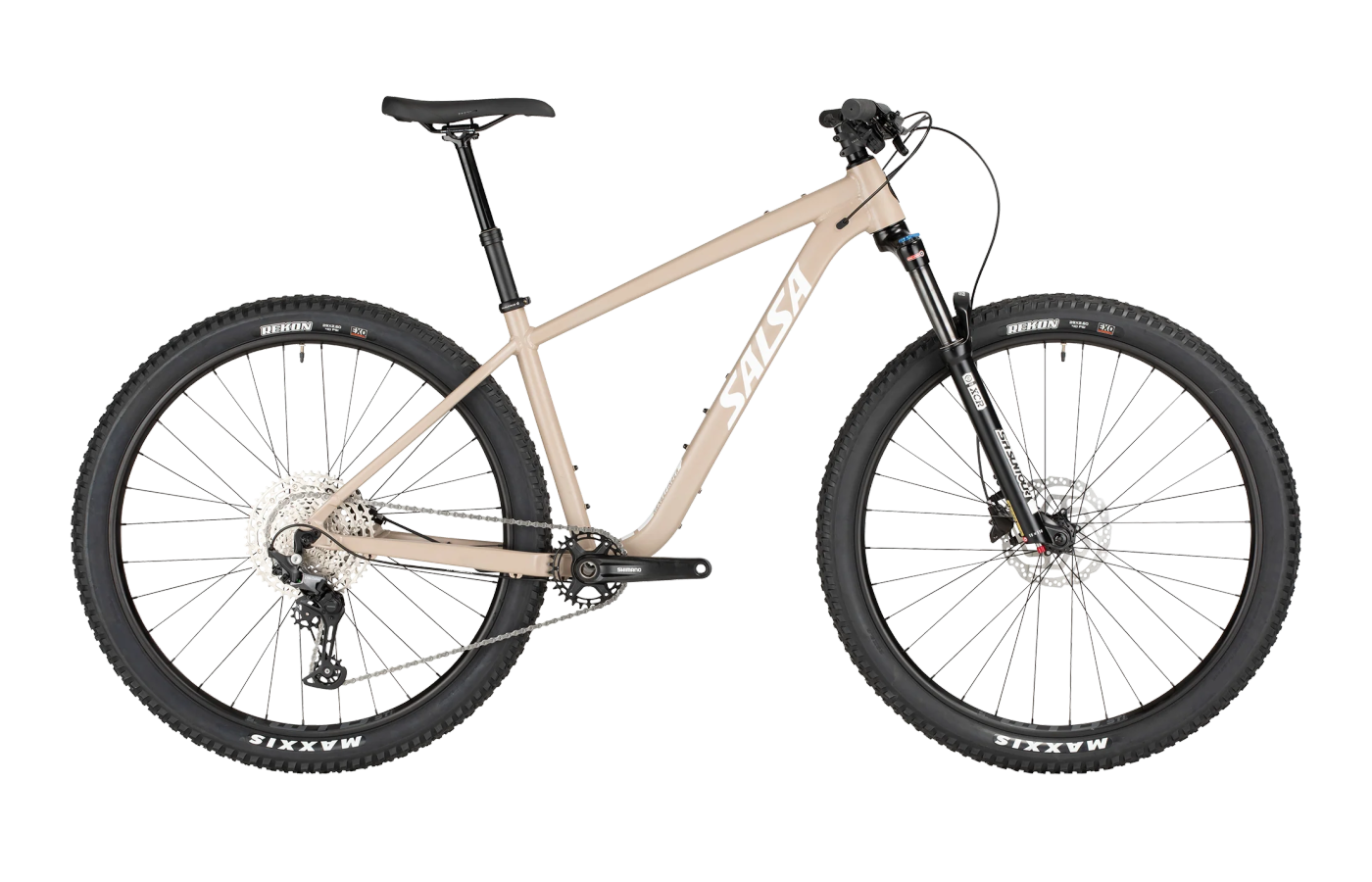
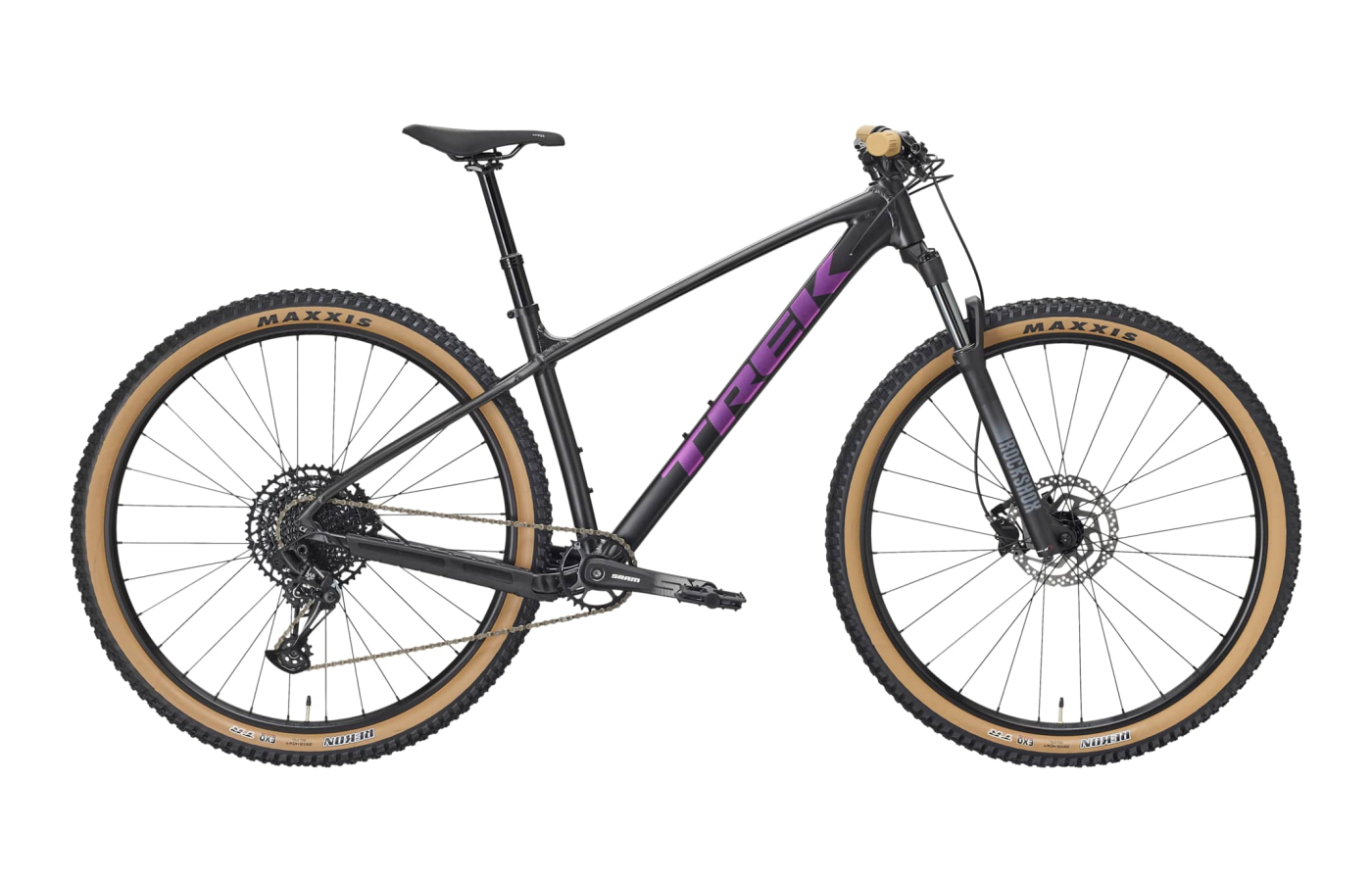
Two budget hardtails, two different jobs.
The Salsa Rangefinder is a bikepacking-friendly XC frame with extra travel. The Trek Marlin Gen 3 is a modern trail-geometry beginner bike for under $1,500.
Rangefinder
- Adventure-ready frame — two bottle mounts, top-tube bag mount, utility mount, rear rack mount. Built for bikepacking out of the box.
- More fork travel at 120 mm front, with an air-spring SR Suntour XCR34 on the top build that takes a 15 mm thru-axle.
- Wider tire clearance (officially 71 mm — fits a true 2.6-inch Maxxis Rekon stock; 2.8-inch on the 27.5+ builds).
- Conservative 68.6 degree head angle limits descending confidence on steeper, more modern trails.
- Stock Maxxis Rekon tires are wire-bead and not tubeless-ready — budget another $150 for a real tubeless setup.
Marlin
- Modern trail geometry — 66.5 degree head angle and 1163 mm wheelbase (size M) make it noticeably more planted on descents.
- Cheaper entry point — the Marlin 4 starts at $629, $20 below the cheapest Rangefinder, and the lineup tops out below the Salsa's.
- Trek's lifetime frame warranty — a real long-term value-add at this price. Rare in the budget hardtail bracket.
- Only 100 mm of fork travel, with a quick-release front axle that reviewers flag as 'twangy' under hard cornering.
- Straight (non-tapered) 44 mm head tube means a future fork upgrade also needs a new headset.
Editor’s analysis
Both bikes live near $1,500, both run aluminum hardtail frames — but one was designed to carry gear into the woods, and the other was designed to learn how to descend.
On paper these look like the same bike — sub-$1,600 alloy hardtails with Shimano-tier drivetrains, dropper posts on the better builds, and Maxxis Rekon-class tires. Spend any time with the geometry numbers and the spec sheets, though, and the Salsa Rangefinder and Trek Marlin Gen 3 turn out to be solving completely different problems.
The Salsa Rangefinder is the older-school answer. Its 68.6 degree head tube angle and 444 mm reach (size Medium) are conservative by 2025 standards, but they're paired with 120 mm of fork travel, 71 mm of tire clearance for true 2.6-inch rubber, and a frame absolutely covered in mounting bosses — two bottle cages, top-tube bag, under-down-tube utility, rear rack. It's a confidence-inspiring XC platform that happens to be ready for a three-day bikepacking trip.
The Trek Marlin took the opposite swing for Gen 3. Trek dropped the head tube to 66.5 degrees — a full two degrees slacker than the Salsa — and lengthened the wheelbase by 13 mm in size M (1163 vs 1149.6). It feels more like a real trail bike when the trail points down. The catches: only 100 mm of fork travel, a quick-release front axle that reviewers consistently flag as flexy, and a non-tapered head tube that limits future fork upgrades.
Put another way: the Rangefinder is the bike you buy if your idea of a great Saturday is a long fire-road loop with a frame bag strapped on. The Marlin is the bike you buy if your idea of a great Saturday is your local flow trail and you want geometry that won't pitch you over the bars on the first steep section.
Where the builds differ.
Comparing our editor's-pick builds side-by-side. Winners highlighted row-by-row — lower price and weight, and the better-spec component, each mark a point.
Build variants & pricing
Both lineups span roughly $650 to $1,600. Salsa offers more rungs (10 builds) split across 27.5+ and 29-inch wheel options; Trek keeps it to 4 builds, all numbered 4 through 7.
Prices are current US MSRP. Salsa breaks out 27.5+ and 29-inch as separate model SKUs at the same price; Trek picks the wheel size for you based on frame size (M and up are 29ers, XS and S are 27.5).
How they fit, how they steer.
Reach is nearly identical (Salsa Medium 444.4 mm vs Marlin M 440 mm), but the Marlin sits slightly lower (609 vs 611 mm stack), runs a 2.1-degree slacker head tube (66.5 vs 68.6), and has a 13 mm longer wheelbase. Two bikes for the same rider, two very different ride characters.
Which size should I buy?
Both ranges cover XS through XL. The Marlin extends further at both ends with a XXS option (26-inch wheels) and a XXL; the Rangefinder's range is narrower but more conventionally spaced.
→These are starting points. Flexibility, riding style, and preferred position all shift the answer — if you’re between sizes, a professional fit beats a chart.
What the magazines said.
Published reviews from trusted cycling outlets. Click through for the full write-up.
Which one should you buy?
If you want one bike for trail rides and bikepacking, get the Salsa Rangefinder. If you mostly ride local flow trails and want geometry that grows with your skills, get the Trek Marlin.
Rangefinder
If your weekends are equal parts singletrack and gravel exploration — and you'd rather strap on a frame bag than load a car — the Rangefinder is the right tool. The conservative geometry and 120 mm of travel make it predictable under load, and there's not a square inch of frame without a bottle boss or rack mount.
Marlin
If you're buying your first 'real' mountain bike and want geometry that won't immediately feel outdated, the Marlin Gen 3 is the smarter pick. The slacker head angle and longer wheelbase teach better descending habits — and Trek's lifetime frame warranty is hard to beat at this price.
Questions buyers actually ask.
Short answers to the things we get emailed about most often.
01Which is better for an absolute beginner?
The Trek Marlin Gen 3, by a small margin. The slacker 66.5 degree head tube angle and longer wheelbase are explicitly designed to feel calmer when the trail points downhill — exactly when a new rider is most likely to lose confidence.
The Salsa's 68.6 degree head tube is closer to a traditional XC bike. It's stable in a different way (slow-speed control, technical climbing) but doesn't hold a line as well on steeper descents.
02Which is better for bikepacking?
The Salsa Rangefinder, without much debate. The frame is purpose-built for it: two bottle cage mounts, a top tube bag mount, additional utility mounts under the down tube, and rear rack mounts.
The Marlin has rack and kickstand mounts too, but only one bottle mount and no top-tube or utility bosses. Both can do an overnight trip; only the Salsa is set up for a multi-day route without lashing things to the frame with straps.
03How much suspension travel does each one have?
Salsa Rangefinder: 120 mm front, no rear (it's a hardtail). The top builds use an air-spring SR Suntour XCR34 with a 15 mm thru-axle and lockout; lower builds use a coil XCM32.
Trek Marlin Gen 3: 100 mm front, no rear. The Marlin 7 (top build) gets a RockShox Judy Silver air fork — well-reviewed for the price — but with a 100 mm quick-release axle rather than a thru-axle. The frame is rated for a fork upgrade up to 120 mm if you want to match the Salsa later.
04What's the maximum tire clearance?
Salsa Rangefinder: 71 mm officially. The 29-inch builds ship with 2.6-inch Maxxis Rekons, the 27.5+ builds with 2.8-inch Rekons. Real plus-tire territory.
Trek Marlin Gen 3: roughly 2.4 inches on 29 (M and up) or 27.5 (XS/S), per Trek's stock tire spec on the Marlin 7. Reviewers note Trek dropped the driveside chainstay specifically to clear a 2.4-inch tire — there's not much room beyond that.
05Which has a better drivetrain?
The top-build Salsa Rangefinder Deore 12 29 runs a full Shimano Deore M6100 12-speed kit — well-regarded for crisp, durable shifting at this price.
The top-build Trek Marlin 7 Gen 3 uses SRAM SX Eagle (shifter, crank) with an NX Eagle rear derailleur. It's also 12-speed, but multiple reviewers have flagged the SX Eagle derailleur's plastic components as cheap-feeling and prone to bending. For a long-term-ownership lens, the Salsa's drivetrain is the better bet.
06Are the wheels tubeless-ready?
Trek Marlin 7: yes — Bontrager Kovee tubeless-ready rims, though the stock tires need a tubeless conversion (rim tape and sealant).
Salsa Rangefinder Deore 12: the WTB ST i30 rims are tubeless-compatible, but Salsa explicitly ships the stock Maxxis Rekons as wire-bead, not tubeless-compatible. To go tubeless on the Salsa, plan on swapping tires — budget another $100 to $150.
07Will either fit a kickstand and a rear rack?
Yes, both have dedicated rack and kickstand mounts. This is unusual at this price and reflects the dual-duty (trail + commute / trail + bikepacking) intent of both platforms.
The Salsa goes further with mounts on the down tube and top tube for bikepacking-specific bags, which the Marlin doesn't have.
08Which has better long-term upgrade potential?
The Salsa, modestly. Its tapered head tube means a future fork upgrade is just a fork swap. The Marlin uses a straight 44 mm head tube, so any modern tapered-steerer fork upgrade requires also replacing the headset.
Neither bike has thru-axles at both ends (the Salsa is thru-axle front / QR rear; the Marlin is QR / ThruSkew rear), which limits high-end wheelset upgrades on both. If you're the type who upgrades aggressively, both bikes will hit a ceiling — and the Trek Roscoe is the cleaner step up from either platform.
Similar bikes
If your priorities don’t map cleanly onto either of these, one of these adjacent bikes probably fits better.
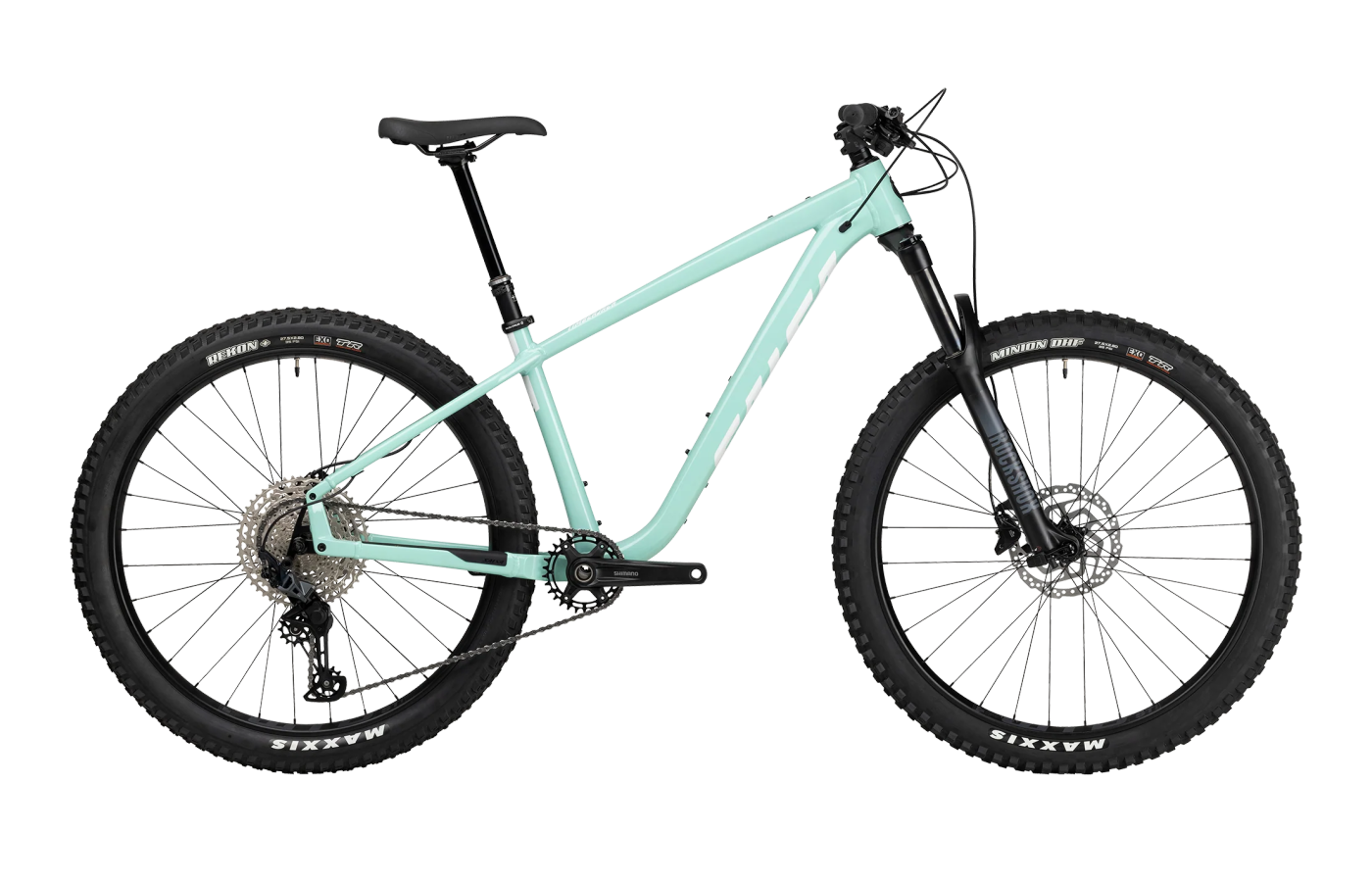
Timberjack
Salsa's higher-tier hardtail — a more premium frame, a 130 mm fork, and modern geometry. Bridges the gap between the Rangefinder's adventure focus and a true aggressive-trail hardtail.
Compare →Roscoe
Trek's purpose-built trail hardtail — 140 mm fork, thru-axles at both ends, and a tapered head tube. Fixes every hardware compromise that keeps the Marlin out of more aggressive territory.
Compare →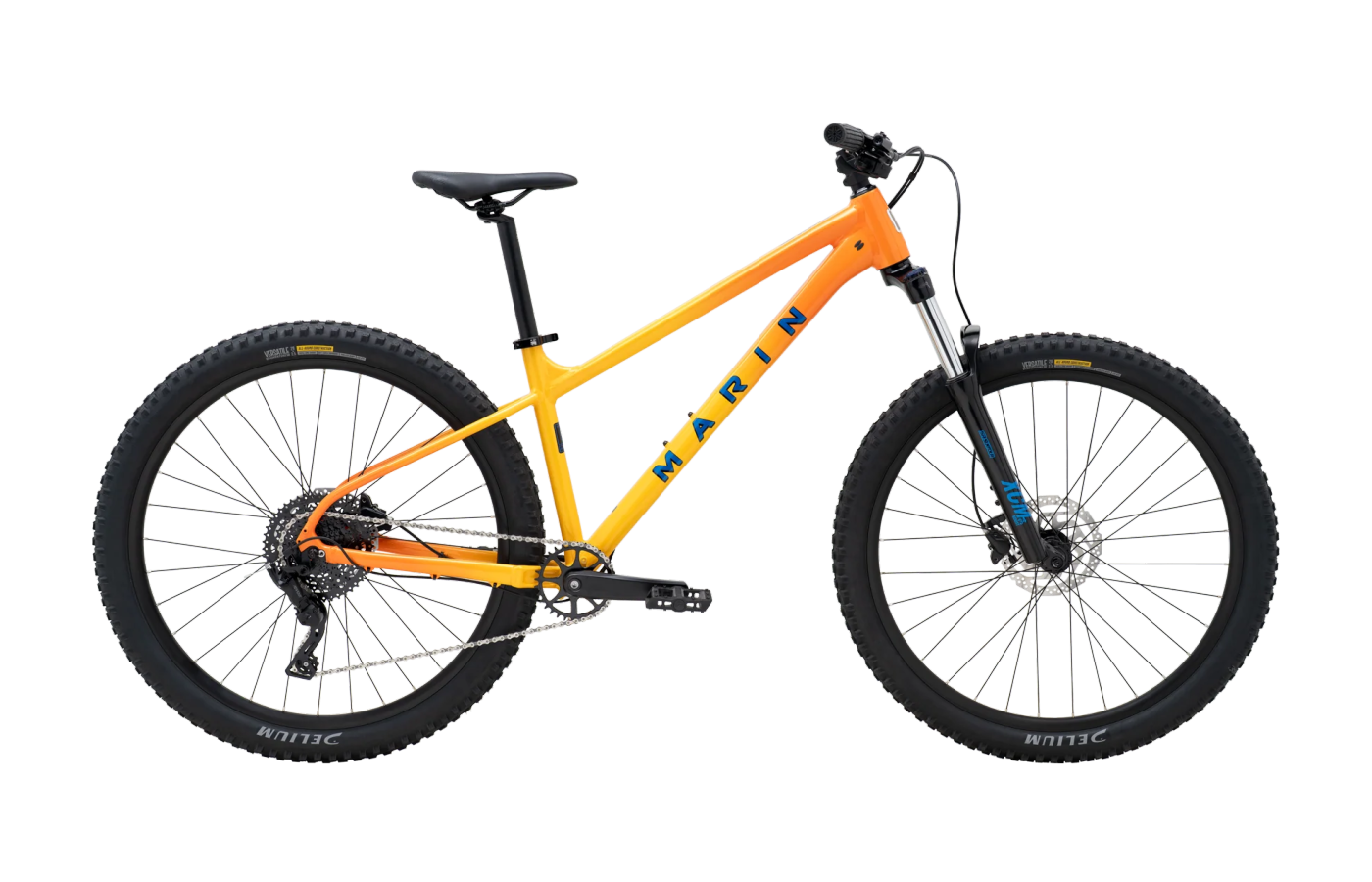
San Quentin
If you want a hardtail for jumping, drops, and technical descents rather than carrying gear, the San Quentin's slacker geometry and burlier build make it the more appropriate tool.
Compare →