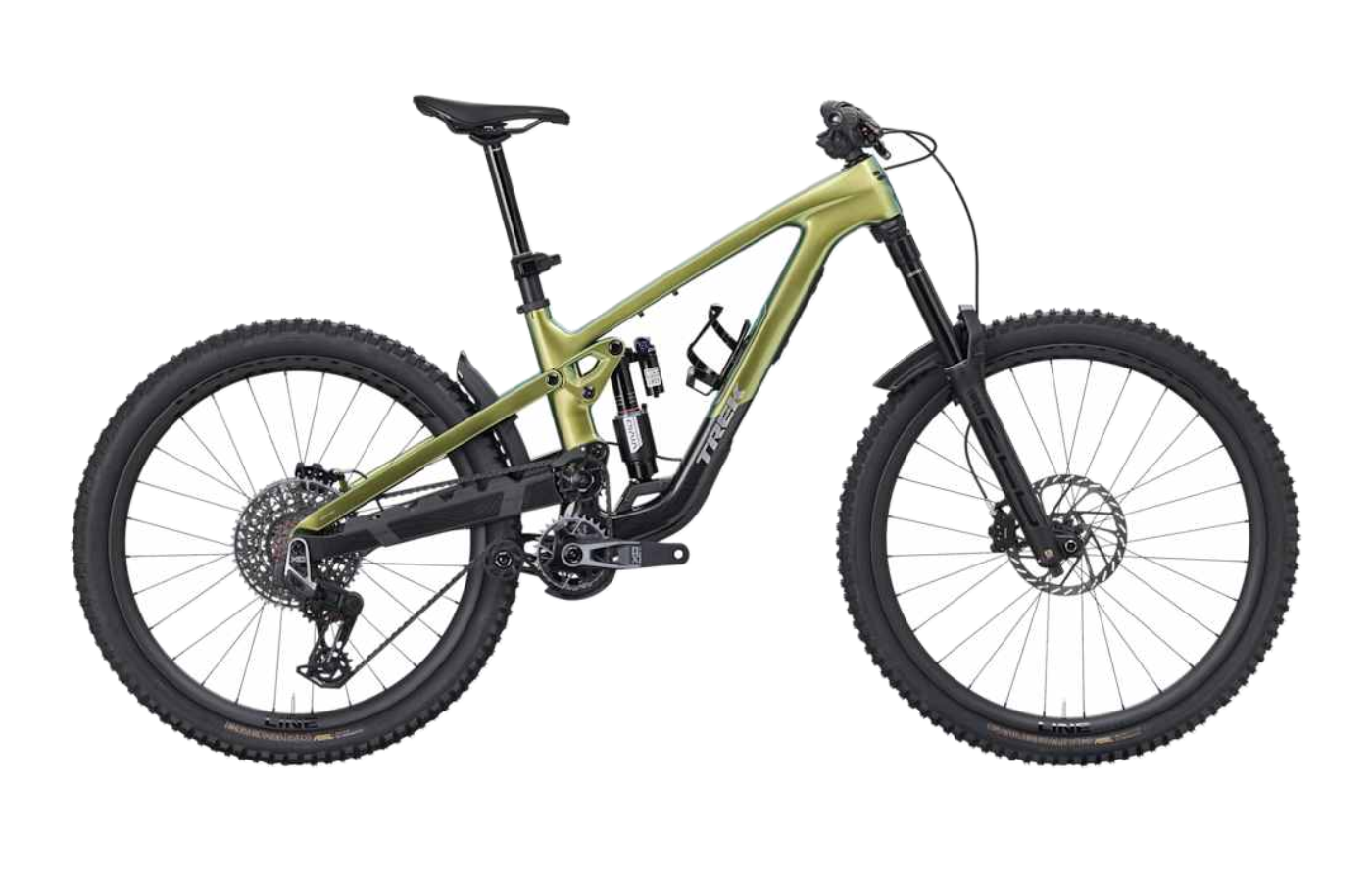
Trek RemedyvsSlash
One reviewer called the Remedy a "big BMX bike" that refuses to act its age, while the newest Slash has been dubbed a "cheat code" for surviving the ugliest terrain. These two bikes occupy the same long-travel category but offer fundamentally different answers to how a trail should actually be ridden.

Overview
For years, these bikes sat side-by-side as Trek's aggressive options, but the Gen 6 Slash has evolved into a dedicated high-pivot bruiser that pushes the Remedy further into its niche as a playful holdout. The Remedy sticks to 27.5-inch wheels and a snappy 150mm platform, focusing on technical finesse and side-hits. It’s the bike for the rider who wants to feel the trail and work with it, whereas the Slash is built to erase the trail's mistakes entirely. The Slash Gen 6 is an unapologetic gravity machine, using a high-main pivot and a mullet wheel setup that prioritizes rearward axle path and straight-line composure. While the Remedy uses a more traditional layout that rewards out-of-the-saddle sprinting and technical climbing, the Slash is a heavy-duty "70/30" bike—meaning it expects 70 percent of your focus to be on the descent. It carries a significant weight penalty, often tipping the scales at nearly 40 pounds in alloy builds, making it a much more patient climber than the Remedy.
Ride and handling
Riding the Remedy feels like a tactical exercise. Because it uses 27.5-inch wheels and a relatively short wheelbase, it rewards a style where you pop over obstacles rather than smashing through them. The RE:aktiv with Thru Shaft suspension acts like "witchcraft," providing a firm platform for pedaling that instantly vanishes when you hit a square edge. It doesn't have the massive forgiveness of the Slash, but it feels "whippy" and light underfoot, allowing you to change lines mid-air or rail a tight switchback without the massive physical effort required by modern enduro sleds. By contrast, the Slash Gen 6 is a "bruiser" that absolutely devours hits of all sizes. The high-pivot suspension allows the rear wheel to move backward with the impact, "scalping" square-edged rocks that would hang up the Remedy. It’s insanely composed at high speeds, offering a "calm and collected" ride that makes chunky rock gardens feel like a minor inconvenience. However, this stability comes at the cost of low-speed agility. At a crawl, the Slash can feel "sluggish" or "dead," requiring more muscle to loft off smaller features compared to the exuberant Remedy. Traction is a defining difference. The Remedy relies on high-volume 2.6-inch tires to provide a "cloud-like" feel over chatter, which some aggressive riders might find "squirmy" in hard corners. The Slash achieves its grip through kinematic magic and the RockShox Vivid Ultimate shock, which testers found to be "spookily coil-like." It isolates the rider from the "chop" of high-speed braking bumps more effectively than almost any air-sprung bike in its class, keeping the rear wheel glued to the ground even under heavy braking.
Specifications
Drivetrain complexity is the headline for the Slash, as it uses an oversized 19-tooth upper idler and a lower tensioner to manage the high-pivot's chain growth. While this system works well when clean, reviewers noted it requires meticulous maintenance and can feel noticeably less efficient once it gets mucky. The Remedy is far simpler, using a traditional drivetrain that avoids the audible drag and mechanical faff of the Slash's extra pulleys. Component quality on high-end Slash builds is a mixed bag. The $8,699 Slash 9.9 build features SRAM's T-Type Transmission and Maven brakes, which provide massive stopping power, but many testers immediately looked to replace the "overly stiff" Bontrager RSL carbon bars and SE5/SE6 tires. The Remedy builds were often more cohesive, though mid-range models were frequently criticized for having underpowered SRAM Guide brakes that couldn't quite keep up with the frame’s 160mm fork. Wheelsets also highlight the bikes' different intents. The Slash often comes with Bontrager Line Pro 30 carbon wheels that testers found edgy and harsh, sometimes masking the frame's inherent compliance. The Remedy’s 27.5-inch Line Carbon 30 wheels contribute to its light underfoot feel and snappy acceleration, and they are backed by Trek’s Carbon Care program, which provides a safety net for riders who aren't afraid of putting their gear through absolute hell in the bike park.
| Remedy | Slash | |
|---|---|---|
| FRAMESET | ||
| Frame | — | Alpha Platinum Aluminum, high main pivot, idler pulley, internal storage, angle-adjust headset, adjustable leverage rate, integrated frame protection, internal routing, alloy rocker link, ISCG 05, Active Braking Pivot, UDH, 148x12mm thru axle, 170mm travel |
| Fork | — | Fox Rhythm 36, Float EVOL air spring, GRIP damper, tapered steerer, 44mm offset, Boost110, 15mm Kabolt-X axle, 170mm travel |
| Rear shock | — | Fox Performance Float X, 2-position damper, 230mm x 65mm |
| GROUPSET | ||
| Shift levers | — | Shimano XT M8100, 12-speed |
| Front derailleur | — | — |
| Rear derailleur | — | Shimano XT M8100, long cage |
| Cassette | — | Shimano XT M8100, 12-speed, 10-51T |
| Chain | — | Shimano SLX M7100, 12-speed |
| Crankset | — | Shimano Deore M6120, 30T, 55mm chainline, 165mm length |
| Bottom bracket | — | Shimano BB-MT501, BSA |
| Front brake | — | Shimano 4-piston hydraulic disc, M6100 lever, M6120 caliper |
| Rear brake | — | Shimano 4-piston hydraulic disc, M6100 lever, M6120 caliper |
| WHEELSET | ||
| Front wheel | — | Bontrager Line Comp 30, Tubeless Ready, 6-bolt, Boost110, 15mm thru axle (Size S: 27.5"; Sizes M/ML/L/XL: 29") |
| Rear wheel | — | Bontrager Line Comp 30, Tubeless Ready, Rapid Drive 108, 6-bolt, Boost148, 12mm thru axle, Shimano Micro Spline freehub (listed as 27.5") |
| Front tire | — | Bontrager XR5 Team Issue, Tubeless Ready, Inner Strength casing, aramid bead, 60 tpi (27.5x2.50" on S/M/ML/L/XL; 29x2.50" on M/ML/L/XL) |
| Rear tire | — | Bontrager Brevard Pro XR, Tubeless Ready, dual compound, aramid bead, 60 tpi (27.5x2.50" on S/M/ML/L/XL; 29x2.50" on M/ML/L/XL) |
| COCKPIT | ||
| Stem | — | Bontrager Elite, 35mm clamp, 0 degree, 35mm length |
| Handlebars | — | Bontrager Line, alloy, 35mm clamp, 27.5mm rise, 780mm width (alt spec listed: 820mm width) |
| Saddle | — | Bontrager Verse P3, chromoly rails |
| Seatpost | — | Bontrager Line Dropper, internal routing, 34.9mm (Size S: 100mm travel, 310mm length; Sizes M/ML/L/XL: 170mm travel, 450mm length) |
| Grips/Tape | — | Bontrager XR Trail Pro, alloy lock-on (alt spec listed: Trek Line Comp, nylon lock-on) |
Geometry and fit comparison
These bikes live in different worlds when it comes to fit and stance. The Remedy uses conservative geometry that seems almost short by modern standards, with a 65.5-degree head tube angle and a 455mm reach on a size Large. This keeps the bike tactical and responsive. In contrast, the Slash XL is a massive machine with a 513mm reach and a slack 63.3-degree head tube angle. The front end of the Slash is designed to stay stable when you’re sending it deeper, while the Remedy's front end is easier to manage in low-speed technical terrain. Trek used size-specific chainstays on the Slash, which grow from 429mm on a Small to 439mm on an XL. This ensures that tall riders on the XL don't feel like they're falling off the back of the bike. The Remedy sticks to a short 435mm rear end across the board, which is what gives it that big BMX bike feel. While the Slash's rear end actually grows as it sags—reaching over 450mm under heavy compression—the Remedy stays short and easy to flick. Fit and body position are also distinct. The Slash features a very steep 77-degree seat tube angle, which is essential for winching a 40-pound bike up steep climbs. This keeps you centered and prevents the front wheel from wandering. The Remedy’s 74.5-degree seat angle is a bit more relaxed, but because the suspension doesn't wallow, it remains an efficient climber that moves uphill in ways that often feel more like a shorter travel trail bike.
| FIT GEO | Remedy | Slash | |
|---|---|---|---|
| Stack | — | 641 | — |
| Reach | — | 488 | — |
| Top tube | — | 628 | — |
| Headtube length | — | 120 | — |
| Standover height | — | 767 | — |
| Seat tube length | — | 435 | — |
| HANDLING | Remedy | Slash | |
|---|---|---|---|
| Headtube angle | — | 63.3 | — |
| Seat tube angle | — | 73.8 | — |
| BB height | — | 351 | — |
| BB drop | — | 27 | — |
| Trail | — | 143 | — |
| Offset | — | 43 | — |
| Front center | — | — | — |
| Wheelbase | — | 1278 | — |
| Chainstay length | — | 434 | — |
Who each one is for
Trek Remedy
The Remedy is for the person who values smiles per mile over race result sheets. If your local trails are a mix of technical ledges, tight switchbacks, and side-hits that you want to pop off of, this 27.5-inch tactician is your bike. It’s for the rider who wants a bike that feels spirited and easy to loft into the air, rather than a heavy sled that just wants to go fast in a straight line.
Trek Slash
The Slash Gen 6 is for the gravity-focused rider who treats the climb as a necessary evil to reach the rowdiest descents. If your weekends are spent in the bike park or hunting for steep, rooty chutes that make you question your life choices, the Slash is your security blanket. It’s built for the meathead or sketchy sender who wants a bike that will bail them out of bad lines and hold its composure when things get ugly.