Trek SessionvsSlash
How much overlap can two bikes from the same stable really handle before one starts cannibalizing the other? With the latest Slash adopting the Session’s high-pivot blueprint, the gap between a big enduro bike and a full-blown World Cup downhill rig has never felt narrower.

Overview
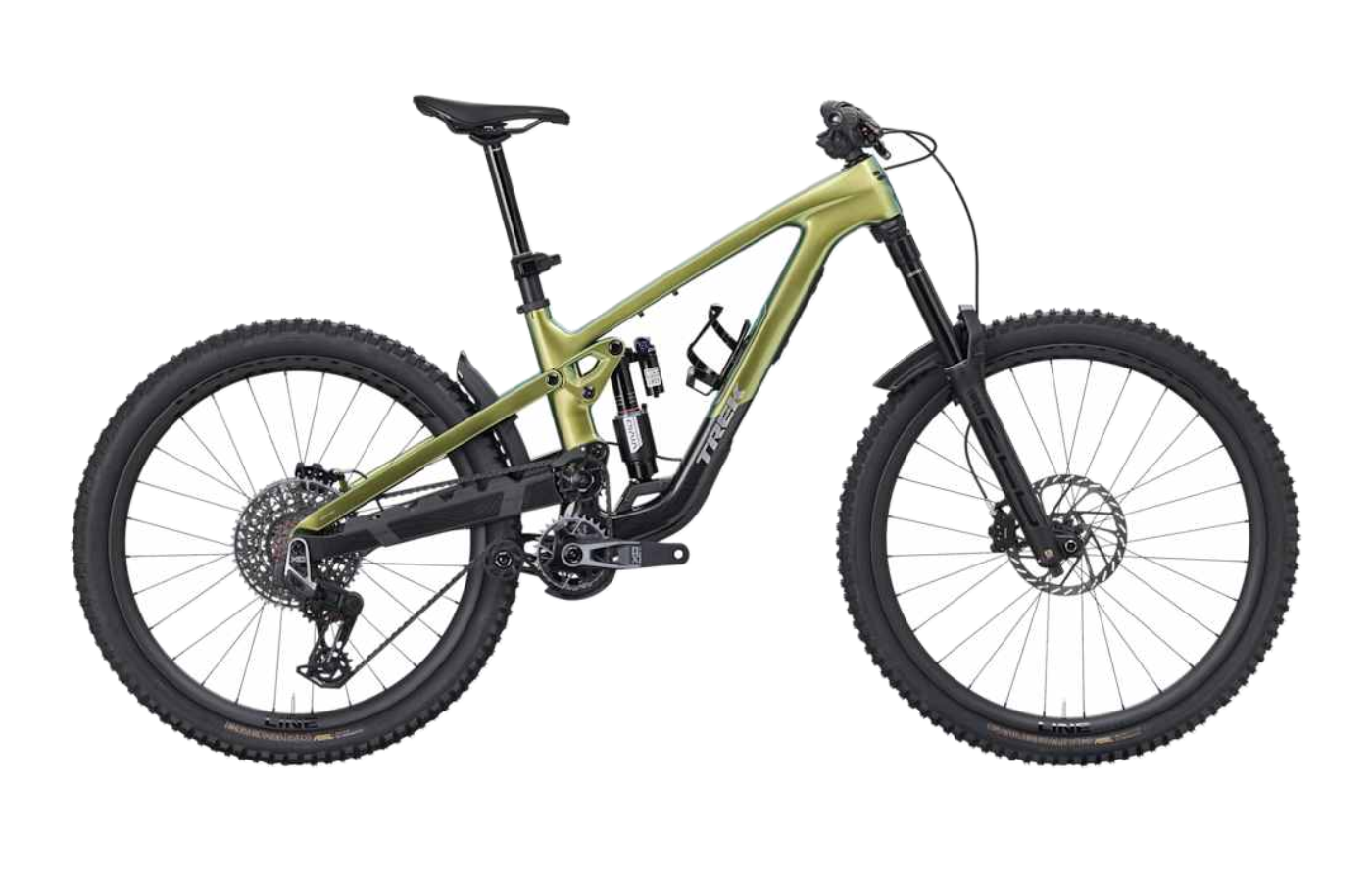
Trek has effectively created a family of high-pivot gravity sleds, but they serve very different masters. The Session is a dedicated, single-purpose racing tool that has ditched its carbon past in favor of an aluminum-only frame—a move dictated by Trek’s factory racers who wanted a calmer, more compliant chassis for the world's roughest tracks. It is a bike designed for the start gate and the lift line, period. The Slash Gen 6, meanwhile, is the ultimate 70/30 compromise: 70% downhill bias and 30% climbing capability. By moving to a high-pivot layout with a massive 19-tooth idler pulley, Trek has turned their flagship enduro bike into a mini-Session that can actually be pedaled back to the top. While the Session is a specialist for the clock, the Slash is a park bruiser that allows you to self-shuttle the kind of terrain that used to require a dual-crown fork.
Ride and handling
Riding the Session feels like unlocking a cheat code for technical, chundery terrain. Its rearward axle path—moving up to 25mm back under compression—means it doesn't just absorb square-edged hits; it feels like it gains momentum through them. It is exceptionally quiet and muted, effectively isolating the rider from the violence of high-speed rock gardens. However, that stability makes it a handful in tight spots. On slow-speed switchbacks, the lengthening wheelbase can make the bike feel ponderous, requiring a game-on racing approach to keep it from feeling like a freight train. The Slash mirrors this plow capability but adds a layer of agility through its stock mullet wheel configuration. It devours braking bumps and chunky rock gardens with a coil-like suppleness, yet it remains surprisingly perky for a bike that can weigh nearly 40 pounds in its alloy builds. On the trail, the Slash acts as a security blanket for questionable line choices, though it suffers more than the Session on flatter, undulating terrain. At lower speeds, the Slash can feel sluggish, needing the fortitude of a steep grade to truly wake up its suspension. While both bikes use Trek’s Active Braking Pivot (ABP) to keep the suspension active under heavy braking, the Session is purely about speed preservation. The Slash is more of a bruiser that rewards an aggressive rider willing to muscle it around. If you're looking for a flickable park bike, neither of these is a natural fit, but the Slash’s smaller rear wheel gives it a slight edge when you need to snap the back end through a tight berm or loft it over a mid-trail obstacle.
Specifications
Braking performance is a major point of divergence. The Slash 9.9 X0 AXS comes standard with SRAM Maven Silver 4-piston brakes and 200mm rotors, providing the kind of massive stopping power an enduro bike of this weight demands. Conversely, the Session has historically been criticized for its stock 180mm rear rotors, which many testers found inadequate for long DH descents. For a bike designed to hit 30mph through rock gardens, that’s a real weakness that requires an immediate upgrade to 200mm or 220mm rotors. Drivetrain choices reflect their respective missions. The Slash 9.9 features the SRAM X0 Eagle AXS Transmission, a robust setup that shifts flawlessly under the high-torque loads of technical climbing. The Session 8 and 9 use dedicated DH groupsets like SRAM GX DH or X01 DH with shortened freehub bodies and 7-speed cassettes. While the Slash’s idler pulley system introduces some mechanical drag and noise—especially when dirty—it is a necessary trade-off for its 100% consistent anti-squat. The Session’s idler is purely about reducing the 15-27 degrees of pedal kickback found on the previous model down to a manageable 5-8 degrees. Component quality on the high-end Slash 9.9 is a mixed bag. The RockShox Vivid Ultimate shock is a masterpiece of air-sprung suppleness, but the house-brand Bontrager SE5 and SE6 tires are often described as flimsy and slick in wet conditions. On a bike this capable, those trail-rated tires are a liability. The Session 8, being the privateer special, offers better out-of-the-box value with its RockShox BoXXer Select and Fox VAN Performance coil shock, providing a bomb-proof platform that doesn't feel like it’s holding the rider back.
| Session | Slash | |
|---|---|---|
| FRAMESET | ||
| Frame | — | Alpha Platinum Aluminum, high main pivot, idler pulley, internal storage, angle-adjust headset, adjustable leverage rate, integrated frame protection, internal routing, alloy rocker link, ISCG 05, Active Braking Pivot, UDH, 148x12mm thru axle, 170mm travel |
| Fork | — | Fox Rhythm 36, Float EVOL air spring, GRIP damper, tapered steerer, 44mm offset, Boost110, 15mm Kabolt-X axle, 170mm travel |
| Rear shock | — | Fox Performance Float X, 2-position damper, 230mm x 65mm |
| GROUPSET | ||
| Shift levers | — | Shimano XT M8100, 12-speed |
| Front derailleur | — | — |
| Rear derailleur | — | Shimano XT M8100, long cage |
| Cassette | — | Shimano XT M8100, 12-speed, 10-51T |
| Chain | — | Shimano SLX M7100, 12-speed |
| Crankset | — | Shimano Deore M6120, 30T, 55mm chainline, 165mm length |
| Bottom bracket | — | Shimano BB-MT501, BSA |
| Front brake | — | Shimano 4-piston hydraulic disc, M6100 lever, M6120 caliper |
| Rear brake | — | Shimano 4-piston hydraulic disc, M6100 lever, M6120 caliper |
| WHEELSET | ||
| Front wheel | — | Bontrager Line Comp 30, Tubeless Ready, 6-bolt, Boost110, 15mm thru axle (Size S: 27.5"; Sizes M/ML/L/XL: 29") |
| Rear wheel | — | Bontrager Line Comp 30, Tubeless Ready, Rapid Drive 108, 6-bolt, Boost148, 12mm thru axle, Shimano Micro Spline freehub (listed as 27.5") |
| Front tire | — | Bontrager XR5 Team Issue, Tubeless Ready, Inner Strength casing, aramid bead, 60 tpi (27.5x2.50" on S/M/ML/L/XL; 29x2.50" on M/ML/L/XL) |
| Rear tire | — | Bontrager Brevard Pro XR, Tubeless Ready, dual compound, aramid bead, 60 tpi (27.5x2.50" on S/M/ML/L/XL; 29x2.50" on M/ML/L/XL) |
| COCKPIT | ||
| Stem | — | Bontrager Elite, 35mm clamp, 0 degree, 35mm length |
| Handlebars | — | Bontrager Line, alloy, 35mm clamp, 27.5mm rise, 780mm width (alt spec listed: 820mm width) |
| Saddle | — | Bontrager Verse P3, chromoly rails |
| Seatpost | — | Bontrager Line Dropper, internal routing, 34.9mm (Size S: 100mm travel, 310mm length; Sizes M/ML/L/XL: 170mm travel, 450mm length) |
| Grips/Tape | — | Bontrager XR Trail Pro, alloy lock-on (alt spec listed: Trek Line Comp, nylon lock-on) |
Geometry and fit comparison
Sizing philosophy represents the biggest shift for these two frames. The Session uses reach-based sizing (R1, R2, R3) with short seat tubes and consistent stack heights, allowing riders to choose their length based on stability preference rather than inseam. In its R3 size, the Session stretches out to a massive 1,321mm wheelbase. The Slash follows a more traditional S-XL range but includes a Goldilocks M/L size that hits a 468mm reach, a crucial demographic many brands ignore. Both bikes share a low bottom bracket philosophy. The Slash sits at a 351mm static height, which allows it to rail corners but leads to frequent KLONK sounds from pedal and bash-guard strikes in technical jank. The Session’s 63-degree head angle is world-cup standard, providing a front end that remains composed on the steepest chutes. On the XL Slash tested, the 513mm reach and 63.3-degree head angle create a footprint that is nearly as large as its DH sibling, reinforcing its mini-Session identity. Chainstay behavior is where the high-pivot magic happens—and where it complicates things. The Slash features size-specific chainstays that grow roughly 11mm at sag, while the Session’s stays are also proportional to frame size. This growth provides incredible high-speed stability, but it’s the reason both bikes can feel reluctant to cut shapes at slow speeds. The Slash’s mullet configuration is the only thing keeping it from feeling like a total anchor in tight switchbacks compared to a full 29er Session.
| FIT GEO | Session | Slash | |
|---|---|---|---|
| Stack | — | 641 | — |
| Reach | — | 488 | — |
| Top tube | — | 628 | — |
| Headtube length | — | 120 | — |
| Standover height | — | 767 | — |
| Seat tube length | — | 435 | — |
| HANDLING | Session | Slash | |
|---|---|---|---|
| Headtube angle | — | 63.3 | — |
| Seat tube angle | — | 73.8 | — |
| BB height | — | 351 | — |
| BB drop | — | 27 | — |
| Trail | — | 143 | — |
| Offset | — | 43 | — |
| Front center | — | — | — |
| Wheelbase | — | 1278 | — |
| Chainstay length | — | 434 | — |
Who each one is for
Trek Session
This is for the rider whose car is a shuttle vehicle and whose pass is for the lift. If you spend your summers hunting for the steepest, chunderiest DH tracks and want a chassis that mutes the world so you can focus on the clock, the Session is the tool. It’s for the racer who wants a bomb-proof aluminum frame and doesn't care about pedaling efficiency, just momentum preservation and surviving a high-speed case on a 40-foot double.
Trek Slash
The Slash is for the gravity addict who still has to earn their turns. It’s for the rider who wants DH-bike composure on the weekend but needs to winch a 40-pound rig up a 3,000-foot fire road climb on Tuesday. If your local trails are steep, technical PNW-style chutes where the descent justifies the hefty climb, the Slash is a security blanket that will talk you into lines you used to walk.